
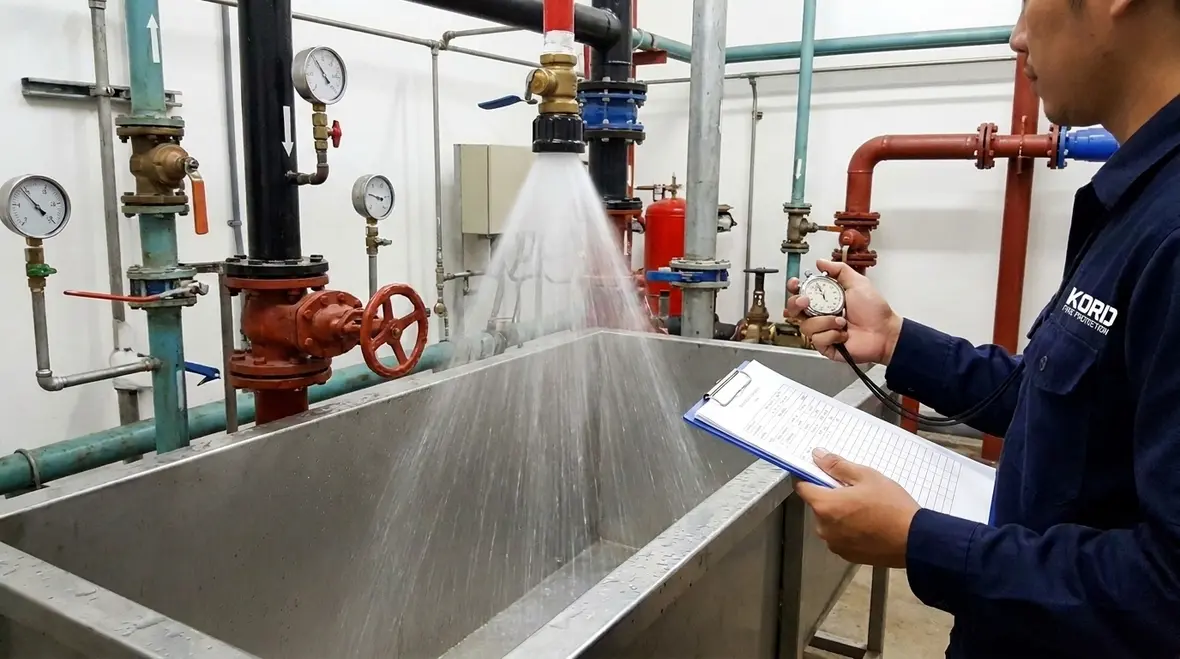
NFPA 15 Section 10.4: The 40-Second Rule in Water Spray System Operating Tests
Quick Answer: NFPA 15 Section 10.4 requires that, during operating tests, the water spray system must achieve a specified discharge condition within 40 seconds of heat detection. This timing requirement helps verify that the heat detector, release mechanism, valves, and pressure delivery perform as intended.
For teams reviewing broader system readiness before test day, it helps to pair operating test planning with fire sprinkler system service so valve condition, inspection history, and repair items are not left to perform miracles on the clock.
What NFPA 15 10.4 operating tests are really checking
In practice, NFPA 15 10.4 operating tests 40 second heat detection discharge pattern is not just a clock requirement. It is a system performance verification that links detection to discharge. When an initiating device activates, the release sequence, control valves, and water delivery system must respond quickly enough to produce an approved discharge pattern under fire-like thermal conditions.
Commercial, industrial, and retail facilities typically operate with tight maintenance windows, critical uptime requirements, and complex piping layouts. That makes the 40-second rule a high-value diagnostic tool during commissioning, periodic maintenance, and after component replacement.
Understanding the 40-second rule for water spray operating tests
NFPA 15 Section 10.4 operating tests evaluate whether the system can reach a required discharge condition after heat detection. The 40-second concept is commonly applied to ensure the discharge begins and stabilizes within an acceptable timeframe, so the hazard protection performance does not degrade due to delayed actuation, sluggish valve response, or insufficient system pressure.
During the test, technicians must observe and document:
- Heat detection actuation timing and sequence (device response and control logic, if applicable)
- Release and valve operation timing (solenoid or pilot operation, main control valve response, trim behavior)
- Water delivery response (pressure stabilization, flow establishment, and discharge development)
- Whether the discharge pattern within the affected area matches the designed spray characteristics
The key compliance intent is performance. A system that technically operates but does so too slowly can fail to meet the protection strategy assumed by the design basis.
How the 40-second heat detection discharge pattern gets verified
To verify the NFPA 15 10.4 operating tests 40 second heat detection discharge pattern, the test must connect electrical and mechanical timing to spray output. Operating tests should focus on the full activation chain rather than only the detector.
1) Detection and release timing
Heat detectors, where used to initiate water spray, must respond to the test heat exposure. The actuation signal then drives the releasing mechanism. Any delay introduced by control modules, delayed transfer logic, or improperly set timers can push system discharge beyond the compliance window.
2) Valve actuation and trim performance
In water spray systems, the discharge timing depends heavily on the control valve assembly and its trim. Common operational bottlenecks include:
- Restriction or contamination in pilot lines that slows valve movement
- Insufficient pilot pressure or improper pilot pressure regulation
- Solenoid coil issues, sluggish plunger action, or electrical voltage drop
- Stiction caused by lack of operation or corrosion inside valves
- Incorrect trim configuration or field modifications during maintenance
3) Water delivery and pressure stability
Even when actuation occurs, discharge performance can lag if system pressure fails to build quickly enough. Technicians should confirm that the water supply stabilizes promptly at the required flow and pressure for the duration assumed by the system design.
For facilities with long branch lines, overhead obstructions, or throttling valves used for balancing, flow establishment can vary noticeably. Those variables directly affect the discharge pattern development time observed during testing.
4) Discharge pattern acceptance
The heat detection trigger is only the beginning. The system must produce the designed discharge pattern across the protected area. Inspectors and maintenance teams should look for changes caused by:
- Clogged nozzles or partial obstructions
- Incorrect nozzle type, orientation, or replacement part mismatches
- Improper spacing or sprinkler alignment errors during installation or prior servicing
- Pipe slope, air binding, or trapped air issues that affect early flow development
Common compliance failure points during operating tests
Most failures tied to the 40-second rule result from preventable issues in the activation chain or the discharge system. The following are frequent field findings in commercial and industrial environments:
- Delayed detector or test exposure mismatch: Heat test devices and procedures must align with the manufacturer and NFPA 15 intent. Incorrect exposure duration or device placement can skew timing results.
- Valve response lag: Solenoid and pilot-operated mechanisms can slow if valves are not exercised regularly or if internal surfaces are contaminated.
- Pressure drop or unstable supply: Undersized pumps, incorrect pump start logic, or fluctuating supply pressure can slow flow establishment.
- Trim mismatch after service: After repairs, technicians sometimes reassemble trim components incorrectly or omit a linkage or setting, creating unpredictable response times.
- Maintenance-induced obstruction: Debris from nearby construction, corrosion products, or debris introduced during nozzle replacement can reduce early discharge performance and disturb spray pattern formation.
Using operating tests as a structured diagnostic process reduces repeat failures and limits downtime. It also strengthens audit readiness for facilities that must demonstrate compliance to insurers, code authorities, and internal risk teams.
Maintenance and documentation practices that keep facilities audit-ready
Compliance is not only the test outcome. It also includes how the facility demonstrates control over the process. Facilities performing NFPA 15 10.4 operating tests 40 second heat detection discharge pattern should maintain disciplined records that include timing observations, flow and pressure data, and corrective action tracking.
Operational procedure expectations
- Pre-test verification of valves, trims, wiring, and control logic configuration
- Confirmation that test equipment and heat application methods meet manufacturer requirements
- Defined acceptance criteria, including what “acceptable discharge condition” means for the system configuration
- Clear post-test status checks to confirm system returns to a normal, supervised condition
Commercial facility realities
Retail stores, warehouses, and light industrial plants often have complex tenancy conditions, seasonal changes, and frequent housekeeping issues that increase nozzle clogging risk. A documented inspection and maintenance cycle helps prevent slow response conditions that only become obvious during periodic operating tests.
Partnering for ongoing compliance
Professional water spray service should include commissioning checks, periodic maintenance, and targeted troubleshooting after any valve, detector, nozzle, or supply component change. Kord Fire Protection supports commercial compliance by helping facilities maintain reliability in detection, actuation, and discharge performance over time.
For additional context on water spray fixed systems, discharge behavior, and compliance-focused system care, refer to: NFPA 15 Enhancing Fire Safety with Water Spray Fixed Systems.
If water supply performance is part of the concern, a related read is NFPA 15 Section 9.3 Acceptable Water Supply Spray Systems, which fits naturally with timing, pressure stability, and discharge readiness.
How to prepare for operating tests and minimize disruption
Operating tests can impact protected operations, especially where building workflows require controlled shutdowns or temporarily reduced protection. Facilities can reduce disruption while improving test accuracy by planning the test sequence, coordinating access, and controlling variables that affect discharge performance.
Field-ready preparation checklist
- Schedule tests during low occupancy or production downtime and coordinate with facility management
- Stage replacement components in advance, including nozzles, fittings, and any valve parts identified during pre-inspection
- Confirm alarm and supervisory signaling pathways are working as designed
- Establish a data capture plan for timestamps, pressure trends, and discharge observation points
- Verify that the system is returned to normal operation and properly supervised after testing
If your facility needs a reference resource on fire pump fundamentals related to water supply performance, see: firepumps.org.
Frequently Asked Questions
Conclusion and call to action
The 40-second rule in NFPA 15 Section 10.4 operating tests validates that your water spray system transitions from heat detection to effective discharge quickly and predictably. Avoid surprises by planning test windows, verifying valve trim and supply performance, and correcting nozzle and flow issues before they become compliance defects. Kord Fire Protection can support your facility with inspection, operating test execution, troubleshooting, and maintenance to sustain dependable system performance. Schedule an NFPA 15 readiness review today.

Join Our Newsletter!
Get the latest fire safety tips delivered straight to your inbox From our Newsletter.



