
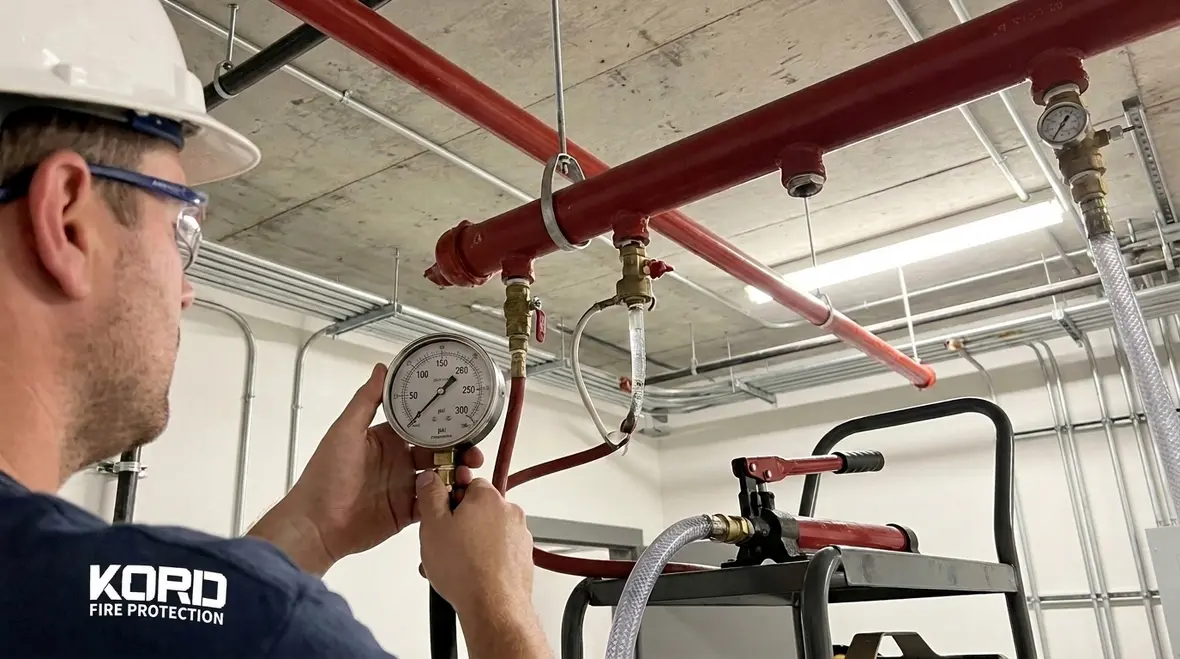
NFPA 15 Section 10.3: Hydrostatic Pressure Testing Water Spray Piping Per NFPA 13
Quick Answer
NFPA 15 Section 10.3 requires hydrostatic pressure testing of water spray piping installed under NFPA 13 requirements, using controlled pressure, documented duration, and verified acceptance criteria. Proper testing supports system reliability and speeds inspection by reducing hidden leaks, joint failures, and piping defects.
If your project also needs broader fire sprinkler system service, it makes sense to coordinate hydrostatic testing with inspection, repair, and commissioning support while access points and test boundaries are still easy to manage.
Why NFPA 15 10.3 hydrostatic testing matters for water spray systems
Water spray systems depend on pipe integrity to deliver consistent discharge patterns under fire conditions. NFPA 15 10.3 hydrostatic pressure tests NFPA 13 new piping are intended to confirm that new water spray piping can withstand test pressure without leakage, defective fittings, or abnormal deformation. This step also exposes workmanship issues that can persist unnoticed during commissioning, especially in concealed ceilings, pipe chases, and routed branches common in commercial, industrial, and retail facilities.
In real-world projects, hydrostatic testing becomes more than a code checkbox. It aligns installation quality with inspection schedules, reduces call backs, and provides measurable documentation for owners, insurers, and authorities having jurisdiction (AHJs).
For more on maintaining fixed water spray systems in operating condition, see NFPA 15 enhancing fire safety with water spray fixed systems.
What Section 10.3 requires and how it references NFPA 13
NFPA 15 Section 10.3 directs that the hydrostatic pressure testing of water spray piping follow the applicable requirements for piping testing found in NFPA 13. That reference matters because it frames both the test mechanics and the inspection expectations for newly installed pipe.
Practically, this means project teams should treat the test as a structured acceptance activity, not an informal leak check. The scope typically includes new piping sections, prepared joint areas, and any newly connected mains, branches, and drains that must perform reliably during a fire event. It also means test pressure handling and hold time should follow the NFPA 13 approach, including ensuring pressure stabilization and maintaining the specified test duration.
Because AHJs can enforce additional documentation requirements, Kord Fire Protection teams commonly prepare a test package that includes test layout, isolation valve locations, pressure source details, gauges used, and results reporting aligned to both NFPA guidance and typical commercial facility recordkeeping expectations.
How hydrostatic testing is executed: a field procedure that holds up under inspection
1) Pre test readiness checks (before any water is introduced)
Before pressurizing, installers and test personnel should confirm the piping layout is complete enough to safely test without creating uncontrolled hazards. Common readiness steps include verifying that:
- All required hangers and supports are installed and set to manufacturer and design requirements.
- Valves, caps, plugs, and temporary test devices are correctly rated and installed.
- Spray heads and other components not intended for test conditions remain isolated or protected per project staging plans.
- System sections are arranged to allow drainage and air removal where needed.
One frequent failure point in commercial and industrial installs involves trapped air. Air can cause inaccurate gauge readings, unstable pressure, and false impressions of leaks due to pressure decay behavior. A controlled air purge strategy prevents test delays and repeat testing.
2) Setting up test pressure with the right controls
Hydrostatic testing depends on pressure accuracy and stability. Teams should use properly calibrated gauges and a pressure source suitable for the expected range. Pressure control equipment must be arranged so that the operator can apply pressure gradually, prevent water hammer, and maintain the target test pressure without overshoot.
In occupied spaces, pressure ramping also supports safety by limiting the risk of sudden joint movement. This is particularly important in retrofit zones where adjacent utilities may be vulnerable.
3) Maintaining test pressure for the required duration
During the hold period, personnel should monitor gauge behavior and inspect for visible leakage at threaded joints, welded connections, flanged joints, and any temporary closures. Even minor seepage can indicate a joint integrity issue that must be corrected before acceptance.
Testing also validates workmanship around couplings and specialty fittings used in water spray piping, where assembly errors often occur. If leakage is observed, teams should depressurize safely, correct the issue, and repeat testing for the impacted section.
4) Documentation and owner facing records
After successful testing, complete records should be retained. A defensible documentation set typically includes:
- Project identifiers and system description
- Test date and location, including tested risers and branch ranges
- Test pressure values and gauge readings
- Gauge identification and calibration information
- Duration and pressure stabilization notes
- Pass or fail result, and corrective actions if applicable
This record set supports future commissioning, alteration work, and maintenance activities, especially in facilities that require recurring compliance updates.
Common compliance challenges for NFPA 15 water spray piping tests
Even well designed systems can fail hydrostatic testing due to procedural gaps or construction realities. The following are typical commercial facility pain points:
Concealed piping and access limits
When piping runs inside ceilings or under raised floors, the test team may not be able to inspect every joint during the hold period. That increases reliance on correct installation practices and careful staging to ensure representative access points exist before concealment.
Joint type variation and workmanship tolerance
Water spray piping uses multiple connection types including threaded, welded, and flanged joints depending on material and design. Each connection type responds differently to pressure loading and assembly errors. Threaded joint failures often show up as slow seepage, while flanged joints can present as gasket displacement or incomplete torque patterns.
Isolation boundaries and unintended system sections
Test boundaries must be planned. If isolation is incorrect, test water can reach components not intended for test conditions or complicate drainage. In mixed use facilities, shared piping spaces can also create unintended cross connections that must be resolved before pressurization.
Gauge selection and pressure stabilization assumptions
Gauge miscalibration or poor pressure stabilization can lead to disputes about whether a hold time was truly maintained at the correct pressure. This risk grows when long pipe runs make it hard to reach uniform pressure quickly.
Kord Fire Protection supports projects by coordinating test planning and verification so the facility team can meet AHJ expectations without disruptive rework. Commercial and retail properties especially benefit because testing windows often conflict with operational uptime requirements.
For additional context on system reliability and service planning, Fire Pump and water based system resources may also be helpful, including firepumps.org.
Equipment and safety controls that reduce failed tests
Hydrostatic testing is a controlled hydraulic activity. Safety and equipment readiness reduce risk and prevent repeated test events.
- Calibrated pressure gauges: Ensures test accuracy and reduces arguments over results.
- Rated temporary fittings and plugs: Prevents leaks at non permanent test devices.
- Safe pressure application and controlled release: Limits water hammer and reduces stress on newly installed joints.
- Drain and air removal provisions: Supports consistent test pressure and efficient post test clearing.
- Site protection for occupied or sensitive areas: Controls water discharge paths to avoid damage during testing.
From a maintenance perspective, successful hydrostatic testing establishes a baseline condition. It supports later inspection findings because the system begins service with verified piping integrity, which reduces early life leakage and improves confidence during routine annual or periodic inspections required by NFPA 25 practices and facility policies.
How to coordinate testing within commercial facility projects
Commercial facility schedules often drive the quality of test execution. The best outcomes occur when the owner, general contractor, fire protection contractor, and test team align early.
Plan for access, staging, and inspection touchpoints
Before installation completion, project teams should identify which sections will remain accessible for inspection during testing. They should also confirm where valves and isolation points will be accessible to support controlled testing and safe shutdown.
Integrate with commissioning and acceptance workflows
Hydrostatic testing should connect logically to subsequent commissioning tasks such as component verification, system control confirmations, and documentation finalization. When testing occurs too late, concealed piping may already be closed in, which forces costly demolition for inspection or correction.
Assign responsibility for documentation delivery
Owners and facility managers typically need a complete record set for compliance binders and ongoing maintenance planning. A clear documentation owner prevents delays when AHJs request test evidence.
Kord Fire Protection, backed by field experience in commercial environments, helps organizations keep projects compliant through structured test execution and follow up service readiness. Service and compliance support is also reflected through Kord’s business presence at kordelectric.com and kordfire.com.au.
Frequently Asked Questions
Call to Action
Ensure NFPA 15 10.3 hydrostatic pressure tests NFPA 13 new piping are planned, executed, and documented to an inspection ready standard. Kord Fire Protection can support test coordination, compliance documentation, and ongoing water spray system maintenance so your commercial facility maintains life safety readiness and minimizes disruption. Contact Kord Fire Protection to schedule a compliance focused review and testing plan tailored to your site layout and AHJ expectations.

Join Our Newsletter!
Get the latest fire safety tips delivered straight to your inbox From our Newsletter.



