
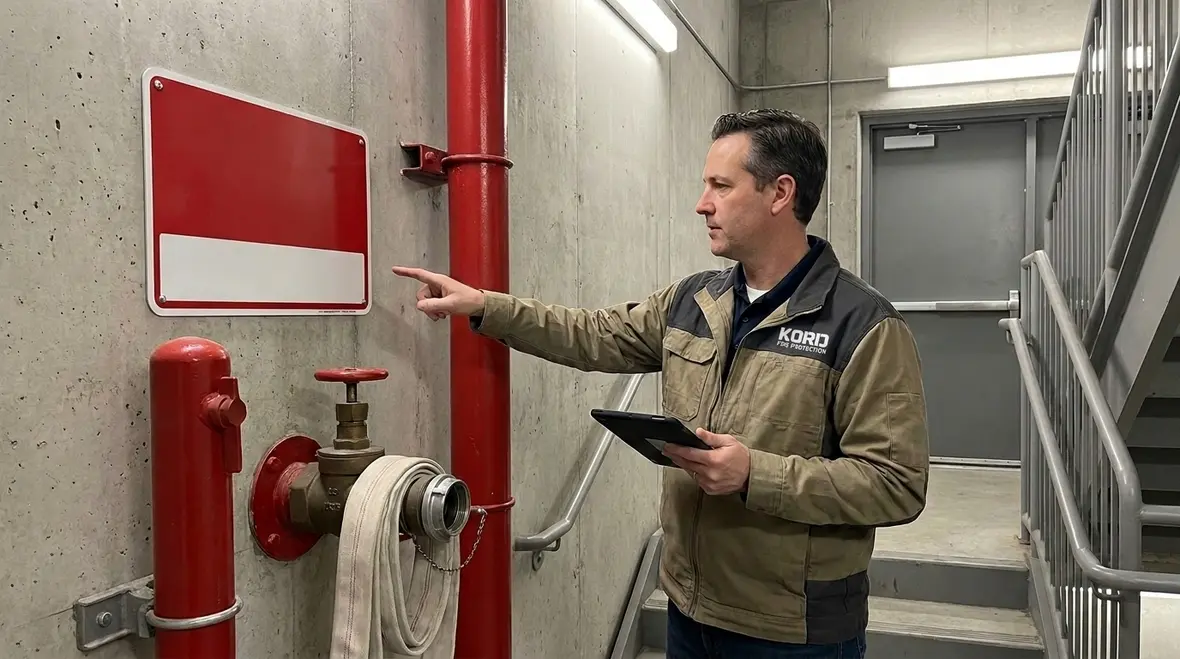
NFPA 14 Section 9.12: Sign Requirements for Standpipe Installation Elements
Quick Answer: NFPA 14 Section 9.12 requires clear, durable signage for standpipe installation elements so occupants and responders can identify system locations, operating features, and hazards. These signs must be legible, properly placed, and maintained to support safe fire department and occupant use during emergencies.
If you need broader support beyond signage alone, Kord Fire’s fire protection services in Southern California can help connect inspections, repairs, and compliance planning into one practical path.
Why standpipe installation sign requirements matter in real operations
In commercial facilities, standpipes often sit behind doors, inside stair enclosures, in corridors, and near mechanical spaces. During an emergency, visibility and access conditions can rapidly deteriorate. NFPA 14 Section 9.12 focuses on reducing confusion by ensuring the right people can quickly find and understand the system.
From a compliance and risk standpoint, standpipe installation sign requirements function as operational “guidance under stress.” They help prevent wrong connections, delayed hose use, and improper activation of system features. For facility owners and facility managers, the maintenance side matters just as much as initial installation, because signage fades, gets painted over, or becomes obscured during renovations.
NFPA 14 documentation and layout drawings support enforcement, but inspectors frequently verify sign placement and legibility in the field. Kord Fire Protection helps commercial properties close those gaps through documentation, field verification, and ongoing inspection support for standpipe and hose systems.
What NFPA 14 Section 9.12 expects for signage
NFPA 14 Section 9.12 addresses sign requirements for specific standpipe installation elements. While the exact wording and placement can vary based on system design and connected components, the intent stays consistent: signs must clearly identify the relevant feature and instruct people how to locate and use it safely.
In practice, facilities typically face three recurring compliance questions during plan review and field inspection:
Are the signs installed at every required standpipe installation element? Incomplete installation is one of the most common findings.
Are the signs placed where responders can see them without delay? Signs behind doors, around corners, or behind stored materials often fail legibility and visibility checks.
Are the signs maintained in durable condition? Faded labels, peeling placards, missing fasteners, and paint coverage undermine the purpose of the standard.
Commercial and industrial buildings tend to add complexity because of frequent remodel cycles, tenant buildouts, and contractor turnover. The sign program must survive that operational reality, not just the initial inspection.
Where signs typically need to be placed (and why visibility fails)
Section 9.12 signage generally supports locating the standpipe system and associated operating features. Most placement issues occur where normal traffic patterns do not align with fire emergency access routes. Common problem areas include:
Stair and corridor transitions: Signs placed too high, behind mirrors, or on surfaces that become blocked during routine cleanup and deliveries reduce usefulness.
At hose valve and outlet locations: If signage fails to correspond to the specific component, responders may waste time verifying what they have found.
Near doors and enclosures: Doors that remain closed during operations can hide signage until the wrong door is opened. Signs must align with the intended access path.
Mechanical and utility areas: In industrial facilities, signage must remain visible despite racks, temporary barriers, and equipment relocation.
When Kord Fire Protection performs compliance-oriented field checks, the team verifies not only that signs exist, but that they are readable from realistic approach distances, with the building in normal operating condition. That operational verification reduces reinspection risk.
Sign content, durability, and maintenance: common failure points
NFPA 14 Section 9.12 relies on practical readability and durability. Signs that meet the minimum appearance requirement on day one can still fail compliance if they degrade or get covered over time.
Durability and environmental exposure
Commercial facilities often install signs in locations exposed to humidity, temperature swings, cleaning chemicals, or periodic repainting. Typical failure points include:
Paint over spray and renovations: New finishes can cover placards without removing or reapplying them.
UV and glare: Sunlit corridors and exterior stair openings can reduce contrast, especially for older adhesive materials.
Corrosion and staining: Utility rooms can accumulate residue that makes printed instructions illegible.
Legibility and mounting practices
Legibility depends on contrast, font size, and mounting location. Maintenance crews may also inadvertently change mount angles or cover portions of the label while performing door and wall repairs. From a compliance perspective, any sign that becomes partially blocked, bent, or detached can compromise the functional intent.
Integrated maintenance with testing schedules
Standpipe systems frequently fall under periodic inspection, testing, and related maintenance requirements. Signs should be inspected during those cycles so corrective action happens before an emergency creates the need for quick decision making.
For a broader standpipe program context, see Kord Fire Protection’s guidance on protecting against fire hazards with standpipe and hose systems: NFPA 14 safeguarding against fire hazards with standpipe and hose systems.
How inspectors verify standpipe installation sign requirements
Field verification usually focuses on functional identification, not paperwork alone. Inspectors commonly compare the installed configuration against the intended system arrangement and then check signage as part of the overall standpipe installation readiness.
Expect verification to include:
Presence at required elements: Signs must be installed where the standpipe installation elements are located.
Correct placement: Signs must support a fast, logical approach path for responders and occupants.
Readable condition: Contrast and clarity must remain intact.
Maintenance after renovations: If wall finishes changed, signage must remain accurate and visible.
Commercial, industrial, and retail facilities often experience sign drift during tenant fitouts. Kord Fire Protection supports ongoing compliance by coordinating signage verification with standpipe and hose system readiness so facilities maintain a defensible compliance position over time.
Implementation checklist for commercial facilities
This practical checklist helps reduce findings related to standpipe installation sign requirements. It is designed for facility managers, contractors, and fire protection service providers who need repeatable results.
Confirm the system layout: Validate standpipe locations, hose valve or outlet points, and the specific standpipe installation elements that require signage.
Verify sign placement in the field: Walk the access route from normal entry points, stair approaches, and hose access areas.
Check legibility under realistic conditions: Confirm the sign reads at the distance and lighting expected during emergency approach.
Inspect during maintenance cycles: Include sign checks alongside inspection and testing activities for standpipe and hose systems.
Control renovation impacts: Establish a handoff process requiring signage verification after any wall, door, corridor, or mechanical room work.
Document corrective actions: Keep a record of verification dates, locations, and any replacements or reapplications.
Frequently Asked Questions
Conclusion and Call to Action
NFPA 14 Section 9.12 turns standpipe installation sign requirements into a measurable operational readiness item. Commercial facilities should treat signage as part of the system, not a one time install. Kord Fire Protection can help verify sign placement, legibility, and durability in the field, align signage with your standpipe layout, and support ongoing inspection and maintenance so you reduce reinspection risk and improve emergency response clarity. Schedule a compliance focused standpipe signage walkthrough today.

Join Our Newsletter!
Get the latest fire safety tips delivered straight to your inbox From our Newsletter.



