
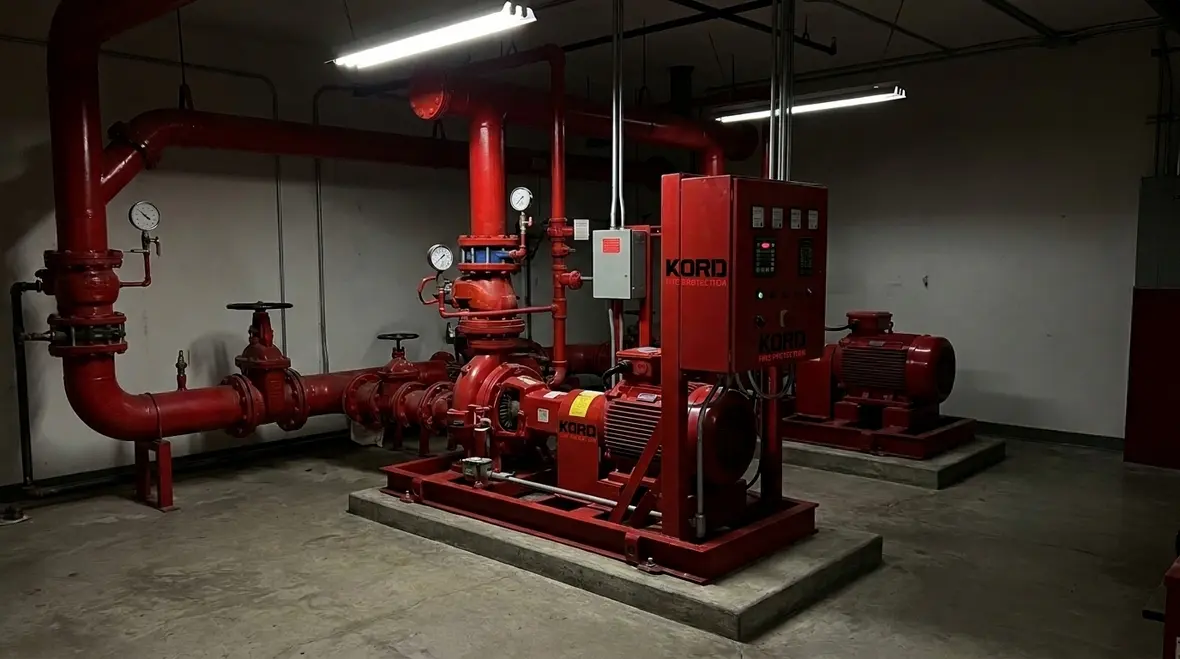
NFPA 13R Section 9.7: Fire Pumps as Water Supply Sources for NFPA 13R Systems
Quick Answer
NFPA 13R Section 9.7 allows fire pumps to serve as a water supply source when the system design and municipal or onsite water supply do not meet the required flow and pressure. The arrangement must comply with NFPA 20 requirements for pump performance and acceptable water supply conditions.
When the water supply picture gets complicated, it helps to understand how ongoing fire sprinkler service and system support fit into real-world pump reliability, especially once the installation is no longer brand new.
Why NFPA 13R 9.7 fire pumps get specified in real projects
In commercial, industrial, and retail facilities, fire sprinkler system reliability depends on the ability to deliver design water for the required duration and at the required pressures. NFPA 13R systems still require dependable water delivery, even though the scope differs from NFPA 13.
When a public main, storage tank, or alternative water source cannot maintain the required performance, designers often rely on a NFPA 13R 9.7 fire pump NFPA 20 acceptable water supply approach. This is not a paperwork exercise. It is a mechanical and operational commitment that must be verified at installation and maintained over time through acceptance testing and ongoing inspection and service.
What NFPA 13R 9.7 actually requires from the water supply and pump system
Section 9.7 focuses on the suitability of the water supply source and the ability to deliver design discharge and pressure to the sprinkler system. Fire pumps are permitted when they provide the required performance and are arranged so the system will operate as intended during a demand condition.
Core compliance elements that drive design
- Performance alignment: The pump and driver combination must match the required flow and pressure at the system’s hydraulic design conditions.
- Reliability of the supply: The water source feeding the pump must be dependable and capable of supporting sustained demand, not just short bursts.
- System interaction: Control valves, check valves, and pump controls must be configured to prevent unwanted conditions during steady state and alarm conditions.
- Acceptance and ongoing readiness: The pump setup must be inspected, tested, and maintained so it performs when needed.
Facilities often discover that “acceptable” depends on documented pump curves, suction conditions, and actual site water availability. A design that looks correct on paper can fail if the suction piping, strainer arrangement, or water source level cannot support the pump at demand.
How NFPA 20 links to NFPA 13R 9.7 fire pump requirements
NFPA 20 governs the installation and acceptance testing of fire pump systems. For NFPA 13R 9.7 applications, the fire pump must be treated as a life safety system with performance and control requirements consistent with NFPA 20.
Key technical areas where projects commonly run into trouble
- Driver starting reliability: Electric motor starters, engine start sequences, and automatic transfer logic must work under actual site conditions. Battery condition, voltage drop, and wiring termination quality frequently cause nondelivery at the worst time.
- Suction conditions and cavitation risk: Improper suction pipe sizing, excessive elbows, inadequate submergence, or blocked strainers can reduce available net positive suction head. Cavitation reduces output and shortens equipment life.
- Hydraulic losses at demand: Miscalculated friction losses in suction and discharge piping cause the pump to miss required pressure at target flow rates.
- Controls and alarms: Nonconforming pressure switches, failed switches, or incorrect alarm wiring can prevent timely pump start or delay signaling.
Fire pump performance verification matters because a sprinkler system’s effectiveness depends on the pump delivering the system’s design demand. For further context on sprinkler system installation practices and design coordination, see this overview: NFPA 13 overview of automatic fire sprinkler system installation.
What counts as an “acceptable water supply” feeding the pump
In a fire pump application, acceptable water supply is not only about water existing on site. It is about the supply being available and capable of sustaining the suction needs and discharge performance for the pump system under fire conditions.
Common water supply sources and practical compliance considerations
- Municipal water mains: Designers must confirm that main pressure and flow at the hydrant demand condition support the pump arrangement. Water main performance variability must be accounted for through site testing and documentation.
- Static or gravity tanks: Tank level, inlet and outlet piping arrangements, and practical maintenance conditions can affect suction performance and delivered flow. Strainers and valves must be accessible and operable.
- Recirculating or on demand sources: Systems that depend on additional infrastructure must prove the infrastructure responds correctly when the pump starts.
- Onsite reservoirs: Pump intake design, suction piping configuration, and debris control drive reliability. Maintenance access and cleaning schedules must be defined.
Industry reference material and training context can also be found through fire pump resources such as firepumps.org, which supports broader understanding of fire pump systems and terminology used in the field.
For owners and facilities, the biggest compliance risk is operational drift. Valves get left in unintended positions, strainers accumulate debris, and tanks lose effective volume. A compliant system requires documented procedures that keep “acceptable” acceptable after installation.
Installation details that directly impact inspection outcomes
Fire pump systems often pass initial reviews but fail later because inspectors evaluate readiness, documentation, and field conditions. The pump system must operate correctly in the real environment of the building, not just the design model.
Field factors inspectors routinely scrutinize
- Valve supervision and lock positions: Control valves and check valves must match the required supervised positions and signage requirements.
- Electrical integrity: Wiring routing, conductor sizing, terminations, and equipment labeling support reliable automatic start and alarm operation.
- Suction strainer and piping configuration: Correct materials, cleanable strainers, and adequate suction geometry reduce risk of performance loss.
- Diesel engine or electric motor readiness: Fuel quality, coolant condition, battery health, and oil levels for engines. For electric motors, verify starting and overload protection are configured correctly.
- Controllers and indicators: Controllers must show proper statuses, alarms must report correctly, and test functions must be accessible.
Kord Fire Protection supports commercial facilities by coordinating the ongoing technical work that keeps pump systems inspection ready. This includes service planning, functional checks, and documentation workflows aligned to the expectations of regulators and insurers.
Where maintenance is neglected, the failure points tend to repeat: clogged strainers, degraded batteries, incorrect valve positions, and control logic faults. Those issues are not theoretical. They show up during acceptance retests and periodic inspections.
Testing, maintenance, and acceptance: what keeps NFPA 13R 9.7 performance dependable
NFPA 20 sets the expectation for acceptance testing and periodic testing of fire pump systems. In practice, compliance depends on an organized testing schedule and trained technicians who can identify and correct the underlying causes of failures rather than only clearing alarms.
Practical maintenance actions that prevent common failures
- Verify suction conditions: Inspect and clean strainers, confirm valves are unobstructed, and verify suction piping is in service condition.
- Perform control system checks: Test start and transfer functions, verify alarms, and confirm that controller indications match field conditions.
- Maintain the driver: For electric systems, verify insulation health and starter function. For diesel engines, verify fuel quality, battery capacity, and readiness.
- Manage documentation: Keep pump curves, test reports, corrective action records, and valve supervision logs current and available.
- Coordinate with building operations: Ensure contractors do not modify valves, electrical panels, or piping without proper sprinkler and fire pump coordination.
For facilities that operate in high-occupancy or high-shift environments, testing windows and operational safeguards must be planned. Downtime and false alarm risks can be mitigated through coordinated procedures and clear communication with building management.
Commercial owners typically need a long-term partner who treats fire pumps as critical infrastructure. Kord Fire Protection delivers that support across ongoing compliance cycles so the system does not degrade between inspections.
Frequently Asked Questions
Next step: confirm your pump arrangement is inspection ready
Have Kord Fire Protection review the pump water supply arrangement, suction piping, controls, and maintenance readiness for your NFPA 13R 9.7 application. A targeted technical assessment helps identify performance risks before they become inspection failures, and it supports a maintenance program that keeps the system compliant between test cycles. Contact Kord Fire Protection to schedule a compliance focused evaluation and next steps.

Join Our Newsletter!
Get the latest fire safety tips delivered straight to your inbox From our Newsletter.



