
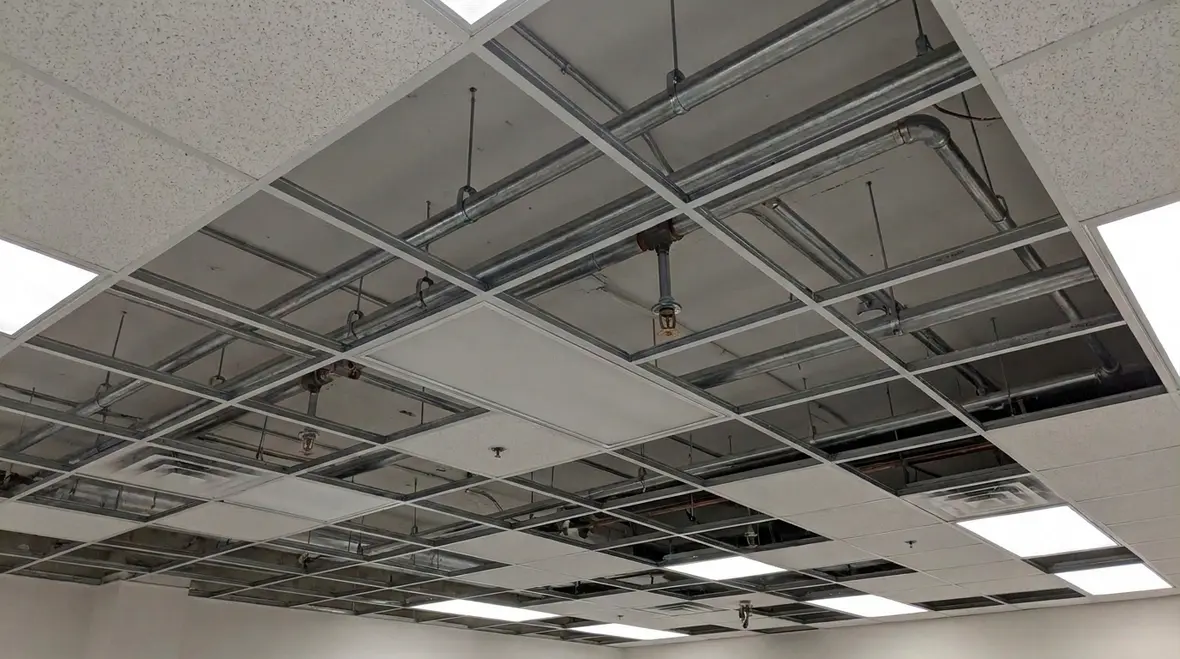
NFPA 13R Section 6.14 Open-Grid Ceilings: When They Are Allowed
Quick Answer: NFPA 13R Section 6.14 permits sprinkler protection arrangements in open grid ceilings only when the construction and sprinkler spacing meet specific conditions. The intent is to avoid concealed obstructions while maintaining predictable water delivery to the fire plume and maintaining inspection reliability.
If you are reviewing open-grid ceiling conditions as part of a broader system upgrade or recurring service program, Kord Fire’s fire sprinkler services and repair support fits naturally into the compliance workflow before ceiling changes start creating expensive surprises later.
Why Section 6.14 exists and what it tries to prevent
NFPA 13R Section 6.14 addresses a common commercial installation reality: ceilings built as open grids that may conceal sprinkler patterns, delay water distribution, or interfere with sprinkler spray. This section defines when NFPA 13R 6.14 open-grid ceilings sprinkler installation can be treated as equivalent to traditional ceiling protection, without creating unintended “no protection” zones.
In practice, compliance teams face recurring challenges in retail, industrial, and mixed occupancy buildings where grid ceilings evolve over time through tenant buildouts, maintenance access changes, and partial infill of ceiling areas. Even when a plan review approves the original layout, field modifications can undermine the original assumptions of the open-grid condition.
What “open-grid” means under NFPA 13R, and why inspectors focus on it
In NFPA 13R, an open-grid ceiling is not treated as a sealed concealed space. Instead, it is evaluated based on how much the ceiling obstructs sprinklers, redirects spray, or blocks heat transfer to the thermal element. Inspectors typically look for practical indicators of whether the grid behaves as “open” during a fire:
Grid continuity and infill such as tiles, panels, or wraps that cover the grid and alter how heat reaches sprinklers.
Basket and plenum interaction where soffits, return air plenums, or duct skirts can create concealed obstructions similar to nonopen ceilings.
Sprinkler visibility and spray access to confirm water is not directed into a blocked ceiling void.
The compliance focus is operational. When the ceiling is not truly open, the fire plume may develop in a way that delays sprinkler activation or reduces the effectiveness of spray impact on combustibles.
When NFPA 13R allows sprinklers to work through an open-grid ceiling
Section 6.14 allows an open-grid ceiling arrangement under defined conditions intended to preserve the sprinkler’s ability to perform predictably. The controlling idea is that the ceiling construction does not create a concealed space that would require a different sprinkler placement or a different design approach.
Key compliance checks for the NFPA 13R 6.14 open-grid ceilings sprinkler installation
Ceiling must remain open in the field through the life of the system, not just at substantial completion. Maintenance practices that replace missing tiles or add temporary finishes can change the ceiling classification.
Sprinkler location and orientation must match the approved intent. Misalignment or incorrect head styles can cause spray obstruction by trim, escutcheons, or ceiling grid components.
Obstruction control includes nearby beams, soffits, lighting housings, and cable trays that can behave like obstructions even when the main ceiling grid is “open.”
System design basis consistency must be maintained across any subsequent ceiling modification, including tenant fit outs and HVAC upgrades that introduce partitions or infill.
Because sprinkler performance depends on ceiling and obstruction geometry, the most frequent failure point is not the sprinkler itself. It is the drift between design assumptions and the installed reality after service and refurbishment.
How open-grid ceilings change sprinkler behavior during a real fire
Sprinklers protect by combining thermal activation with spray distribution to cool and control fire growth. In an open-grid ceiling condition, the goal is to keep the ceiling from acting as a barrier that separates the burning material from sprinkler activation and from the spray pattern.
Common installation variables that affect performance
Ceiling height changes created by different drop dimensions in tenant spaces. Even small height changes can affect spray impact distances.
Accessory hardware such as soffit angles, recessed lighting trim, and ventilation diffusers. These can block spray or redirect it away from the intended target.
Maintenance access panels added or replaced without fire protection coordination. The “open” classification can be lost when panels close or when the grid is covered.
Corrosion and mechanical damage in service. A sprinkler head impacted or mislocated by ceiling work may remain visually present but can fail to perform as designed.
For teams managing commercial and industrial facilities, this is why documentation and ongoing verification matter. The sprinkler system is only as compliant as the ceiling environment it depends on.
Inspection, testing, and maintenance: where compliance breaks down
Even when the original installation meets Section 6.14, commercial maintenance schedules can unintentionally create noncompliance. Grid ceilings are high interaction zones for electricians, HVAC contractors, and interior trades. The system must remain consistent after those activities.
Practical field practices that support ongoing compliance
Ceiling change management using a formal work permit for any ceiling infill, panel replacement, and lighting or duct modification.
Coordination with fire sprinkler inspection so that inspectors can verify the open-grid condition at the time of inspections, not only during plan review.
Clear documentation capturing ceiling type, sprinkler locations, head styles, and approved design intent for future tenants and maintenance vendors.
Targeted visual verification during maintenance and service calls to catch misaligned escutcheons, damaged deflectors, and obstructing accessories.
For an installation overview that supports these operational checks, facilities often use resources like this NFPA 13 overview and automatic fire sprinkler system installation. While it focuses on NFPA 13, the installation coordination and obstruction awareness translate directly to the management of sprinkler performance under complex ceiling conditions.
How Kord Fire Protection helps keep Section 6.14 installations compliant
Open-grid ceiling conditions create a moving target. Kord Fire Protection supports commercial facility owners, building managers, and contractors with a compliance mindset that extends beyond the initial inspection.
That support typically includes:
Verification at acceptance and after renovations to confirm that the ceiling remains within the approved open-grid assumptions.
Routine inspection planning that accounts for the likelihood of ceiling access work, lighting upgrades, and HVAC service in retail and industrial environments.
Service response readiness to correct common field issues such as head misalignment, damaged trim, or obstructions introduced by new trade scope.
Operationally, Kord Fire Protection helps reduce the risk of repeated rework and enforcement problems by aligning sprinkler maintenance workflows with the realities of commercial building use.
For broader fire protection knowledge resources, facilities also reference how fire pumps support sprinkler systems when coordinating water supply performance and system reliability considerations.
Frequently Asked Questions
Conclusion and next steps
NFPA 13R Section 6.14 permits sprinkler installations through open-grid ceilings only when the ceiling stays truly open and does not create concealed obstruction effects. The compliance risk is usually not the sprinkler layout at installation, but the ceiling changes that occur after tenant work and maintenance. Contact Kord Fire Protection for a field verification and a practical compliance plan that includes change management, inspection readiness, and timely correction of obstruction or damage issues.

Join Our Newsletter!
Get the latest fire safety tips delivered straight to your inbox From our Newsletter.



