
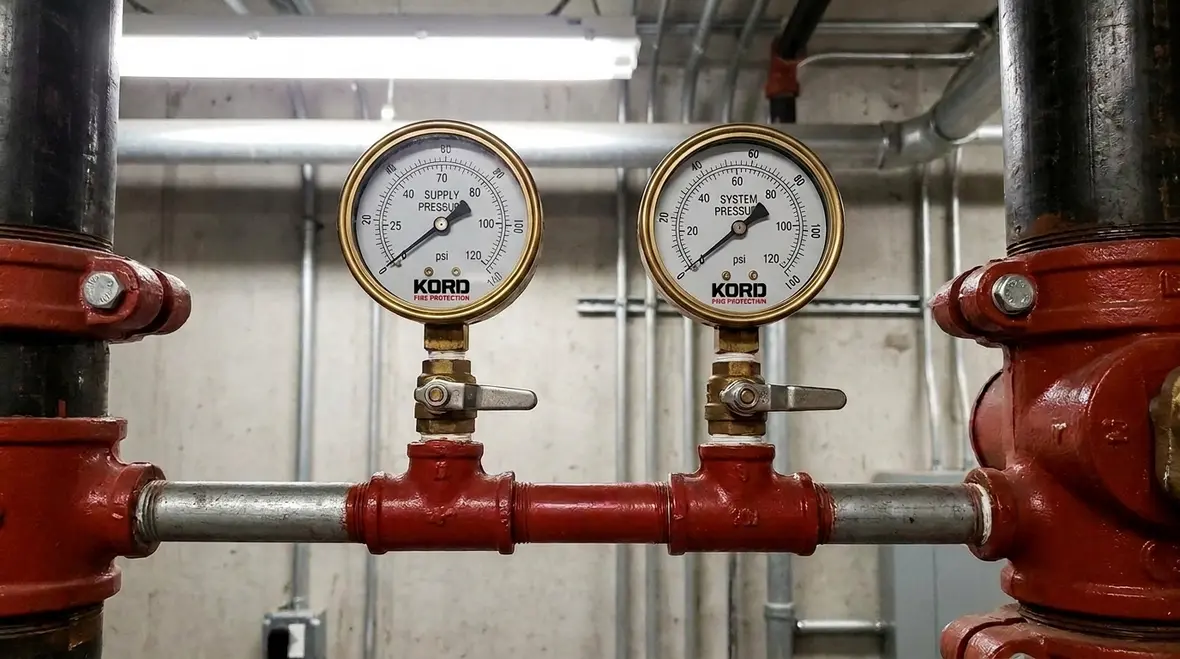
NFPA 13R Section 6.12 Pressure Gauges: Supply and System Pressure Indication
Quick Answer: NFPA 13R Section 6.12 requires pressure gauges that clearly indicate supply pressure and system pressure at key locations. Proper installation, shutoff control, and routine testing support reliable readings, faster troubleshooting, and defensible compliance for commercial fire sprinkler systems.
What does NFPA 13R 6.12 require for pressure gauge indication?
NFPA 13R Section 6.12 focuses on pressure gauges that provide dependable supply and system pressure indication for sprinkler system performance verification. In practice, these gauges serve two operational needs. First, they help confirm the available water supply pressure at the system interface. Second, they help verify that the system pressure at the discharge side remains within expected limits when the system is flowing or simulated during inspections.
For facilities seeking an auditable compliance position, accurate pressure gauge readings depend on correct mounting, correct piping connections, correct range selection, and correct isolation so gauges can be inspected and maintained without disrupting the entire system. Many inspection teams also look specifically for the use of the NFPA 13R 6.12 pressure gauges supply system shutoff valve arrangement and its ability to support service without compromising system integrity.
For facilities planning inspections or service work, fire sprinkler services and repair can help connect code language to what actually needs to happen in the field. For additional system installation context, see this overview of automatic fire sprinkler system installation practices: NFPA 13 overview and automatic fire sprinkler system installation.
Where gauges connect and why the location matters
Pressure gauges must be installed where the indicated pressure correlates to the system performance being evaluated. While exact locations are tied to the specific system configuration and the standard requirements applicable to the installation, commercial facilities commonly see gauges provided for:
-
Supply pressure indication at or near the water supply connection point so the available pressure can be verified.
-
System pressure indication at a point representative of the system hydraulic condition, often near the control connection or where the system pressure becomes established.
Location affects reading quality. A gauge placed after air pockets, downstream restrictions, or poorly designed piping runs can lag during flow tests, respond inconsistently to transient pressure, or show values that do not match expected system hydraulics. That mismatch increases inspection friction because vendors and AHJs must reconcile “what the gauge shows” against “what the system should do” during static and flow verification.
How the supply and system shutoff valve supports safe inspection and compliance
Gauges still need routine care because they are field instruments exposed to vibration, thermal cycling, and corrosion potential in sprinkler rooms and pump houses. Section 6.12 expectations translate to a practical requirement: gauges must be maintainable and testable without leaving the system in an uncertain state.
The NFPA 13R 6.12 pressure gauges supply system shutoff valve concept typically enables service personnel to:
-
Isolate the gauge to permit replacement, recalibration, or internal cleaning without forcing unnecessary water to discharge into the building.
-
Reduce the risk of gauge drift caused by prolonged exposure to moisture and corrosive atmospheres in the gauge body and siphon lines.
-
Perform controlled verification during inspections by stabilizing gauge operation prior to recording readings.
Common compliance challenges occur when isolation is not provided or is installed inconsistently. When a gauge has no practical isolation point, service teams often delay corrective work, extend downtime, or bypass testing steps. AHJs and insurance surveyors then encounter incomplete documentation, missing readings, or a gauge that cannot be proven accurate.
For broader design context around hydraulic components and system operation, fire pump and sprinkler system references can support facility troubleshooting planning at: https://firepumps.org.
Installation details that prevent false readings and premature failures
Pressure gauge accuracy depends on more than gauge brand and scale. Commercial and industrial facilities typically experience recurring issues from installation and maintenance gaps. The following installation and setup elements directly affect whether gauges provide dependable supply and system pressure indication:
1) Gauge scale selection and reading discipline
Gauges must include an appropriate range so the technician can read and record pressures within the workable portion of the dial. If the range is too high, readings become coarse and drift can hide behind low resolution. If the range is too low, the gauge can peg during flow events and damage internal mechanisms.
2) Proper connection piping and tubing routing
Long runs, sharp bends, and unaddressed trapping or low-point accumulation can create lag or inaccurate response. In sprinkler spaces, condensate can also migrate into gauge lines. Routinely, facilities correct this by using appropriate routing, ensuring no unintended restriction exists, and verifying that gauge lines stay protected from freezing conditions where applicable.
3) Vibration and mechanical stability
Pump rooms and mechanical areas generate constant vibration. Vibration can loosen fittings, damage gauge internals, and create microleaks. Facility maintenance teams improve reliability by confirming secure mounting, tightening practices, and verifying that gauge connections and shutoff valves remain in serviceable condition.
4) Corrosion resistance and environmental protection
Corrosion causes sticking needles, inconsistent movement, and slow response times. Commercial facilities often improve gauge survivability by using properly rated components for wet or humid environments and by keeping gauge assemblies protected from direct spray, chemical exposure, and persistent condensation.
Inspection, testing, and documentation practices that stand up to audits
Even when gauges visually appear functional, NFPA-aligned compliance requires that facilities capture evidence and follow repeatable inspection procedures. A defensible maintenance program typically includes:
-
Visual inspection of gauge condition, readable markings, and secure mounting, including the gauge shutoff configuration.
-
Operational verification during scheduled inspections using the appropriate method for that system, recording static readings and confirming gauge response to system pressure conditions.
-
Isolation valve function checks to confirm that the gauge can be isolated and returned to service reliably. This matters because a “present but nonfunctional” shutoff valve fails the real-world intent of the gauge arrangement.
-
Calibration or verification planning based on facility risk and manufacturer guidance. If a facility cannot justify gauge accuracy, it cannot confidently validate system pressure indication.
-
Corrective action documentation for stuck needles, inaccurate readings, leaking connections, damaged valves, or tamper damage that affects operation.
In many commercial, industrial, and retail settings, the audit failure pattern is consistent. Maintenance records show “inspected” without recorded pressures, or recorded pressures cannot be reconciled with system expectations because the gauge was not verified, isolated, or serviceable at the time of the visit. Strong procedures eliminate that ambiguity and keep the facility in a reliable operational state.
Kord Fire Protection supports this compliance requirement with field-oriented testing and maintenance planning aligned to real installation conditions, not just theoretical placement. That approach reduces repeat visits, strengthens documentation, and improves response speed when an AHJ requests verification of supply and system pressure indication.
Frequently Asked Questions
Need an NFPA 13R 6.12 pressure gauge compliance check?
Schedule a Kord Fire Protection inspection to confirm correct gauge placement, shutoff valve serviceability, and defensible documentation for supply and system pressure indication. A focused field review helps facilities correct common failure points early, reduce repeat visits, and maintain readiness for AHJ and insurance verification. Contact Kord Fire Protection today to align your gauges, isolation arrangements, and maintenance records with practical code compliance.

Join Our Newsletter!
Get the latest fire safety tips delivered straight to your inbox From our Newsletter.



