
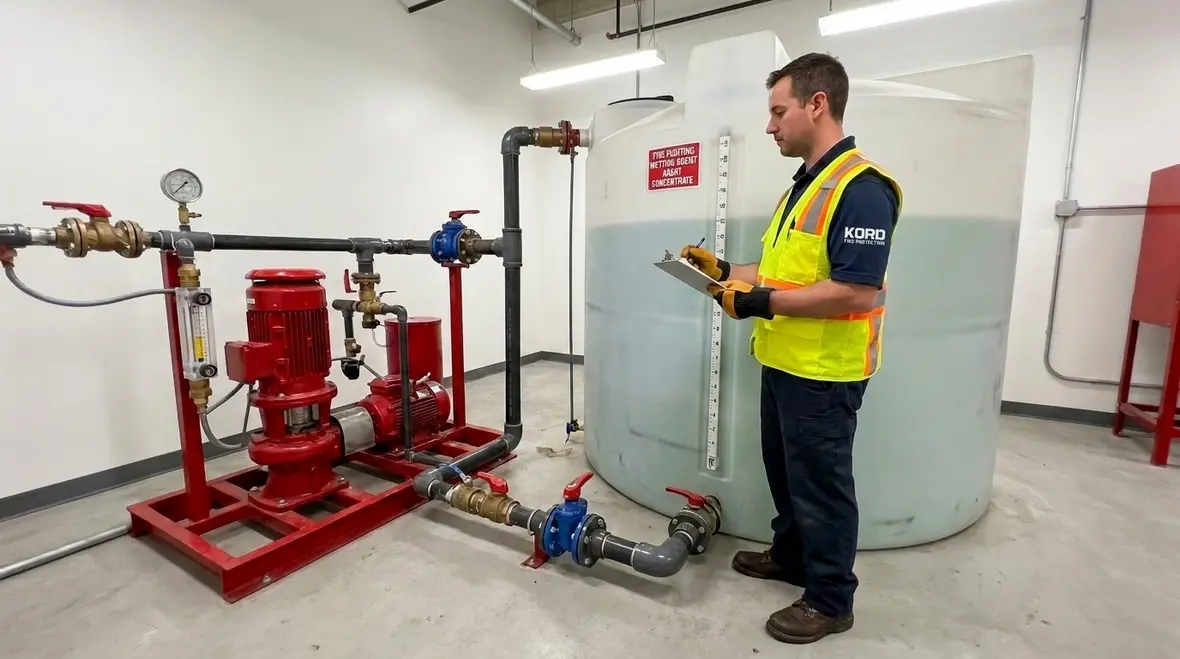
NFPA 18 Section 5.2: Wetting Agent Concentrate Property Requirements Explained
Quick Answer
NFPA 18 section 5.2 requires wetting agent concentrates to meet specific physical and chemical property limits so they perform reliably under fire conditions. These limits support correct dilution, effective surface wetting, stability, and consistent fire pump and proportioning performance during inspections and use.
If your maintenance team is tightening testing and documentation around proportioning equipment, it also helps to review fire pump inspection and testing services early in the process so chemical performance and water delivery reliability are being looked at together.
What NFPA 18 section 5.2 is trying to protect against
In commercial, industrial, and retail fire protection systems, wetting agents are not “set and forget” chemicals. NFPA 18 section 5.2 wetting agent concentrate physical chemical property requirements exist to prevent a common pattern: a product that looks correct at delivery but behaves differently after storage, temperature swings, dilution, or contamination. The goal is consistent foam and spray system effectiveness, repeatable hydraulic performance, and predictable operator outcomes during inspections, testing, and actual emergencies.
When concentrates fail property requirements, the failure often shows up in the real world as poor wetting, inconsistent concentration at the nozzle, pump strain, residue buildup, or separation in storage tanks. Those issues can reduce suppression performance and create compliance problems during annual or hydro testing cycles and functional system checks.
Which properties matter most for concentrate acceptance
Although facilities typically focus on “dose rate” and whether the right brand was purchased, NFPA 18 section 5.2 emphasizes that wetting agent concentrate acceptance depends on physical and chemical characteristics. These characteristics influence how the concentrate mixes with water, how it stays stable during storage, and how it performs across the operating temperature range.
1) Concentration integrity and dilution reliability
Wetting agent concentrates must maintain their intended composition so that the final solution reaches required concentration after proportioning. Practical compliance depends on how the chemical behaves during dilution in the proportioning equipment, not just what the concentrate label claims.
-
Common failure point: concentrate stratification or partial separation that causes uneven dosing, especially after seasonal temperature changes.
-
Operational impact: nozzle performance variability, uneven suppression effectiveness, and harder troubleshooting during test runs.
2) Viscosity and flow behavior in storage and metering equipment
Concentrate viscosity affects suction conditions, pump priming, and metering accuracy. In systems that use proportioning pumps, injectors, or eductors, the concentrate must flow consistently from the bulk container to the injection point.
-
Common failure point: viscosity shift at cold start resulting in delayed injection or dose deviation.
-
Commercial site concern: facilities with unheated chemical storage rooms or outdoor bulk storage experience wider temperature swings.
3) Chemical compatibility and residue control
Wet agents interact with metals, elastomers, and internal surfaces of proportioning components. Physical and chemical property requirements help prevent excessive corrosion and residue that can accumulate in lines, strainers, and injectors.
-
Common failure point: degraded seals or gasket swelling leading to leakage and inaccurate dosing.
-
Common failure point: deposits that partially block strainers and injection orifices.
4) Surface tension and wetting performance stability
The wetting agent concentrate must produce the expected wetting effect when diluted to the designed operating concentration. That includes maintaining performance within specified physical and chemical limits over its service life.
-
Common failure point: performance drift after extended storage, exposure to contaminated water sources, or incorrect dilution procedures during maintenance.
-
Compliance impact: results can fall short during functional testing and inspection measurements, triggering remediation.
How property requirements translate into real inspection and maintenance work
Compliance with NFPA 18 section 5.2 wetting agent concentrate physical chemical property requirements is not achieved by paperwork alone. Commercial facilities succeed when their maintenance program connects concentrate properties to equipment functions and documentation.
Step-by-step: what inspections typically need to confirm
- Product verification and change control. The installed concentrate must match the approved product documentation, including batch traceability and storage conditions. This reduces the risk of “wrong bottle” or undocumented substitution.
- Storage condition monitoring. Facilities should confirm the concentrate is stored within the manufacturer recommended temperature range and protected from contamination. Label legibility and container condition matter during annual checks.
- Proportioning system verification. Technicians should confirm injectors, eductors, proportioning pumps, strainers, and check valves operate as intended. Any evidence of residue or restricted flow signals a need for cleaning and inspection.
- Dilution and delivery consistency. The service process must ensure correct concentration at the delivery point. Functional tests and sampling procedures should be defined in the site maintenance plan.
Where facilities most often fall short
- Uncontrolled tank mixing. Concentrate may settle or separate if storage is not maintained per the service procedure.
- Inadequate strainer and injector attention. Even small deposits can change suction conditions and dosing accuracy.
- Weak documentation. Missing batch data and manufacturer property sheets makes it difficult to demonstrate compliance during audits or insurance reviews.
- Incorrect flush and recharge practice. Inadequate system flushing can carry contaminants that alter chemical behavior and create residue.
Why wetting agent systems demand a disciplined water and equipment management approach
Wet agents operate in a coupled environment. Water quality, flow rates, pump conditions, and system materials all influence how the concentrate performs after dilution. That is why Kord Fire Protection and experienced sprinkler services teams treat wetting agent maintenance as a system lifecycle task, not a simple chemical top-up.
For a broader overview of wetting agent selection and system integration, facilities can review the Kord Fire Protection resource: NFPA 18 overview: wetting agents.
For facilities in Australia using sprinkler and fire services practices that align with NFPA 18 concepts, Kord Fire Protection also supports ongoing compliance and maintenance planning through Australian fire sprinkler services.
Proportioning equipment considerations that connect to concentrate properties
NFPA 18 section 5.2 property requirements drive the selection and ongoing usability of compatible concentrate within specific equipment configurations. Commercial facilities typically use proportioning pumps, injection systems, or eductors. Each configuration creates distinct operating conditions that can magnify concentrate property deviations.
Pumps and metering hardware
Metering accuracy depends on stable concentrate flow. Changes in viscosity, density, or chemical characteristics can affect pump performance curves, suction stability, and calibration.
Strainers, check valves, and injectors
These components are sensitive to residue and particles. If a concentrate falls outside required property limits, residue formation or compatibility issues can increase restriction over time, leading to dose drift.
Sampling and testing logistics
Where sampling occurs, technicians must follow consistent procedures to avoid introducing bias through dilution water differences, container contamination, or incorrect mixing time. Professional testing workflows reduce false failures and accelerate corrective actions.
For general reference on fire pumps and system support concepts that influence water delivery reliability, see Fire Pumps.
Frequently Asked Questions
Get your NFPA 18 wetting agent compliance program audit-ready
Kord Fire Protection can help commercial facilities verify concentrate documentation, tighten storage and proportioning maintenance practices, and reduce the risk of dose drift, residue issues, and audit findings. Schedule a wetting agent system review to confirm your inspection workflow, equipment compatibility, and corrective action readiness. Proactive service improves reliability when it matters most.

Join Our Newsletter!
Get the latest fire safety tips delivered straight to your inbox From our Newsletter.



