
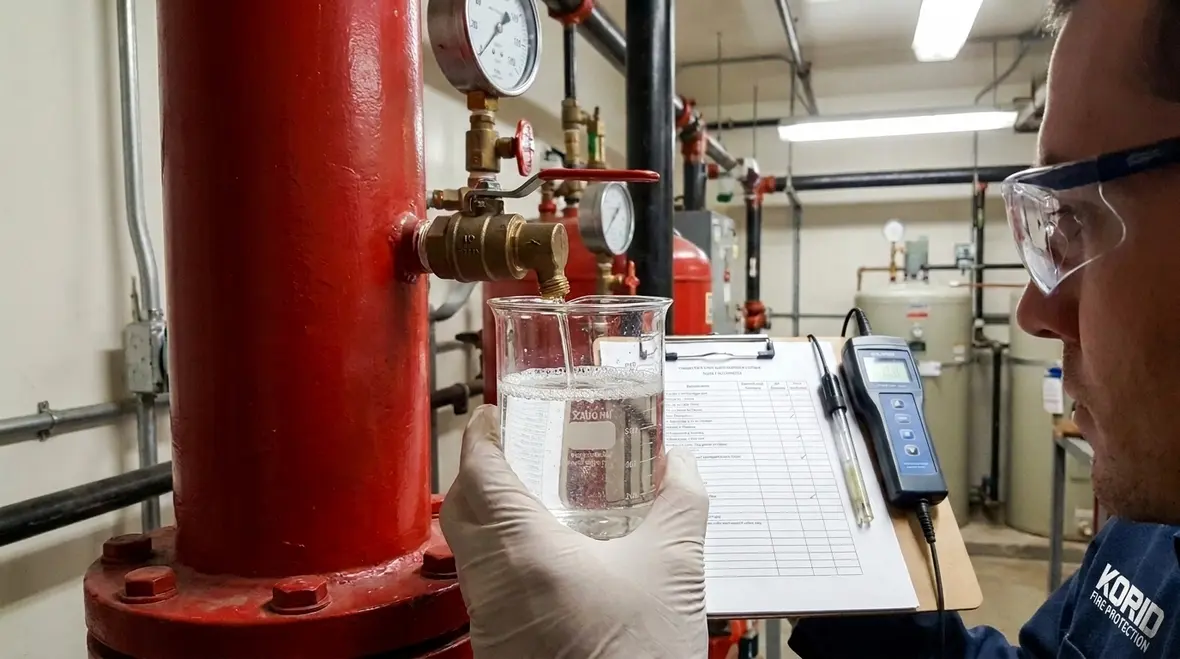
NFPA 18 Section 5.1: Overview of Requirements and Test Methods for Wetting Agents
Quick Answer: NFPA 18 section 5.1 requirements and test methods overview explains how facilities evaluate wetting agents used with fire extinguishing systems. It covers selection, performance expectations, field verification, and documentation to support reliable operation, safe storage, and consistent system effectiveness.
Facilities that want stronger inspection alignment can also review fire pump testing documentation across global codes to tighten recordkeeping and compliance habits near the start of their broader fire protection planning.
Why NFPA 18 section 5.1 matters for commercial wetting agent programs
Wetting agents play a direct role in how extinguishing solutions spread and maintain contact with fuels. In commercial, industrial, and retail fire protection environments, this matters because performance can change with storage conditions, contamination, dilution practices, and aging. NFPA 18 section 5.1 requirements and test methods overview supports a structured approach to keep wetting agents within acceptable performance limits, backed by repeatable testing and traceable records.
In practice, owners and facility managers usually struggle with four recurring gaps: missing product documentation, inconsistent handling and dilution, incomplete testing frequency, and unclear acceptance criteria. A compliant wetting agent program reduces operational uncertainty, supports incident readiness, and lowers the risk of costly remediation after discharge, inspection, or insurer reviews.
For background on wetting agent concepts and the broader NFPA 18 approach, refer to Kord Fire Protection’s NFPA 18 overview of wetting agents.
What NFPA 18 section 5.1 requires: scope, intent, and performance expectations
Section 5.1 focuses on ensuring wetting agents perform as intended when used in relevant fire extinguishing applications addressed by NFPA 18. The requirements generally emphasize:
- Correct selection: Wetting agents must match the system’s intended design, including compatibility with the extinguishing liquid and the operational environment.
- Controlled handling: The wetting agent must be stored, mixed, and managed to avoid degradation or changes in concentration.
- Verification of effectiveness: Testing supports that the wetting agent provides the required wetting and spreading performance under defined conditions.
- Documented compliance: Records must support what was installed, when it was tested, and what results were observed.
Commercial facilities often treat wetting agents as “set and forget” products. NFPA 18 section 5.1 requirements and test methods overview pushes the opposite approach: wetting agent performance is verified through test methods and managed through a lifecycle program, not just installation paperwork.
Where wetting agents fail in real facilities
Operational failures often come from mechanisms that do not trigger obvious damage to tanks or piping until performance drops:
- Concentration drift: Refill practices, partial drain refills, or inaccurate dilution can reduce wetting performance.
- Contamination: Oils, coolants, dust loading, or incompatible additives can change surface tension behavior.
- Temperature cycling: Storage temperature swings can accelerate degradation in some formulations.
- Cross contamination: Shared transfer equipment and unclean hoses can introduce residues.
- Improper mixing: Incomplete mixing can create nonuniform concentration throughout the tank.
A compliant program targets these mechanisms with controlled procedures and measurable acceptance criteria.
Testing and verification: how facilities confirm wetting agent performance
NFPA 18 section 5.1 requirements and test methods overview supports testing that confirms wetting agent effectiveness and concentration. While facilities may apply specific test procedures aligned to their adopted standard practice and system design, the typical compliance objective remains consistent: demonstrate that the wetting agent provides the performance required for the extinguishing liquid to work properly.
Common test categories used in wetting agent compliance programs
- Concentration verification: Confirms the wetting agent is within allowed concentration limits after storage and mixing.
- Performance based checks: Confirms surface active behavior that supports wetting and spreading characteristics.
- Sampling integrity: Confirms samples represent the tank contents and were collected without introducing bias.
- Documentation and traceability: Records the product, batch, test method, results, and corrective actions where applicable.
Operational sampling and handling procedures that reduce rework
Many failures during compliance testing do not come from the wetting agent itself. They come from sampling and handling. Facilities should implement repeatable steps:
- Define sampling points: Establish where samples are collected to represent mixed solution, not just the top layer or transfer line residue.
- Use clean, compatible containers: Avoid introducing surfactants or residues that skew results.
- Record temperature and conditions: Testing outcomes can be influenced by temperature during sampling and measurement.
- Perform mixing verification: Ensure that prior to sampling, mixing or circulation procedures produce uniform concentration.
- Calibrate measurement tools: Concentration and performance measurements require reliable instrumentation.
When these steps are absent, results can appear “out of specification” even when the installed product is correct, or compliance can be falsely confirmed. Kord Fire Protection supports facility teams with disciplined processes that align with commercial inspection realities, including shop testing coordination and on site documentation.
Inspection and maintenance integration: keep wetting agents compliant between tests
Compliance extends beyond periodic testing. NFPA 18 section 5.1 requirements and test methods overview should drive a maintenance workflow that prevents concentration loss, contamination, and mixing errors.
Lifecycle controls for wetting agent storage and dilution
- Storage controls: Segregate wetting agent containers, protect against cross contamination, and maintain temperature conditions consistent with manufacturer guidance.
- Transfer controls: Use dedicated or controlled transfer equipment with cleaning procedures documented for audits.
- Dilution controls: Require measured dilution steps using calibrated equipment and defined mixing time.
- Change management: Treat any product change, vendor change, or formulation update as a compliance event requiring verification.
Commercial facility coordination points
In real buildings, maintenance teams often coordinate wetting agent tasks around downtime windows, production schedules, and access constraints. These practical issues create compliance risk. A structured plan typically includes:
- Scheduling alignment: Tie wetting agent testing into the broader fire protection inspection calendar so results are acted upon quickly.
- Accountability and sign off: Define who verifies concentration targets and who maintains test logs.
- Corrective action triggers: Define what happens when a test result drifts out of range, including re mix, re sample, and escalation steps.
- System compatibility checks: Confirm the wetting agent remains compatible with the extinguishing solution and delivery system components.
For facilities that also manage water supply and delivery hardware, Kord Fire Protection coordinates related fire protection scope with wetting agent compliance. If pump and fire protection system details affect operational readiness, it helps to align with broader technical resources like firepumps.org.
Common compliance gaps and how to address them before an audit
Auditors and insurers typically look for evidence that the wetting agent program is controlled, measurable, and repeatable. The most common gaps include missing documentation, unclear test method selection, and poor sample traceability.
Gap 1: Missing product traceability
Facilities sometimes cannot link the wetting agent in service to the installed product data sheet, batch records, and concentration target. Fix this by maintaining a wetting agent register that includes product identifiers, delivery dates, and any formulation changes.
Gap 2: Unclear acceptance criteria
Testing without defined acceptance criteria turns results into opinions. NFPA 18 section 5.1 requirements and test methods overview expects the program to connect test outcomes to performance expectations. Establish clear pass fail criteria aligned to the system and adopted test procedure.
Gap 3: Inconsistent sampling practices
Sampling variation can produce false failures or mask drift. Standardize sampling locations, container cleanliness, mixing conditions, and recordkeeping to reduce variability.
Gap 4: Incomplete corrective action documentation
If a result falls outside limits, facilities need a controlled response and follow up testing. Maintain a corrective action log that tracks what changed, when it changed, and confirmation tests that verify the fix.
For Australian facilities coordinating sprinkler and related wetting agent program activities, it also helps to align with Kord Fire Protection Australia sprinkler and fire services planning practices, especially where local inspection schedules intersect with NFPA based system requirements.
QA and documentation: what “good” looks like in test records
Strong documentation often separates compliant programs from those that struggle during review. A high quality test record typically includes:
- System identification: Equipment or tank identifiers, installation location, and service type.
- Product information: Manufacturer, product name, and batch details where available.
- Test method references: The method used and the equipment used, including calibration status where applicable.
- Sampling conditions: Tank mixing state, sampling date, and measured temperature if relevant.
- Results: Measured values with pass fail determination.
- Corrective actions: What was done, when it was done, and verification test results.
- Sign off: Responsible party and date, aligned to the facility’s governance model.
Kord Fire Protection supports customers by aligning wetting agent compliance with commercial service workflows, including repeatable field procedures and record management practices that match real facility audit expectations.
Frequently Asked Questions
Next step: build a defensible wetting agent compliance program
If your facility needs to strengthen NFPA 18 section 5.1 compliance through disciplined testing, sampling control, and maintenance recordkeeping, Kord Fire Protection can help. Contact Kord Fire Protection to review your current wetting agent procedures, validate your test documentation workflow, and establish a repeatable service plan designed for commercial, industrial, and retail readiness.
Start with an NFPA 18 wetting agent program overview and then align your next inspection and maintenance cycle with expert support.

Join Our Newsletter!
Get the latest fire safety tips delivered straight to your inbox From our Newsletter.



