
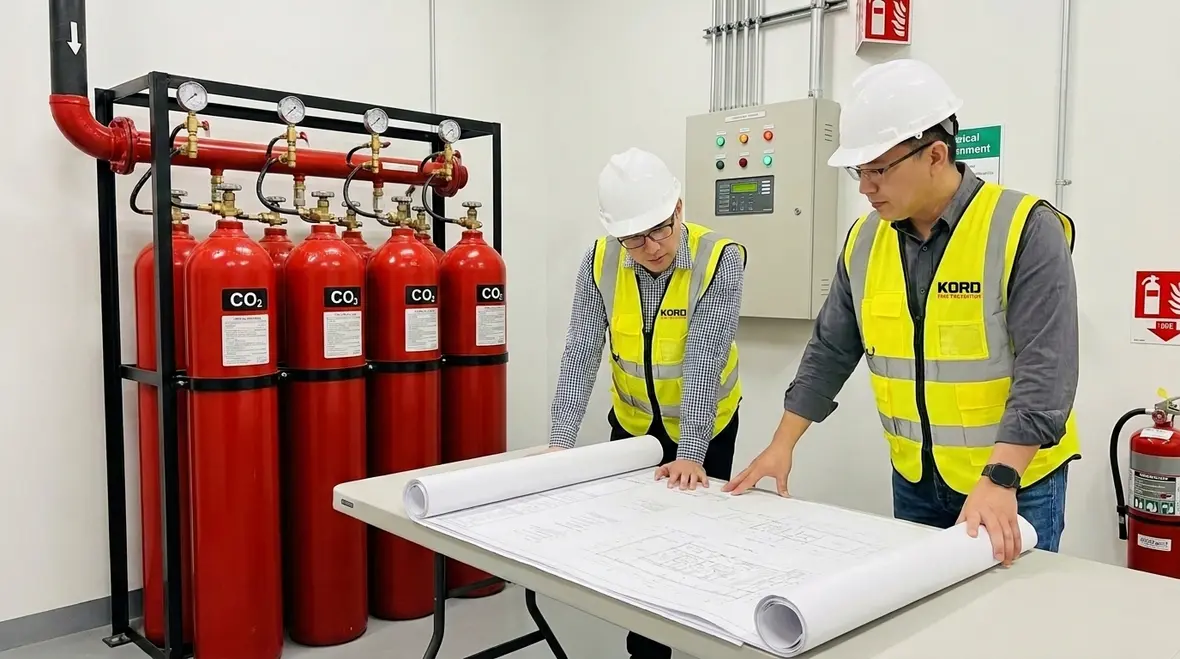
NFPA 12 Section 4.4: CO2 System Specifications Plans and Approvals
NFPA 12 Section 4.4 CO2 System Specifications Plans and Approvals
Quick Answer
NFPA 12 CO2 specifications plans approvals are defined by NFPA 12 Section 4.4. For commercial facilities, precise plan content, rigorous calculations, and AHJ coordination are essential. Understanding NFPA 12 CO2 specifications plans approvals helps ensure safe design, reliable performance, and verifiable compliance across installation, testing, and maintenance.
If your facility is planning a carbon dioxide system project, Kord Fire Protection’s CO2 fire suppression systems services page is a useful next stop for understanding installation, inspections, repairs, and code-focused support before you move deeper into plan review.
Scope and intent of NFPA 12 Section 4.4
Section 4.4 establishes the minimum content and review process for CO2 extinguishing system plans. It requires clear documentation of protected spaces, hazard analysis, agent storage, and the integration of detection, alarm, and control systems. The intent is to provide prescriptive guidance that supports safe operation while facilitating timely approvals by the authority having jurisdiction (AHJ).
Required plan components you must include
Plans submitted for review should present a comprehensive, connected set of documents. Critical components include:
- General scope and protected area description with occupancy type and risk assessment
- General arrangement drawings showing cylinder locations, discharge nozzles, piping routes, and valve assemblies
- System data sheet with design concentration, discharge time, motive force, and equipment ratings
- Piping and valve details including material, size, connection types, and hydrostatic testing requirements
- Hazard analysis and occupancy characteristics to justify CO2 use and clearance times
- Detection and alarm interfacing and control logic for safe actuation
- Electrical drawings and control panel wiring and supervision requirements
- Operating, maintenance, and reset procedures with safety precautions
- As built documentation and any field changes recorded for final acceptance
Design calculations and layout considerations
Accurate calculations are central to compliance. Designers must determine room volume, target CO2 concentration, and time to reach that concentration while considering leakage, temperature, and occupancy. Calculations should be verified by qualified engineers and corroborated with saliency checks for interlocks and confirmation that personnel safety measures remain intact during release.
Layout considerations emphasize nozzle spacing, coverage uniformity, and integration with detectors and warning devices. Piping must avoid obstructing egress paths and maintain accessibility for service. The plan should clearly illustrate all equipment locations, manual actuation points, and accessibility for maintenance personnel.
Approvals and permit process with the AHJ
AHJ review is a gatekeeper for CO2 suppression systems. The process typically involves plan review for code compliance, coordination with electrical and mechanical disciplines, and may require third party review. Contractors should anticipate questions about space ventilation, occupant safety during discharge, and the sequence of alarm activation and system shutoff.
For commercial facilities, aligning with local building and life safety codes is essential. Submittals should be organized, with traceable revisions and clear markups to expedite approvals. An experienced consultant or fire protection contractor can help navigate jurisdictional preferences and document formats used by the AHJ. For a broader code-focused reference, Kord Fire Protection also has an NFPA 12 compliance guide for carbon dioxide extinguishing systems that fits naturally alongside this section-specific topic.
Commissioning, testing, and acceptance
Commissioning verifies that the CO2 system operates as designed under real conditions. Functional testing includes verification of actuator sequencing, alarm interlocks, and correct pressure and flow in the discharge network. A formal acceptance test often requires presence of the AHJ or its designee, confirmation of visible warning devices, and demonstration of safe occupant evacuation procedures during a simulated discharge.
Testing should cover interlocks with detection, the status of automatic and manual actuation, and safety interlocks to prevent accidental release. All test results must be documented and retained with the project records to support ongoing compliance and future inspections.
Maintenance, inspections and ongoing compliance
Ongoing maintenance is a core aspect of NFPA 12 CO2 plans and approvals. Routine inspections should verify cylinder integrity, valve operation, detection system health, and control logics. Annual or semiannual service by qualified technicians is typical, with recharging procedures and leak checks as required. Documentation of all service events should be retained with the system records for AHJ audits.
Commercial facilities should establish a preventive maintenance schedule, maintain spare parts inventories, and train staff on occupancy protection during maintenance and release scenarios. Clear signage and safety training reduce risk during any required servicing.
Documentation, change management and updates
Any design change or retrofit must trigger a formal update to plans, calculations, and AHJ submittals. Change management controls ensure that updated drawings reflect current field conditions, that all valves and detectors are correctly labeled, and that maintenance records align with the latest configuration. Regular reviews help sustain compliance across the facility lifecycle.
Partnering with Kord Fire Protection
Kord Fire Protection serves as a vital commercial partner for planning, review, commissioning, and ongoing maintenance of CO2 suppression systems. The team brings practical experience with commercial, industrial, and retail facilities, helping clients meet NFPA 12 4.4 requirements while optimizing safety and uptime. From initial plan reviews to periodic testing and training, Kord offers end to end support to sustain compliance.
Frequently Asked Questions
Conclusion and next steps NFPA 12 CO2 specifications plans approvals require meticulous planning, precise calculations, and disciplined documentation. For commercial facilities, partnering with Kord Fire Protection accelerates AHJ approvals, ensures rigorous commissioning, and supports ongoing maintenance. Reach out today to schedule a plan review, secure approvals, and build a compliant, safe CO2 suppression solution for your facility.

Join Our Newsletter!
Get the latest fire safety tips delivered straight to your inbox From our Newsletter.


