Fire Protection for Data Centers by Kord Fire Protection
Quick Answer: Modern data centers need fire protection that thinks like a systems engineer, not a checkbox. They pair detection speed, suppression control, compartment design, and staff procedures so a small event never becomes a business ending event. Kord Fire Protection can act as a vital partner by designing, installing, and maintaining solutions that match real site risks across Australia.
In a modern facility, fire protection for data centers does not start at the nozzle and end at compliance paperwork. It begins with how risk moves through the building, how people respond under pressure, and how quickly systems act when smoke, heat, or electrical faults appear. That is why many Australian industrial, retail, and commercial sites now treat fire as a managed hazard, not a hoped for miracle. And when teams need a steady hand, Kord Fire Protection can become a vital partner by aligning system design with the realities of data halls, plant rooms, and tight operating schedules. Facilities that need broad support can explore full fire protection services for a practical view of how inspection, maintenance, alarms, sprinklers, and suppression fit together. After all, uptime is sacred, and fire does not respect service windows. It never does. Fire alarms always love interrupting meetings.

Why modern data centers fail when protection is almost right
Most incidents do not grow from zero to catastrophe in one leap. Instead, they follow a chain: a hidden ignition source, a delay in detection, a suppression gap, and then uncontrolled spread along cabling, racks, and airflow paths. Fire protection for data centers must therefore account for the way smoke behaves in contained aisles, how heat stratifies near ceiling voids, and how electrical systems can create conditions that do not look dramatic at first.
To avoid the almost right trap, the facility owner should map fire scenarios to actual layouts. This includes equipment density, cable routes, server rack arrangement, and ventilation patterns. Then it should select detection and suppression that respond to those scenarios without overshooting, so the system protects people and data while keeping downtime as low as possible.
Why layout specific planning matters
A data center is not just a room with servers and a stern warning label on the door. It is an environment shaped by pressure differences, cable congestion, underfloor paths, and cooling strategies that can either help or hinder response. That means two sites with the same floor area can behave very differently during the first few minutes of an incident. Those few minutes are where outcomes are decided.
Detection that reacts fast, then stays accurate
For data halls, time matters, but accuracy matters even more. Sensors that trigger too late allow flame spread and smoke loading to accelerate. Sensors that trigger too often create alarm fatigue, where operators treat signals like background noise. Good programs eliminate both problems through proper siting, sensitivity tuning, and disciplined maintenance.
Modern strategies often use layered detection, which means the system can see early signs from multiple angles. For example, aspirating smoke detection can find microscopic smoke particles before they become visible. Heat detection can complement this in areas where smoke patterns vary, such as near plant interfaces or mechanical rooms. Meanwhile, manual call points and controls ensure trained staff can act when the automation needs a human brain, not just a sensor reading.
As the system ages, dust and airflow changes can quietly degrade performance. Therefore, facilities should adopt test intervals that match their environment, and they should document results so trends do not surprise them mid-year, right when everyone is busy. Transitioning from guesswork to evidence keeps fire protection for data centers grounded in reality.

Suppression engineered for racks, airflow, and risk zones
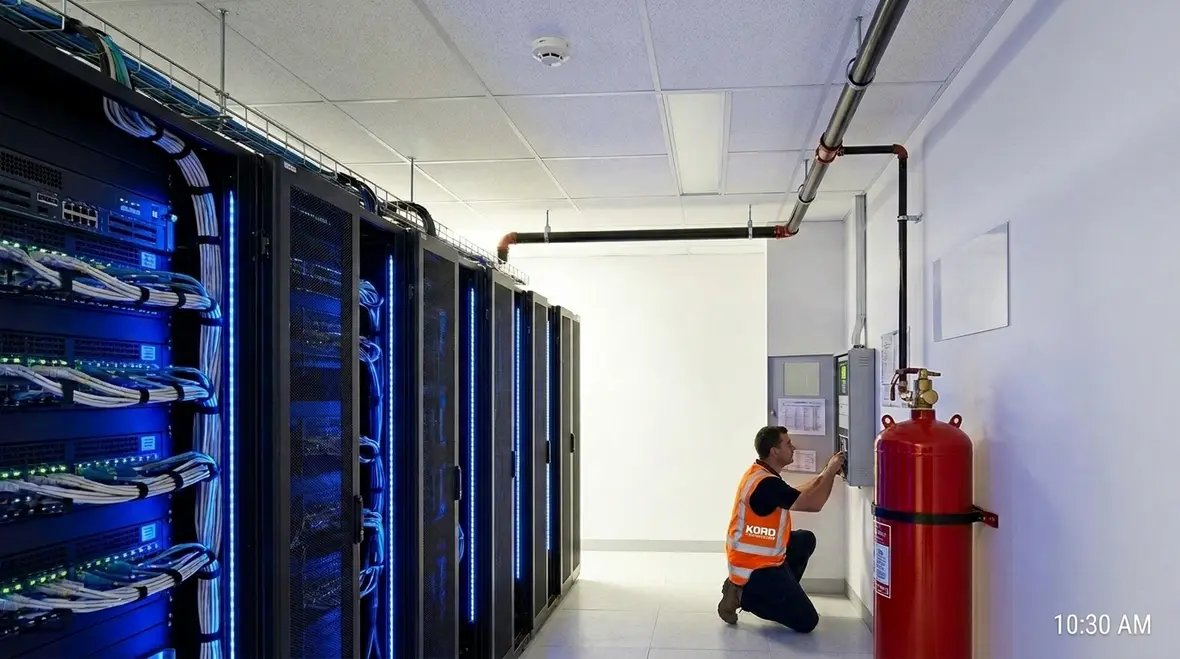
Once detection signals, suppression must act in the right place and for the right duration. In a data center, the biggest challenge often hides inside the structure of the space: dense racks, cable bundles, and airflow management create paths for smoke and heat to travel. So suppression must consider compartmentation, airflow direction, and the separation of risk zones.
Common approaches include clean agent systems for sensitive equipment areas and water based systems where appropriate for other hazards. However, selection should not rely on what worked in a different building. It should rely on the local fuel load, expected fire size, and the operational need to protect electronic assets while supporting safe evacuation.
To keep performance consistent, teams should plan for cylinder integrity checks, discharge testing where permitted, and control logic verification. Additionally, they should ensure the system design allows for safe system reset and clear procedures for staff. If the facility cannot recover quickly, it has not truly reduced risk. It has only delayed the problem. That is like pausing Netflix instead of fixing the Wi Fi. The story keeps going.
Where zone design earns its keep
Suppression zones should reflect how the site actually operates, not how a generic template says it should operate. Data halls, battery rooms, electrical interfaces, loading areas, and support rooms can carry very different hazards. When zones are drawn intelligently, teams gain a better chance of containing a problem without shutting down half the building for no good reason.
Compartment design and passive protection that contains smoke
Active systems win headlines, but passive fire protection does the quiet work. Fire doors, seals, penetrations, duct protection, and barriers help keep smoke and heat from racing through service corridors. In data halls, smoke control is often the difference between manageable conditions and a facility wide disruption.
Advanced strategy includes thorough sealing of penetrations where cables pass through walls and floors. It also includes reviewing subfloor or raised floor voids, because airflow in those spaces can carry smoke in unexpected patterns. Then, it should confirm that fire dampers, where installed, close correctly and that maintenance teams know how to inspect them.
Facility owners should treat passive protection as a living system. Contractors change routes, add services, and open voids. If the building changes and passive protection does not, the protection plan gradually becomes outdated. Transition words help here because the logic is simple: if the building evolves, the protection must evolve too.

Operational readiness: procedures, training, and drills that match the design
Even the best hardware fails if people do not know what to do next. Therefore, data center protection programs should include clear decision trees, roles, and communication steps. Staff must understand alarm categories, how to verify conditions safely, and when to initiate controlled shutdown procedures.
Training should focus on practical actions. For example, operators should know how to respond to suppression system alarms, how to coordinate evacuation routes, and how to handle unexpected conditions such as false alarms or partial system states. Drills should also cover how to keep critical processes running when allowed, and when to stop them to avoid making the fire bigger. That is not dramatic. It is disciplined risk management.
To improve results, facilities can run scenario based exercises that reflect their reality: peak occupancy, after hours work, contractors on site, and changes in airflow due to maintenance. The goal is to ensure the protection system and the human response work as one team. Otherwise, it is like having a seatbelt and refusing to buckle it. Technically, you have safety. Practically, you do not.
How Kord Fire Protection strengthens advanced programs
Kord Fire Protection can become a vital partner because advanced fire protection for data centers requires more than installation. It needs an approach that respects site complexity, schedules, and long term performance. Many industrial, retail, and commercial portfolios share the same pain points: tight access windows, multi-tenant constraints, and the need to keep operations stable during service works.
Kord can support teams by helping define protection strategy, coordinating system design considerations, and supporting inspections and maintenance that keep reliability high. In addition, a strong partner provides clear documentation, so stakeholders understand system status without decoding a technical novel. When teams receive consistent reporting and responsive support, they reduce downtime risk and avoid the last minute scramble before an audit or a shutdown. Readers who want a deeper look at lifecycle planning can also review the full lifecycle of fire protection servicing, which fits naturally with long term data center reliability.
Ultimately, a partnership means fewer surprises. It also means the facility owner can focus on uptime, while the protection team focuses on performance. And performance, as it turns out, is the thing fire tries to steal first.
Cost control without cutting safety corners
Budget pressure can tempt facilities to simplify too far. However, advanced protection often saves money by preventing downtime, damage, and emergency callouts. The smarter approach links system choices to risk, then prioritizes upgrades that reduce the most severe outcomes.
Facilities can control cost in a disciplined way by conducting gap assessments, then phasing improvements based on impact. For instance, replacing outdated detection coverage in the highest risk zones usually delivers faster gains than broad changes across every area. Similarly, targeted passive upgrades such as improved penetration sealing can reduce smoke spread with less disruption than major structural work.
Because maintenance drives long term costs, the facility should plan service schedules that align with production cycles. Transitioning maintenance away from high demand periods lowers operational friction. It also reduces the risk that systems sit untested during the very time conditions change.
Advanced fire protection planning: a dual column reality check
| What advanced teams assess | Why it affects performance |
|---|---|
| Smoke movement and airflow paths | It shows where suppression and detection must see the event early |
| Cable density and rack layout | It estimates fuel load and likely fire growth along equipment runs |
| Compartment and penetration integrity | It controls smoke spread beyond the origin area |
| Control logic and reset capability | It reduces downtime after an event or test |
| Training and drill realism | It ensures people act quickly and correctly, not emotionally |
FAQ
Final thoughts and next step
Modern data centers need fire protection that operates like a well run control room: early detection, targeted suppression, strong passive containment, and trained response. Teams should plan upgrades around real layouts, airflow behavior, and operational schedules. Kord Fire Protection can help turn that plan into dependable performance, so facilities protect people and critical systems without sacrificing uptime.
For a next step, facilities can start by reviewing current detection coverage, suppression zoning, passive barriers, and drill readiness against actual site conditions. Then they can bring in a partner that understands how those pieces connect. Reach out for an assessment and build a safer, smarter protection program now.

Join Our Newsletter!
Get the latest fire safety tips delivered straight to your inbox From our Newsletter.