Fire Escape Regulation 4 Compliance Made Simple
Are Your Fire Escape Assemblies Regulation 4 Compliant?
If you’ve ever looked at your building’s fire escape and thought, “Well, that ladder hasn’t been touched since the first Avengers movie came out,” it might be time to ask the real question: Are your fire escape assemblies Regulation 4 compliant?
For property managers, landlords, and anyone responsible for fire safety, Reg 4 compliancy under the Regulatory Reform (Fire Safety) Order 2005 isn’t just a line in a rulebook—it’s a critical benchmark. The experts at Kord Fire Protection have made it their mission to not only keep buildings safe but make sure you understand why staying compliant matters. And they explain it the way your favorite uncle might—with clarity, insight, and the occasional sly joke.
So buckle up—or rather, climb up—because we’re about to take a closer look at fire escape assemblies, compliance, and what happens when “I didn’t know” doesn’t cut it during an inspection.

Understanding Regulation 4: What’s Hiding Behind the Red Tape?
If Regulation 4 sounds like a lost Star Wars droid, you’re not alone. But in reality, Reg 4 of the Fire Safety Order is about maintenance—specifically, making sure all fire safety systems and features in a building are properly maintained to remain efficient and effective.
Now, here’s the zinger—most people assume this only covers fire alarms and sprinklers. But Kord’s technicians will be the first to shake their heads and calmly explain, “No, sir, that rusty fire escape covered in pigeon poop is absolutely included.”
Fire escape stairs, ladders, platforms, railings, hinges—they’re all regulated components. And just like that treadmill in the garage, they can’t protect anyone if they’ve been gathering dust and disappointment for five years. Regular inspections, documentation, and preventive maintenance are legally expected. Skip them, and you’re not just risking lives—you might be writing big checks or facing serious enforcement action.
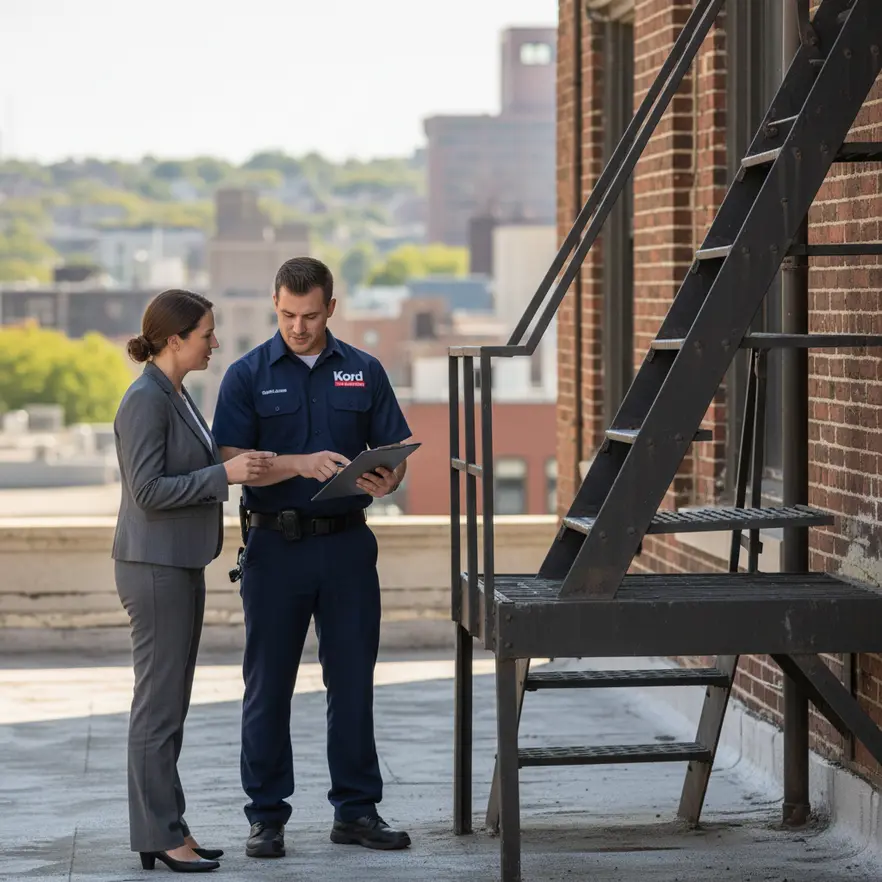
Signs Your Fire Escape Needs Some TLC (Or a Full Overhaul)
If your fire escape looks like an extra from a post-apocalyptic zombie movie, we’ve got some issues. Here are the less-than-subtle signs Kord Fire Protection technicians see often—and wish they didn’t:
- Corrosion: If your metal stairs double as a tetanus trap, it’s time for maintenance.
- Loose Bolts: That wobble isn’t a “feature.” It’s a liability.
- Obstructions: Storage boxes, plant pots, or decorative gnomes do not belong on fire escape routes.
- Structural Weakness: Sagging platforms or missing railing sections aren’t “quirky.” They’re dangerous.
The Kord team often finds the problem isn’t malice—it’s oversight. Out of sight becomes out of mind, until someone tries to run down a warped staircase during a fire drill and suddenly becomes the building’s canary in the coalmine.
How Kord Fire Protection Technicians Walk You Through Compliance
If your fire escape system feels like a puzzle box from a Saw movie, the good news is: you don’t have to decode it alone. Kord’s technicians are like the Morgan Freemans of fire safety—calm, authoritative, and incredibly good at breaking down complex things.
During a property assessment, a Kord technician doesn’t just point at faults like a stern school teacher. They explain why something matters, how it aligns with Regulation 4 obligations, and what steps would bring it back into compliance. It’s education without the intimidation.
Plus, they don’t upsell disasters. If a minor bolt replacement can solve a bigger issue, they’ll tell you. No Hollywood-level drama, just real-world, practical solutions. They’re informative allies, not doomsday prophets.

Don’t Just Inspect—Maintain: Making Compliance a Habit
Checking off “fire escape inspected” on a clipboard once a year is not the same as true compliance. Reg 4 specifies ongoing maintenance, which means regular, proactive action.
Here’s where routines come in—think of them like brushing your teeth, but for steel stairs:
- Monthly Visual Checks: Quick scopes for rust, debris, or damage.
- Quarterly Safety Inspections: Bolts tightened, hinges lubricated, steps tested.
- Annual Certification: A documented once-over by certified professionals like, you guessed it, the folks at Kord.
Don’t worry—you won’t have to keep 62 different spreadsheets. Many fire safety companies (Kord included) streamline documentation. This isn’t 1997; everything can live in the cloud now.
What Happens If You’re Not Reg 4 Compliant? (Spoiler: It’s Not Great)
Let’s take a page from “Final Destination” and explore the worst-case scenarios. If you’re caught lacking on Reg 4 compliancy? Well, here are the highlights:
- Enforcement Notices: The get-your-act-together letter from the Fire Authority.
- Fines: These aren’t small. We’re talking thousands, depending on the risk level identified.
- Legal Liability: In the event of an incident, your name leads the legal paperwork parade.
- Insurance Denials: “We won’t cover that” said no one in your time of need… until now.
And let’s face it—no one wants to be the person who had six reminders to fix the fire ladder and did squats instead. Compliance is cheaper than consequences. Every. Single. Time.
How AI Can Support Your Fire Safety Strategy
We live in a world with refrigerators that text us and vacuums with names. So why not plug AI into your fire safety efforts?
Modern building management systems, powered by real-time alerts, can now track maintenance schedules, generate compliance reports, and alert you when something’s off—before it gets dangerous. You can even log when a technician (like Kord) visits and what actions were taken.
This isn’t to replace the human eye, but let’s be honest—AI doesn’t take coffee breaks or get distracted by cat videos. It’s your digital fire warden working round-the-clock.
Have Tenants? Here’s What They Should (And Shouldn’t) Do
Fire escapes are not balconies. And no matter how photogenic it looks on a sunny day, that platform wasn’t built for wine tastings. Educating tenants is part of maintaining compliance.
Kord often provides property owners with smart-safe tips to pass along:
- Don’t Block It: Bikes, BBQs, and potting benches DO NOT belong here.
- No Tampering: If something’s loose or broken, report it—don’t fix it with duct tape.
- Respect Inspections: Kord’s techs aren’t just visiting for small talk. Give them access.
Improving tenant awareness creates natural checkpoints that support the broader compliance strategy. Every educated resident is a potential safety booster—not a blocker.
When Dual Columns Make Sense: Common Defects vs. Fixes
| Common Defect | Fix Provided by Kord Techs |
| Rust on treads | Rust-treated, sealed, and painted with thermal-resistant paint |
| Loose handrails | Secure with replacement fixings and reinforcements |
| Worn paint surface | Surface sanding and resealing done onsite |
| Stiff deployment ladder | Lubrication and spring mechanism calibration |
Future-Proofing: What’s Next in Reg 4 Compliancy?
Regulations evolve, because fire safety is not static. The climate changes. Building materials change. Even workplace dynamics—like hybrid work—shift evacuation needs.
Kord keeps its technicians trained on upcoming code revisions and safety trends. Biometrics for exit tracking? Smart-lock fire doors? Heat-sensitive UV coatings? They’re already exploring these options.
And no—Kord won’t show up in robot suits. Yet.
FAQs: Straight Answers for Real Questions
- What is Regulation 4 compliance?
It means maintaining all fire safety features—including fire escapes—so they remain safe and functional. - How often should fire escapes be inspected?
At least once annually by professionals, with monthly checks by the property team. - Is my landlord responsible for maintaining fire escapes?
Yes, under Reg 4, landlords and building managers must ensure all fire escape assemblies are kept in proper condition. - Can tenants report non-compliance?
Absolutely. Raise concerns immediately and, if needed, report to local fire safety or tenancy enforcement bodies. - Do fire escapes count as “equipment” under the law?
Yes. They fall under functional systems that need regular upkeep by law. - Can I DIY fix anything?
If it’s a loose screw, maybe. But for anything structural—call a pro. Kord recommends this firmly.
Make Smart Moves Now, Not Emergency Fixes Later
Your fire escape isn’t just a metal add-on—it’s a lifeline. So show it some love before it becomes a legal nightmare or Netflix documentary. Kord Fire Protection offers the kind of trusted, clear, and proactive support that ensures your fire safety systems are always Reg 4 compliant.
Let our experts take the stress off your shoulders by managing the inspections, documentation, and guidance you need. Reach out today—and climb confidently toward compliance tomorrow.

Join Our Newsletter!
Get the latest fire safety tips delivered straight to your inbox From our Newsletter.