Fire Alarm Wiring Safety for Long Term Reliability
Quick Answer: Long-term fire alarm reliability starts with how technicians route, terminate, and test wiring. Proper cable selection, safe installation practices, and disciplined testing reduce nuisance alarms and failures during an emergency. Businesses can protect assets and occupants by following strict Fire Alarm Wiring Safety procedures and ongoing maintenance.
In every industrial, retail, and commercial facility, the fire system must behave like a professional under pressure. It needs to detect early, signal clearly, and stay dependable for years, not months. That is why Fire Alarm Wiring Safety matters from day one through final commissioning and repeat inspections.
And yes, wiring faults are sneaky. They can hide behind tidy cable runs and “it seemed fine last time” attitudes. However, when a system fails, nobody laughs. So this article walks through what teams should do to optimize fire alarm wiring for long-term system integrity, and how Kord Fire Protection can become a vital partner for both service and job completion. For facilities that need immediate support, professional fire alarm services can help keep systems inspection-ready and dependable over time.
Start With Cable Planning That Prevents Future Headaches
Plan for route, environment, and future access
Before anyone pulls cable, teams should plan the route, the environment, and the life cycle of the system. Because every site has its own challenges, designers and installers should consider building layout, heat sources, vibration, moisture risk, and traffic areas. Then they should map cable paths that avoid hazards, sharp bends, and areas where other trades may later cut or reroute conduit.
To protect long-term integrity, they should also define cable type and rating early. In commercial and industrial facilities, it is common to see mixed pathways: trays, conduit, risers, and penetrations through fire-rated walls. Therefore, selecting the right cable for the setting helps prevent insulation breakdown, corrosion at terminations, and signal drift over time.
Transitioning from planning to execution also matters. If a team improvises during installation, it often creates hidden weak points. Those weak points tend to show up later as intermittent faults. And intermittent faults are like gremlins. You can spend hours chasing them, and then the moment the inspector arrives, the system acts perfect. That is not the plan.
A strong planning phase also makes later maintenance easier. When routes are logical and documented, technicians spend less time opening ceilings or tracing mystery circuits and more time solving the actual issue. That saves labor, reduces disruption to occupants, and cuts down on those awkward moments when everyone in the room pretends the unlabeled cable “probably goes somewhere important.”
Facilities that expect tenant changes, machinery upgrades, or phased renovations should think a few steps ahead. Leaving room for safe additions keeps future work from turning into a tangle of workarounds. Fire alarm wiring does not need drama. It needs order, consistency, and enough foresight to avoid becoming the building’s most expensive scavenger hunt.
Terminations, Labeling, and Separation That Hold Up Over Time
Precision at the endpoints matters just as much as the cable run
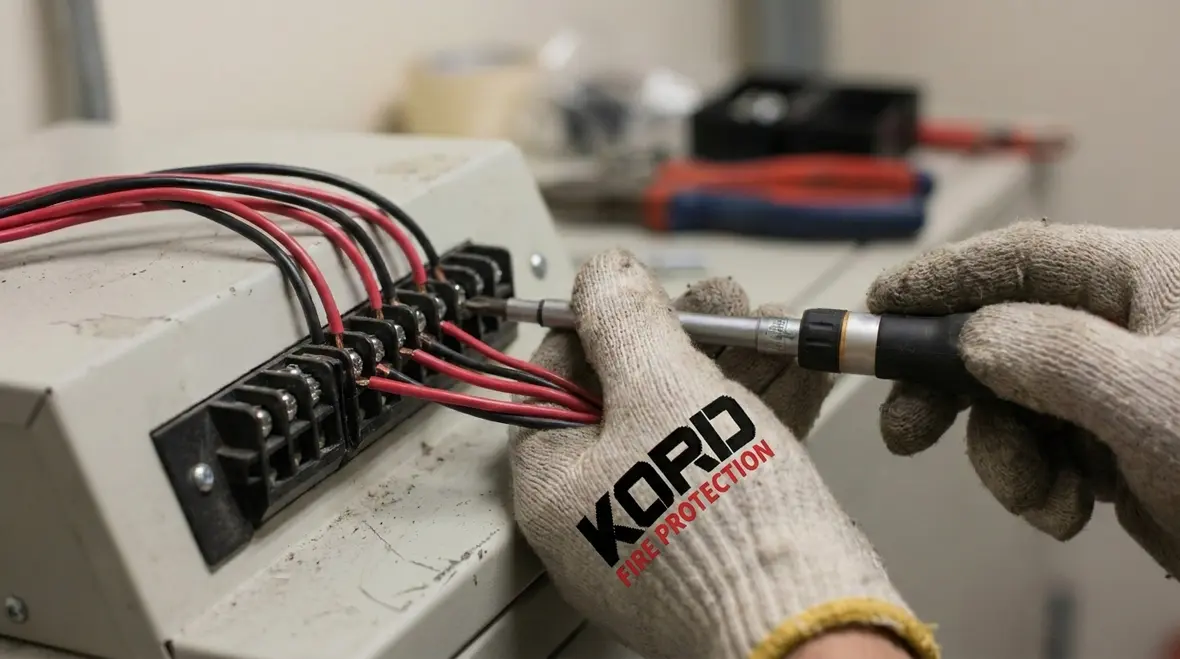
Once cables reach panels, devices, and junction points, the work shifts from “pull and place” to “precision and proof.” Fire alarm systems depend on consistent conductivity and secure connections. So technicians should use correct strip lengths, proper crimp or termination methods, and the right torque values where applicable.
They should also avoid practices that look fine but slowly fail, such as loose conductors under terminal screws or reusing damaged lugs. Over time, vibration in plant areas or routine building maintenance can loosen a marginal connection. As a result, the system may report trouble signals, or worse, it may fail to communicate.
Labeling is the quiet hero. When technicians document circuit identity, device location, and wiring paths clearly, future service becomes faster and safer. Moreover, a well-labeled system supports operational teams when they need to understand what changed and when. It also helps service providers trace issues without guessing.
Many facilities run multiple electrical systems side by side: power circuits, lighting, access control, and communications. Therefore, installers should think beyond the immediate connection and consider electromagnetic interference. When wiring runs too close or shares conduits improperly, the fire alarm system can pick up noise, leading to false signals or trouble events.
To optimize Fire Alarm Wiring Safety, teams should follow separation requirements, use proper segregation methods, and control how cable bundles are routed through shared spaces. They should also respect bend radius, avoid crushing cables, and prevent strain at terminations. If cables experience stress from installation shortcuts, the insulation can crack, and the system may only show symptoms under certain conditions like humidity changes or temperature swings.
In commercial sites, they also need to plan for expansions. Retail fit-outs, tenant upgrades, and new plant equipment often require new runs. So technicians should design cable pathways so upgrades do not force unsafe crossovers or risky “temporary” connections that become permanent. Nobody wants a permanent shortcut. That is how you get a system that behaves like it is haunted.
This is also where good service partners make a difference. Kord’s fire alarm monitoring guidance reinforces the idea that detection is only part of the story. Clean wiring and dependable signal paths help ensure the message gets where it needs to go when it matters most.
Protect Routes, Commission Thoroughly, and Keep Service in the Loop
Reliability depends on physical protection and real-world verification
Penetrations through walls and floors create a special risk. Smoke and fire can travel through gaps, and heat can degrade cable materials if the build-up is not properly sealed. Hence, installers should treat penetrations as part of the fire protection design, not just a way to “get through.”
Teams should use correct fire stopping materials and methods, and they should verify that sealing stays intact after installation. Additionally, they should protect cables in mechanical danger zones, such as where forklifts operate, where ladders get moved, or where plant maintenance creates frequent access.
In industrial settings, cable trays may face abrasion, and conduit may face impact. So technicians should select routes that minimize physical stress and then secure cables at appropriate intervals. This reduces movement, which in turn protects terminations and keeps the system stable during daily operations.
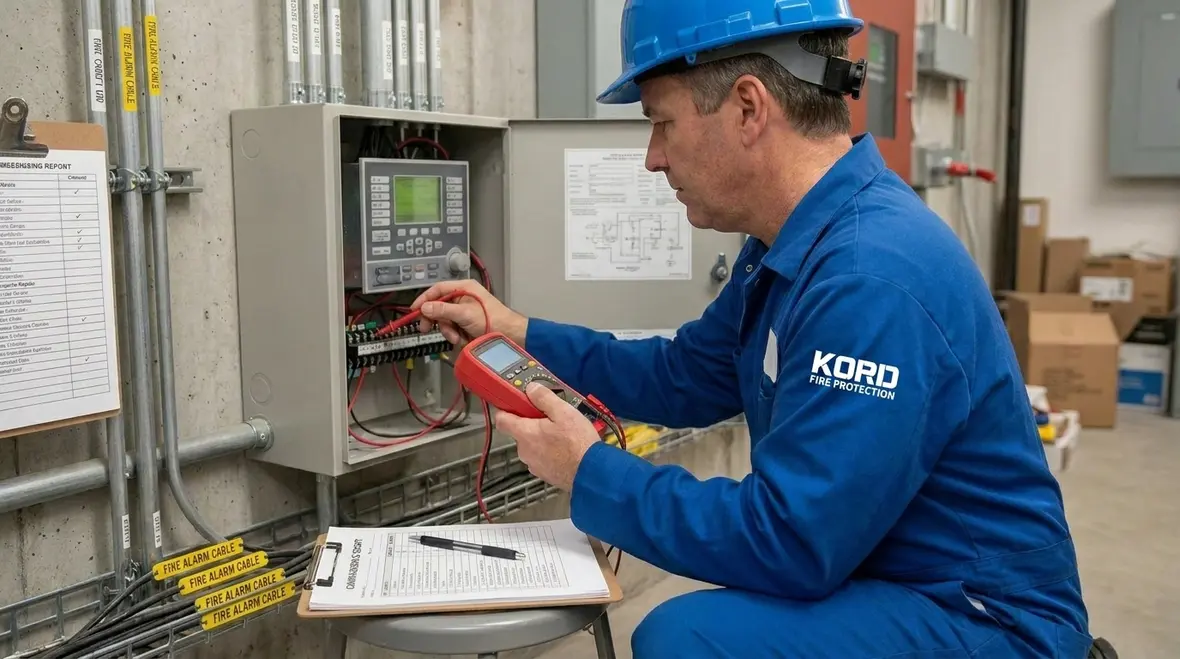
Optimizing wiring does not end after devices get mounted. Teams must test and commission the system so it performs under expected conditions. During commissioning, technicians should verify continuity, correct polarity where needed, and proper loop resistance values. They should also test device functionality, confirm panel responses, and document results clearly.
Furthermore, because system integrity changes over time, service plans should include periodic checks. Over the years, labels fade, devices get adjusted, and minor site changes happen. Therefore, routine inspections catch issues early while they are still small and repairable. This approach supports business continuity and reduces downtime linked to alarm faults.
Transitioning from commissioning to service also requires good change management. If a facility modifies equipment, adds circuits, or alters cable routes, it should notify the fire alarm service team. Otherwise, “temporary reroutes” can sneak into the system and weaken Fire Alarm Wiring Safety. And again, those gremlins return.
Even when an installation team does everything correctly, long-term success depends on ongoing support. Kord Fire Protection can act as a vital partner for service and job completion by providing disciplined commissioning support, structured maintenance, and clear reporting. Their broader view of the full lifecycle of fire protection fits naturally with the idea that wiring reliability is not a one-time task. It is a managed process.
A Dual Approach for Mixed Facility Types
Different buildings share the same goal, but not the same wiring risks
Industrial plants, retail centres, and commercial buildings share the same goal: dependable alerting in an emergency. Yet the wiring risks differ. Therefore, teams should use a dual approach that fits the environment. One side focuses on installation rigor, and the other focuses on service readiness.
| Facility type | Wiring integrity focus |
|---|---|
| Industrial | Route protection, vibration control, cable separation from noise sources, and frequent checks in active zones |
| Retail | Fit-out changes management, clean labeling for fast fault tracing, and stable pathways through shared ceilings |
| Commercial | Penetration sealing integrity, documentation for multi-tenant upgrades, and commissioning checks that match building operations |
As a result, facilities avoid a one-size-fits-all mindset. They instead build a system that fits the way the site actually runs. That practical mindset supports better inspections, fewer nuisance issues, and less backtracking after renovations or equipment changes.
It also improves communication between facility managers, electricians, fire alarm technicians, and general contractors. When everyone understands the purpose behind route protection, labeling, and testing, the project stays cleaner from start to finish. That is good for compliance, good for uptime, and good for everyone who would rather not discover a hidden wiring problem during a live emergency.
FAQ
Conclusion
Long-term fire alarm integrity comes from disciplined planning, careful termination work, protected routes, and testing that proves performance. When facilities build the right structure at install time, they reduce faults and keep response times reliable.
For ongoing confidence, partnering with Kord Fire Protection helps teams maintain wiring integrity, document changes, and stay ready for inspections. If a system needs service, updates, or commissioning support, reach out and get a plan in motion.

Join Our Newsletter!
Get the latest fire safety tips delivered straight to your inbox From our Newsletter.