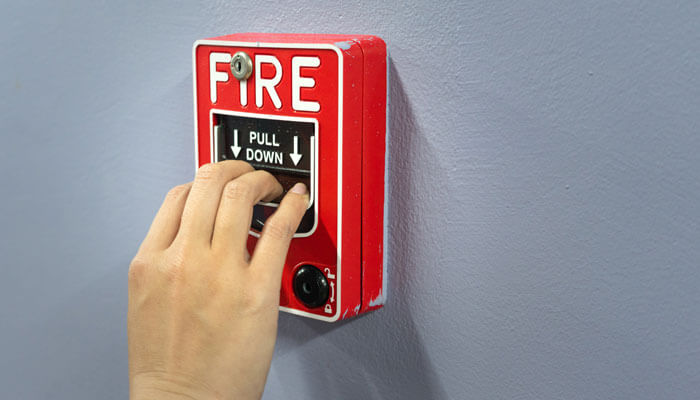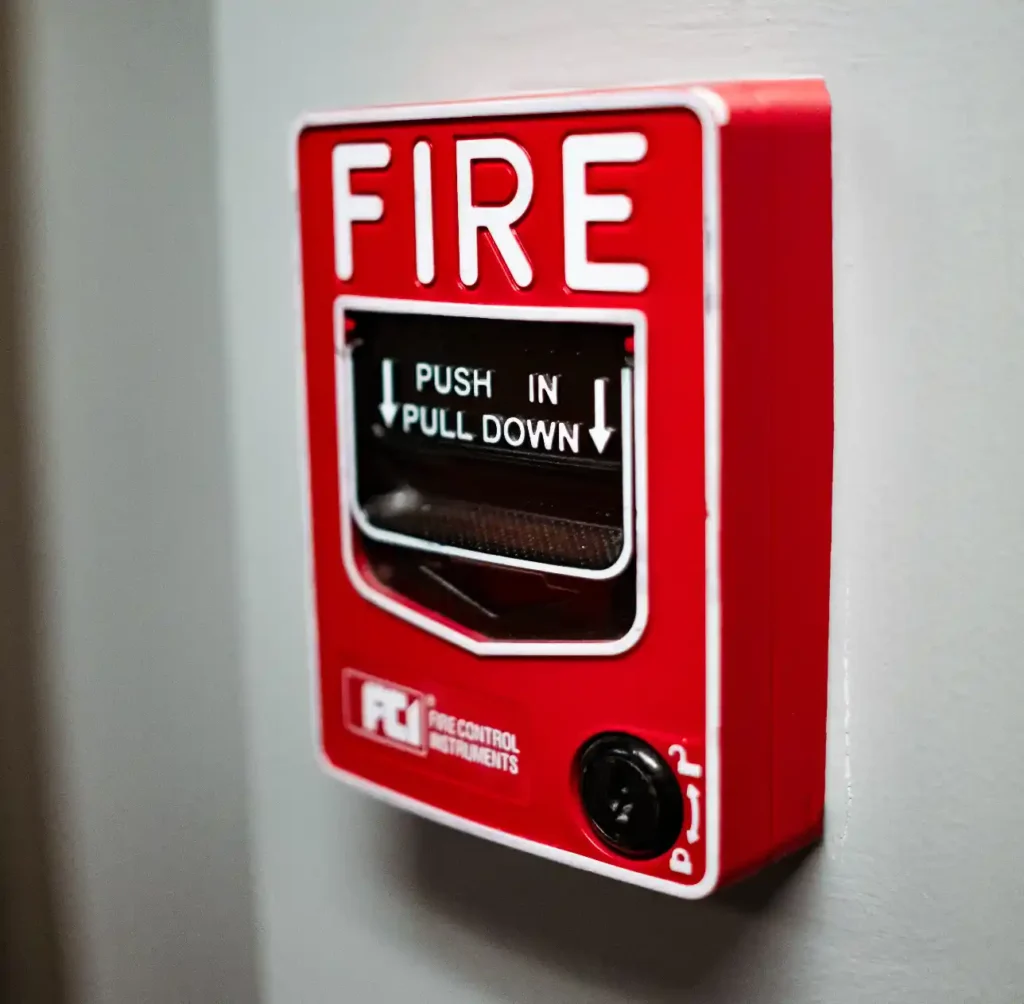
Fire Alarm System Power Redundancy for Outages
Commercial fire alarm systems do not get to “take a break” when the power flickers. That is why fire alarm system power redundancy matters early, and not just in paperwork. When a building loses utility power, the life safety equipment must stay awake, communicate, and trigger alarms without hesitation. In the first steps of planning, Kord Fire Protection technicians explain how engineers and electricians design backup power paths that keep circuits supervised, signals clear, and response times fast. In other words, the system keeps doing its job while everyone else is still wondering what caused the outage. And yes, it needs to do this even if the maintenance staff just missed the memo, or the building manager is blaming “the weather.”
What does power continuity mean for a commercial system?
Power continuity means the fire alarm system keeps operating through common disruptions, including utility outages, brownouts, and short interruptions during switching. Instead of relying on a single power path, the system uses controlled backup sources so notification appliances, control panels, and monitoring devices remain functional. Kord Fire Protection technicians often break it down like this: the control unit must stay powered long enough to interpret conditions, transmit alarms, and manage trouble signals. At the same time, the system must remain supervised, so it can alert staff to issues before they become emergencies.
In practice, this involves more than “having a battery.” The design must support the entire chain of operation. That includes the initiating devices that detect smoke or heat, the circuits that send signals, and the outputs that drive horns, strobes, and other notifications. If any part loses power without notice, the system becomes a silent bystander, which is not a fun role for life safety equipment. For buildings that also rely on monitored communication paths, a continuity plan works even better when paired with professional fire alarm monitoring that improves response time, because sending a fast signal still depends on having reliable power in the first place.
Why continuity starts at design, not after installation
A commercial fire alarm system is only as dependable as its weakest power component. That is why designers look beyond the panel cabinet and consider the whole operating sequence during a real event. They review standby demand, alarm current, communication pathways, and how the system reports trouble under stress. Waiting until final testing to think about redundancy is a little like buying an umbrella after the downpour has already won.
How redundancy keeps circuits alive during outages
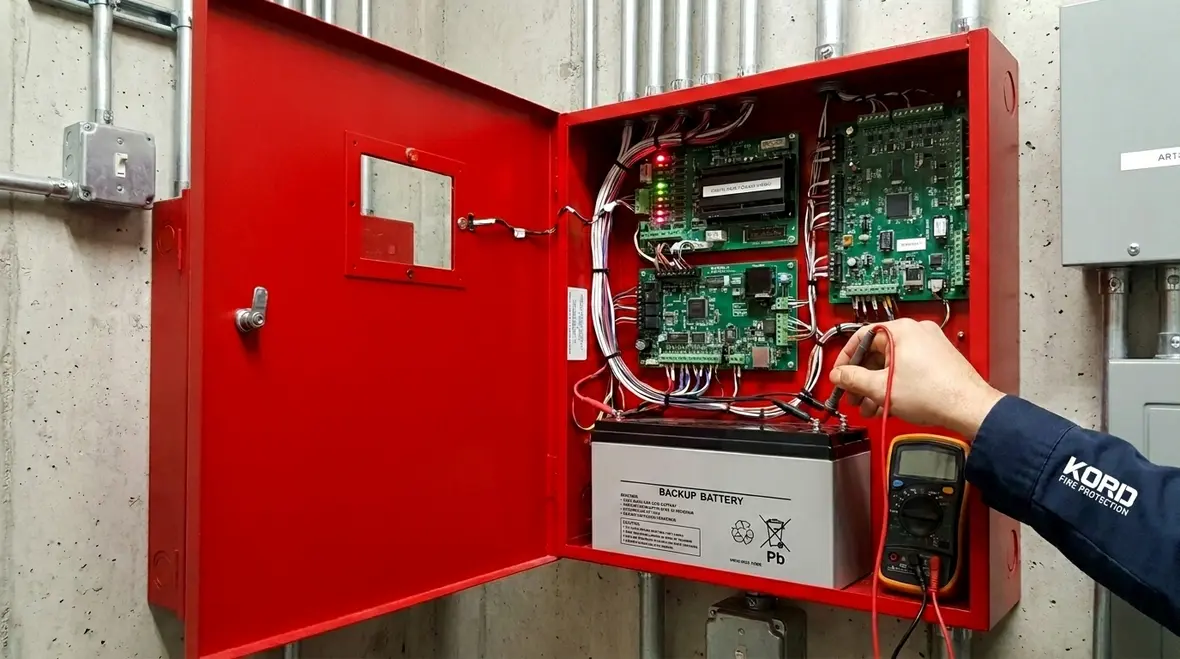
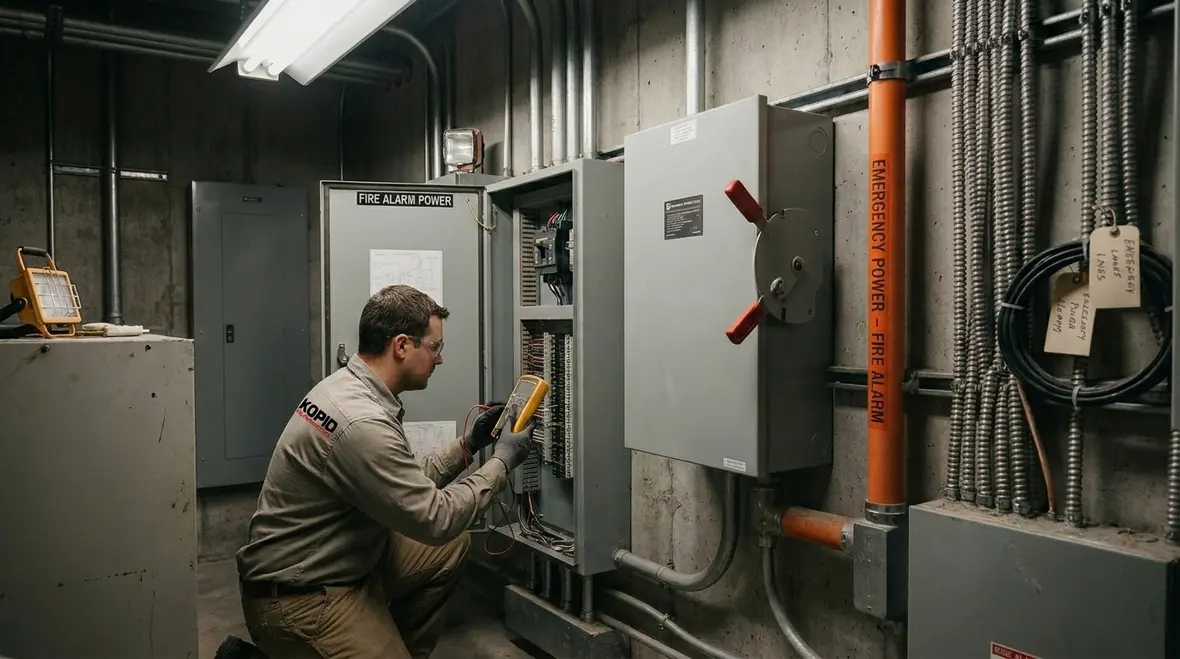
Fire alarm system power redundancy provides multiple ways for the system to receive power so failure in one path does not stop the whole system. Common approaches include commercial grade control panels with integrated standby batteries, separate charging circuits, and transfer methods that switch loads without dropping vital signaling. Additionally, some projects include generator support or monitored power distribution that feeds the fire alarm equipment through a dedicated path.
However, redundancy works only if it is designed as a system, not a collection of parts. First, the system must size batteries or backup power for the required standby and alarm durations set by the applicable codes and local authority requirements. Then it must ensure the charger capacity can maintain batteries after an outage. Finally, it must verify that supervision functions keep reporting status, so the panel does not just keep running, but also communicates that it is running on backup.
Multiple paths are useful only when they are coordinated
Redundancy sounds impressive on paper, but real performance depends on coordination between the panel, charger, transfer equipment, and distribution path. If one element lags or drops out at the wrong moment, the rest of the setup may look good while still leaving the building exposed. Kord Fire Protection technicians focus on that handoff between components, because that is where hidden failures love to wait quietly until the worst possible timing.
Why battery capacity and charger performance matter most
When power fails, the standby battery does the heavy lifting. Yet the battery is not a magic box. Kord Fire Protection technicians explain that battery selection, placement, and maintenance directly impact reliability. Batteries must handle the required load current for the time required by code, and the panel must manage the charge correctly. If the charger underperforms, the battery can sit at a weak state for months, then fail when it counts. If the charger overdrives the battery, it can age faster than planned.
To keep this from becoming a “works until it does not” situation, technicians check battery load calculations and verify installation details. They also confirm that terminals are tight, wiring is routed correctly, and ventilation supports safe battery operation. And while some building teams treat battery testing like a yearly chore, good teams treat it like a health check. The earlier a weakness shows up, the fewer alarms get handled by luck and coffee.
Small battery problems become big emergency problems
A battery issue rarely announces itself with dramatic flair. More often, it shows up as reduced standby time, weak output under load, or inconsistent charging behavior that gets ignored until testing day. That is why recordkeeping matters. Dates, ratings, replacements, and observed performance all help technicians spot trends before the system decides to surprise everyone at 3:00 a.m.
Transfer switches, supervision, and trouble reporting
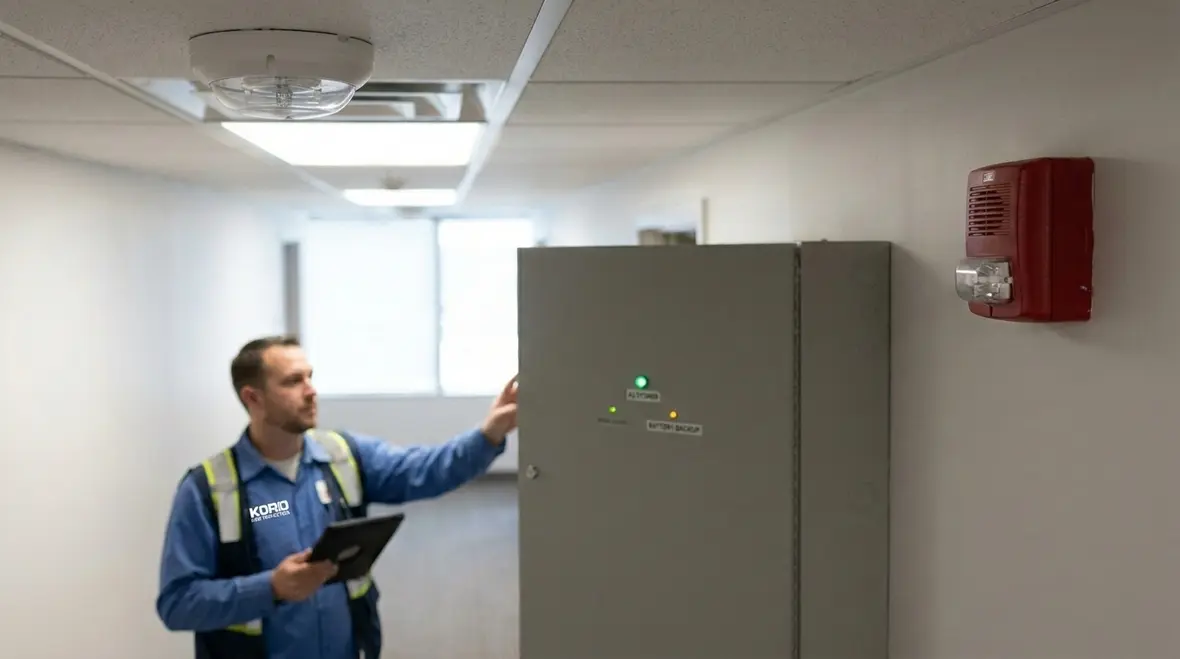
Power continuity requires smooth switching and clear supervision. If a system uses transfer equipment, it must switch from normal power to backup power with minimal disturbance to the control panel. Even a brief interruption can cause the panel to reset, which may delay outputs. Therefore, the design should ensure transfer behavior supports the operating profile of the fire alarm panel.
Supervision ties everything together. The panel must detect and report trouble conditions such as low battery voltage, charger failure, loss of AC power, open circuits, and ground faults. Importantly, these trouble signals must reach the monitoring path. If the building relies on offsite monitoring, the signals should travel through paths that also maintain power continuity.
As Kord Fire Protection technicians often say, trouble signals are the system’s way of raising a flag before the ship hits the rocks. When that reporting works, teams can correct issues without waiting for a real fire event to find out the system was unhappy. This is also where a dedicated fire alarm service and systems team adds real value, because fast repairs and proper supervision checks keep backup power from becoming a false comfort.
Power distribution and wiring practices that prevent hidden failures
Even with proper batteries and switching, poor wiring practices can sabotage power continuity. The fire alarm system depends on correct conductor sizing, proper terminal torque, clean connections, and routing that avoids damage. Loose connections can create voltage drops under load, and that can reduce notification appliance performance at the worst time.
Good teams also manage electromagnetic interference and physical protection. If wiring routes too close to noisy power cables, signals can degrade. If conduits get damaged, insulation can fail. That is why technicians look at the whole pathway from power sources to the control equipment and out to the devices. They also confirm that any dedicated power circuits stay dedicated, with no shared loads that create unpredictable surges.
In the field, this is where “we thought it was fine” becomes “why did the strobe pattern act weird during the test.” The fix is not guesswork. It is documentation, verification, and consistent installation standards.
Redundancy in real projects: what a Kord technician checks
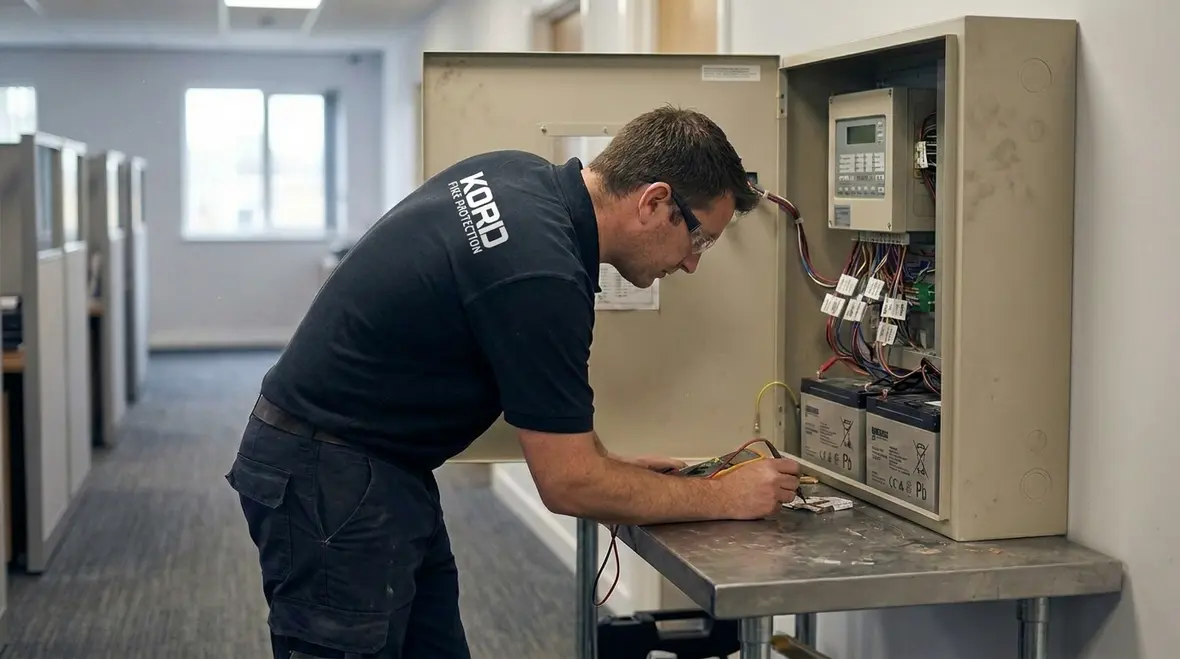
Kord Fire Protection technicians approach power continuity with a practical checklist mindset. They do not just observe; they validate how the system performs under realistic conditions. They also coordinate with electricians and facility teams so nothing falls through the gaps between disciplines.
Common checks that support fire alarm performance
Power source readiness
- AC power monitoring and loss behavior
- Battery sizing against required standby and alarm time
- Charger output and charging method
- Transfer switch operation and timing
System supervision and load stability
- Panel trouble reporting paths
- Voltage drop checks under alarm load
- Notification appliance circuit supervision
- Wiring integrity and terminal condition
After these checks, technicians also confirm that testing methods align with the system design. They verify that the panel reports the right events, communicates correctly, and powers outputs at the right levels. In short, they make sure the system behaves like it was designed, not like it is improvising. Because improvisation in life safety can be funny in movies, but it is expensive in real buildings.
Maintenance and testing schedules that keep redundancy trustworthy
Redundancy is not a one time install feature. It is an ongoing commitment. Batteries age. Chargers drift. Connections loosen. So the most effective plan includes scheduled inspection and testing that targets power paths, not just visible device performance.
At a minimum, maintenance teams should review system records, confirm battery condition, and test reporting to the central monitoring path if used. They should also verify that trouble indicators work and that system logs show expected behavior during test events. When technicians replace components, they should document ratings, installation details, and dates so future teams can track performance trends.
Transitioning from reactive fixes to planned maintenance reduces downtime and surprise failures. It also keeps the building compliant. And compliance, unlike pop culture characters, does not rely on “plot armor.”
FAQ
Conclusion and next step
Commercial fire alarm systems must keep operating when power stops behaving. That is the real value of fire alarm system power redundancy, backed by correct battery sizing, strong charging, reliable switching, and clear supervision. Kord Fire Protection technicians help teams avoid hidden failures by validating how the system performs, then supporting it with practical testing and maintenance.
If this matters for your building, schedule a power continuity review with Kord Fire Protection and explore their full fire protection services for broader system support. You will get clarity, safer operations, and fewer “we will handle it later” moments.

Join Our Newsletter!
Get the latest fire safety tips delivered straight to your inbox From our Newsletter.