Building Height and Density Impact Voice Evacuation Systems
Introduction: When High-Rise Meets High Stakes
If you’ve ever walked through Downtown Los Angeles and tilted your head to look up at the towering skyline—carefully avoiding stepping into a rogue food cart—you know high-rise buildings come with big expectations. But beyond the glass facades, sophisticated elevators, and rooftop pools lies a serious challenge: voice evacuation requirements in Downtown Los Angeles have to be surgically precise due to the area’s building density and vertical complexity. These aren’t your average suburban fire alarms. Here, things need to be smart, loud, clear, and fast. Kord Fire Protection technicians have spent years untangling this dense web of rules, cables, and high-decibel peccadilloes, guiding clients like patient sherpas up Mount Compliance.
The Concrete Jungle Problem: Building Height Isn’t Just a Number
Take a guess. What’s harder: climbing a 40-story building or designing a notification system that covers it all, top to bottom, flawlessly? If you guessed the second, you’re either a fire safety nerd or a Kord technician. Building height directly affects how emergency alerts are delivered. In a high-rise, sound doesn’t naturally travel upwards or downwards effectively. And no, cracking a window won’t help. Gravity is no friend to audio clarity, especially when sirens and alarms need to go stairwell-deep and penthouse-high.
Voice evacuation systems in tall buildings must be engineered to overcome vertical audio decay, delay propagation, and tenant confusion. The higher you build, the more zones you segment. Think of it like a Netflix server network: the larger the spread, the more delicate the synchronization. With overlapping sirens and distorted messages, panic can escalate faster than a Hollywood rumor.
Density: Where Chaos Meets Opportunity
We’re not here to villainize density. After all, density built cities, boosted economies, and gave us the miracle of 24/7 taco delivery. But in terms of evacuations, density creates a unique cocktail of problems. Too many people in too tight a space can make average notification systems buckle under pressure.
In tightly packed buildings, cross-talk between systems, echo from hard surfaces, and delays caused by multiple channels can cause confusion. In LA’s dense downtown corridor, it’s not uncommon for a single building to house restaurants, offices, gyms, residential units, and even an AI startup hacking away at digital immortality. Each service zone has different noise patterns and structural materials, demanding zone-specific sound calibration and customized speaker placement.
Kord technicians handle this matrix with ninja-level coolness—mapping floor plans, running decibel tests, and making sound decisions (pun proudly intended) for individualized system slices.

Why One-Size-Fits-All Could Get You Fined (Or Worse)
Your building is not a glorified shoebox. Standard fire alarm templates just won’t cut it. Failing to meet voice evacuation requirements in Downtown Los Angeles isn’t just a slap on the wrist; it’s a code violation that could cost thousands—or worse, delay occupant evacuations when seconds matter.
Here’s where most DIY developers fall flat: assuming that sprinklers and an alarm bell are enough. Uh-uh. Not in LA. NFPA 72 (for the non-nerds, that’s the National Fire Alarm and Signaling Code) has stringent rules about intelligibility, audibility, speaker survivability in fire conditions, and battery backup durations. And the LAFD? Let’s just say they’re the Gordon Ramsays of building compliance—they notice everything.
Kord Fire Protection technicians walk clients through these mistakes before the fire marshal does. Because let’s be honest, nobody wants a surprise inspection with a side of shutdown.
A Tale of Two Towers: How Location Shapes System Strategy
Tower A: Residential Magic
A 32-floor luxury apartment in LA Live. Residents include influencers, crypto bros, and a dog with more followers than you. Voice systems here must consider domestic noise, closed bedroom doors, and early morning yoga music. Kord techs used low-profile speakers with auto-adjusting volume based on ambient sound levels—making sure “Evacuate now” was louder than “Namaste.”
Tower B: Office Realism
45 floors of executives, coffee machines, and fictional deadlines. Because of the constant hum of HVAC and conference room chatter, this building needed directional speakers and higher wattage amplifiers. Integration with building management systems ensured smooth overrides during emergencies, turning down white noise while ramping up critical alerts.
Bigger Buildings, Bigger Brains: The Tech Evolution Behind Voice Systems
Okay, so we all love a good retro vibe. Vinyls are back. Polaroids earned cool points. But nobody—and we mean nobody—wants a 1990s fire alarm panel in a 2025 skyscraper. The paradigm has shifted. Voice evacuation systems have evolved along with urban architecture. And thank the fire gods, because yesterday’s solutions could never handle today’s complexities.
Modern buildings use intelligent fire panels that analyze audio quality by zone in real-time. Add to that self-diagnosing amplifiers, digital audio storage for pre-recorded multilingual messages, and fiber-optic backup pathways, and you’ve got a setup smarter than your average smart home. When the power goes out, systems switch to battery mode faster than you can say “grid failure.”
Kord technicians, fluent in tech and fire code dialects alike, keep these systems humming with graceful maintenance and savvy upgrades. Their motto? “Silicon Valley brains. Brick-and-steel toughness.”
The Human Factor: Designing with Real People in Mind
Systems don’t evacuate the building—people do. If systems fail to account for human behavior, they’re about as useful as a broken espresso machine on a Monday. Research (and recurring Fire Drill Fridays) shows people freeze when they don’t fully understand alarms. Panic. Delay. Snapchat stories. The works.
This is why voice clarity is king. Messages must be clear, concise, bilingual (sometimes even trilingual in Downtown LA), and free from ambient distortion. Kord technicians partner with behavioral consultants to finetune messages, spacing, and pacing. The result? Fewer deer-in-headlights moments, more feet on stairwells heading for exits.
Integrating Smart Systems Without Overcomplicating Life
Smart buildings love to flex their tech. Motion sensors, temperature regulation, touchless entry—even the trash bins send status updates now. But over-integration is a real danger. Overlapping notification systems can confuse residents and cause signal interference. When it’s April 10 and your “test message” sets off the HVAC voice alert and the security PA simultaneously… someone’s calling building management in ALL CAPS.
Kord designs with simplicity in mind: integration where it makes sense, separation where it doesn’t. They isolate emergency messages from facility notifications and run frequent overlap simulations—because nothing should drown out the phrase “Exit immediately.” Not even robot janitors announcing their cleaning route.
Fine-Tuning: The Art (and Science) of Sound Mapping a Megastructure
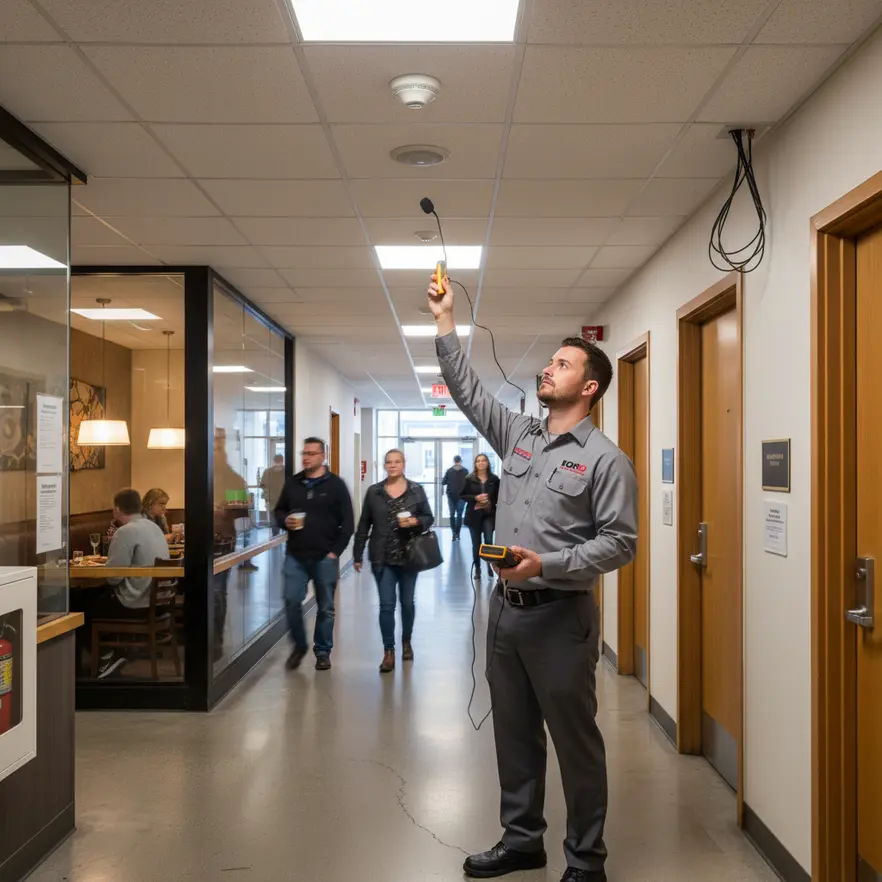
Imagine tuning a guitar. Now imagine tuning 300 speakers in 40 zones across 60 vertical feet. All with bouncing echoes, multiple ceilings, and real people moving around. Welcome to sound mapping. This is the diagnostic phase where Kord’s techs earn their coffee. They test audio drop-off points, pinpoint dead zones, and recalibrate speaker direction with laser-focused precision.
They also check for audio drift over time. Yes, even high-end speakers start to slur with age—kind of like your uncle after eggnog. Routine recalibrations ensure whispered exits never become shouted chaos.
FAQ: Quickfire on Voice Evacuation in Downtown LA
What are voice evacuation requirements in Downtown Los Angeles?
They involve specific design criteria for clarity, zoning, language support, and integration, based on NFPA 72 and local LA codes.
Why does building height affect voice evacuation system design?
Taller buildings require more zones and amplification to cover vertical distances without sound distortion.
Does density really interfere with emergency notification?
Yes. High occupancy areas generate more noise and can cause echo and confusion without zoned sound distribution.
Can my system be integrated without messing up other features?
Absolutely. With proper design, integration enhances, not hinders. Just avoid over-complication.
How often should I test my voice alarm system?
At least annually, plus after any major structural or system changes.
Is bilingual messaging required?
In many Downtown LA buildings, yes. It improves clarity and legal compliance.
Conclusion: Don’t Leave Safety to Chance, or to That Outdated Alarm Panel
Downtown Los Angeles is reaching higher and packing tighter every year—and that means your emergency voice systems need to do more than buzz and blink. Whether your building is 5 stories or 50, getting the voice right saves time, lives, and liability headaches.
Reach out to the passionate, people-first team at Kord Fire Protection. Let the experts in tailored, high-tech solutions walk you through every decibel of compliance. Your voice evacuation plan should sound as smart as your building looks.
Know Your Weapon Before You Fight the Flame
Kord Fire Protection is your go-to when it comes to all things fire protection. For over 20 years, we’ve been serving Southern California with the quality service and equipment to keep your home or business safe at all times. Our competitive prices reflect our unwavering commitment to protecting what matters most in the event of a fire emergency. Give us a call, send an email, or use that form!

Join Our Newsletter!
Get the latest fire safety tips delivered straight to your inbox From our Newsletter.