Automated Suppression Integration with Smart Building Controls
Quick Answer
Quick Answer (50 words)
Automated suppression integration connects fire suppression system actuation with smart building controls like BMS, BAS, and alarm panels. It helps facilities in Australia reduce response time, improve coordination, and maintain compliance. Kord Fire Protection can act as the vital partner that designs, integrates, tests, and supports the whole setup.
Automated suppression integration with smart building controls moves fire safety from a reactive checkbox into a coordinated, always watching system. Early in the plan, Kord Fire Protection can become a vital partner by aligning suppression logic, detection events, and building control signals so they work as one reliable process. And yes, that means fewer “mystery trips,” fewer late-night tech visits, and fewer meetings that start with, “So… the panel is confused.”
In Australia, industrial sites, retail centres, and complex facilities need systems that respond fast and communicate clearly. Therefore, this article explains how integration works, what matters during design and commissioning, and how Kord Fire Protection supports the job from planning through ongoing service.
Near the top of the article, it is worth noting that related fire alarm services and systems often fit naturally into this kind of project, because suppression integration rarely succeeds in isolation when detection, notification, and coordinated control all need to work together. For broader context around connected life safety planning, Kord Fire Protection also covers fire alarm service as part of integrated facility support.

How automated suppression and building controls work together
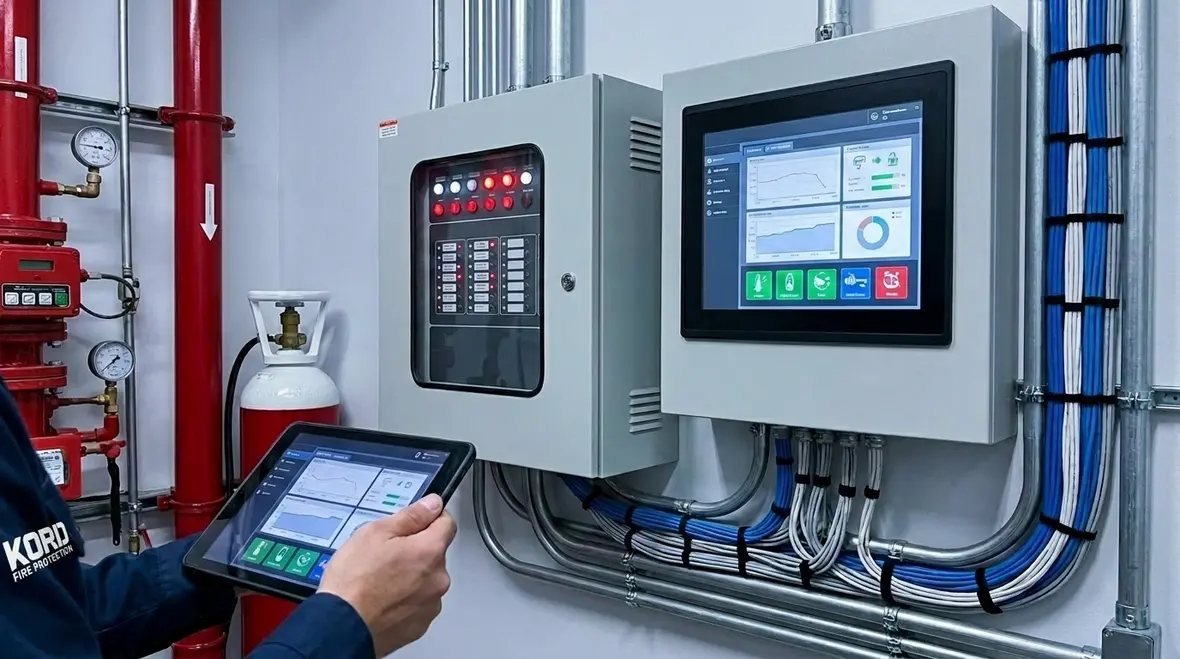
Smart building controls typically include a Building Management System (BMS), Building Automation System (BAS), and integration gateways that manage alarms, fans, dampers, and emergency interfaces. Automated suppression adds another layer: the system must activate suppression while coordinating the surrounding building actions.
When designed correctly, the process looks like this. Detection triggers an alarm condition. Then the control layer validates the event and starts the suppression sequence according to the approved cause and effect logic. At the same time, the system drives related building outputs such as door releases, smoke management control, or shutdown of non essential equipment.
To keep everything safe, the integration uses clear rules, time delays where required, and supervised status signals. If the building control system and the suppression system talk in the same “language,” operators get fewer surprises and maintenance teams get clearer diagnostics. In short, the system reduces chaos, not just fire risk.
Why coordination matters beyond the panel
That coordination matters because the suppression event is rarely the only thing happening in the space. Air handling may need to change state. Access controls may need to release. Certain machines may need to stop. Staff may need clearer information than a blinking light and a hopeful shrug. A properly integrated setup turns these moving parts into one process instead of a pile of expensive opinions.
Integration design for industrial, retail, and multi use facilities
Different occupancies create different hazards and control needs. Industrial sites might involve dust, flammable liquids, or high bay storage. Retail areas face large open spaces, concealed voids, and high customer loads. Multi use facilities often combine many zones, multiple levels, and complex airflow paths.
Therefore, the integration design must map detection zones, suppression zones, and control zones. It also needs to account for how the building behaves in an event. For example, mechanical ventilation might increase oxygen to a growing fire, or smoke fans might push smoke toward escape routes if they start at the wrong time. A proper design prevents that by sequencing actions with suppression and alarm states.
During the engineering stage, Kord Fire Protection helps align the suppression system integration with real site workflows. That includes how staff respond, how plant equipment shuts down, and how emergency services interfaces operate. The goal stays the same: suppression triggers correctly, building controls react predictably, and documentation stays audit ready.
Cause and effect logic: the part people skip at their peril
Cause and effect logic defines what happens after a detection or alarm state change. Many projects treat this like a formality. However, in integrated fire suppression system integration, it is the heart of the job.
A sound logic design includes these elements. It identifies which detector zones lead to which suppression zones. It specifies what the control system must do immediately, what it must do after confirmation, and what it must never do during an event. It also defines interlocks, such as maintaining proper ventilation state or preventing conflicting commands.
Additionally, the logic should reduce false activations without weakening safety. For instance, supervisory signals help confirm equipment readiness, while controlled delays support nuisance filtering where permitted by the design. If someone changes the building automation configuration later, the integrated logic should still protect the system intent.
And yes, people do change configurations. Often they do it on a Friday. So the cause and effect design should survive real world maintenance.
What good logic documents usually capture
- Which detection events start which responses
- What delays are required and why
- Which outputs must never conflict
- How faults, disables, and supervisory states appear to operators
- How future changes are reviewed before anyone “just updates a point”
Communication methods and system boundaries that stay safe
Integration can happen through different pathways, such as alarm panel interfaces, BACnet gateways, relay based I O, or dedicated integration controllers. Regardless of the method, clear boundaries matter. The suppression system should not depend entirely on the BMS for life safety actuation.
In most robust setups, the fire detection and suppression panels maintain primary control. Meanwhile, the smart building layer receives status and triggers non critical coordinated actions. That separation prevents a situation where a network issue, power fluctuation, or misconfiguration disrupts suppression performance.
Therefore, the installation should include supervised communications, monitored faults, and defined fail safe behavior. When a signal fails, the system should fall back to a safe state and alert maintenance. In addition, the design must handle restarts, firmware updates, and commissioning changes without breaking event sequencing.
Kord Fire Protection supports this by helping teams define integration points, test communication paths, and verify the cause and effect results match the approved intent.
Commissioning and testing: prove it works before the fire does
Integration without strong commissioning is like writing a fire drill plan and then ignoring it. For automated suppression integration, commissioning should include end to end testing of detection, alarm signaling, suppression actuation, and building control outputs.
That means testing in controlled sequences. It verifies that the suppression triggers at the correct state. It confirms that associated fans, dampers, doors, and shutdown circuits move to the correct position. It also checks timing, because seconds matter and delays can create unintended conditions.
Further, commissioning should include documentation that auditors and insurers can follow. That includes cause and effect matrices, interface point lists, and test results by zone. In multi tenant retail or industrial parks, teams also need coordination for access, downtime, and after hours testing.
Kord Fire Protection typically emphasizes a structured acceptance approach. It helps the project team confirm reliability, not just functionality in theory. Then the facility gains a system that performs under pressure, which is the only kind of performance that matters.
Commissioning details teams should not rush
- Zone by zone verification
- Output timing checks
- Fault simulation and fail safe response review
- Reset and recovery confirmation
- Final documentation that matches what was actually installed
Ongoing service, monitoring, and upgrades without breaking the chain
After handover, integrated systems still need care. Facilities change layouts. Tenants swap equipment. Controls get tuned. Therefore, the integration plan should include ongoing service practices and a clear change management process.
Good service includes regular inspections, functional testing schedules, and monitoring of faults or degraded signals. It also includes reviewing logs to detect patterns like repeated interface faults or recurring supervisory events. If the building automation system updates, the facility needs a verification plan to ensure suppression logic and building outputs still align.
Upgrades also need planning. For example, when a site expands a production line, new detection zones may require new suppression coverage and updated cause and effect logic. If the facility adds new air handling units, smoke management sequences need review to prevent conflicts during an alarm.
Kord Fire Protection can serve as the vital partner over the lifecycle, helping teams keep the suppression system integration stable while still allowing growth.
Common integration challenges in Australian facilities
Large Australian industrial and commercial sites often face practical obstacles. Distance between equipment rooms and suppression zones can complicate wiring runs and signal integrity. High ambient conditions may affect controls and require careful selection of components. Existing buildings may already have legacy panels and older BAS platforms.
Furthermore, facilities often operate with strict downtime limits. That pushes teams to schedule testing carefully and manage commissioning in phases. In retail centres, integration must also consider customer safety, evacuation flow, and after hours commissioning windows.
Then there is documentation reality. Project teams sometimes inherit incomplete as built drawings, unclear zone mapping, or inconsistent naming conventions. That is where a disciplined integration process saves time and avoids confusion during future service visits.
Kord Fire Protection helps address these issues by supporting integration planning, validating zone mapping, and ensuring test documentation stays clear. In other words, the system stays understandable long after installation day.
FAQ
Conclusion and call to action
Automated suppression integration with smart building controls strengthens coordination, reduces uncertainty, and improves response performance across industrial, retail, and multi use facilities in Australia. To make it work reliably, teams need the right cause and effect logic, safe communication boundaries, and end to end commissioning.
Kord Fire Protection can become your vital partner for integration design, testing, and lifecycle support. Contact Kord Fire Protection today to plan the job properly and keep your facility safer.

Join Our Newsletter!
Get the latest fire safety tips delivered straight to your inbox From our Newsletter.