
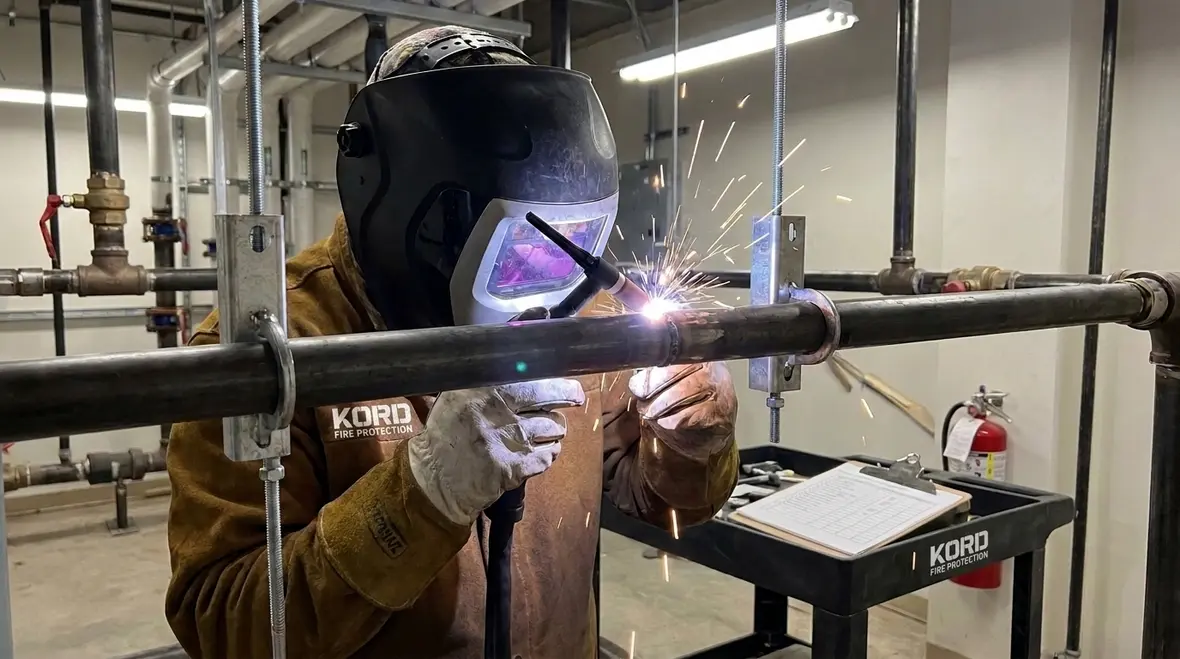
Welding and Brazing Water Spray Piping the Right Way: NFPA 15 Section 5.5
Quick Answer
NFPA 15 Section 5.5 sets the expectations for how water spray system piping is joined so the system performs reliably. Proper welding or brazing qualifications, approved joining processes, and correct inspection and testing prevent leaks, loss of pressure, and premature component failure in commercial environments.
The joining method for water spray piping directly affects system integrity, installation speed, and long term maintenance cost. For facilities that operate under strict uptime requirements, the compliance risks are not theoretical. Poor welding or brazing quality can cause micro leaks, tube distortion, corrosion acceleration, and inaccurate hydraulic performance. NFPA 15 5.5 joining pipe fittings welding brazing grooved qualifications provides the framework for installers and inspectors to verify that joints meet the standard before the system ever goes into service.
For teams reviewing broader component requirements early in the project, it also helps to look at NFPA 15 Section 5.1 general system components requirements so the joining discussion fits naturally into the bigger system picture.
Why NFPA 15 5.5 Joining Matters in Water Spray Fixed Systems
Water spray systems rely on dependable piping hydraulics and tight pressure boundaries. When joining fails, the problem often shows up later during flow testing, overhead maintenance, or after temperature cycling. In commercial, industrial, and retail settings, that delay can turn a fixable defect into a disruptive outage.
NFPA 15 5.5 focuses on joining practices that protect:
- Pressure retention so the system maintains design flow and pressure during operation.
- Mechanical stability so joints do not crack, loosen, or deform under thermal movement.
- Corrosion resistance so internal and external surfaces do not become initiation points for failure.
- System inspection readiness so the authority having jurisdiction and facility maintenance staff can verify installation quality.
For system owners, the practical takeaway is simple: joining qualifications and workmanship are part of life safety system performance, not a purely technical formality. If a facility uses contractors who cannot document welding or brazing qualifications and procedures, compliance becomes an ongoing operational risk.
What NFPA 15 5.5 Requires for Welding and Brazing Qualifications
NFPA 15 Section 5.5 addresses how water spray piping joints are made and how those joints are evaluated. The standard expects that installers can demonstrate that welding and brazing are performed using qualified personnel and approved processes. It is not enough to “know how.” The facility needs evidence of qualification, correct procedures, and outcomes that withstand inspection.
In practice, compliance programs typically need to cover these elements:
- Qualified welders or brazers with documented competency relevant to the piping material and joining method.
- Approved welding or brazing procedures that match the pipe type, schedule, diameter, and intended service conditions.
- Control of heat input to prevent overheating, warpage, or metallurgical degradation.
- Proper surface preparation including cleaning and removal of contaminants, oxides, and oil prior to joining.
- Correct joint design and fit up so the joint geometry supports strength and leak tightness.
If the facility also uses grooved couplings, NFPA 15 5.5 joining pipe fittings welding brazing grooved qualifications becomes the controlling phrase for coordination. Grooved joining does not remove welding and brazing expectations. It adds a parallel documentation and inspection layer for coupling compatibility, groove integrity, and assembly procedures.
How Welding and Brazing Should Be Performed to Avoid Common Failure Points
Typical operational failure modes from poor joining
Most water spray piping failures trace back to preventable workmanship issues. During commissioning or later maintenance, the symptoms may look unrelated, but the root causes often originate at the joint.
- Incomplete penetration or lack of fusion that creates weak sections and eventual cracking.
- Overheating that damages base metal properties and reduces ductility.
- Porosity and contamination from poor cleaning, improper shielding, or moisture exposure that reduces integrity.
- Excess braze alloy or poor wetting that leads to flow restriction and leak paths.
- Distortion that introduces misalignment, excessive stress, or stress corrosion conditions.
- Blocked or constricted openings that change the hydraulic behavior of adjacent components.
Fit up, alignment, and inspection readiness
Commercial installers often face time pressure, overhead access limitations, and tight schedule windows. That environment increases the chance that fit up standards are treated casually. NFPA 15 expectations are best met by controlling the basics:
- Maintain consistent alignment to prevent stress at the joint.
- Use calibrated cutting and preparation practices to avoid thin spots.
- Protect open ends from contamination during staging and assembly.
- Verify that joint preparation and cleaning are documented, not implied.
Coordinating with grooved fittings when both methods appear
Many commercial facilities use a hybrid approach. Some lines may be welded or brazed, while other runs use grooved couplings for schedule and serviceability. The compliance challenge is ensuring each joining method follows NFPA 15 5.5 joining pipe fittings welding brazing grooved qualifications without mixing procedures or skipping inspections.
Grooved systems require correct groove profiles, consistent roll depth, and verified coupling engagement. Those requirements become especially important where welded or brazed sections connect into grooved fittings.
Inspection, Acceptance, and Documentation That Pass the Real World
Successful NFPA 15 compliance depends on inspection artifacts that hold up during review, testing, and future maintenance. Many installations fail not because joints are visibly defective, but because qualification records and inspection results are incomplete.
Facility and contractor teams typically align on the following acceptance items:
- Welder or brazier qualification documentation showing competency tied to the applicable materials and joining method.
- Procedure references that indicate how the work was performed and controlled.
- Joint inspection results consistent with the project requirements and the standard’s expectations.
- Pressure test and system acceptance records that confirm the piping system can withstand required test conditions without leakage.
To support ongoing compliance, maintenance organizations should also plan for how records will be retrieved during periodic testing cycles. For guidance that ties water spray system upkeep to compliance objectives, see: NFPA 15 enhancing fire safety with water spray fixed systems.
When facilities partner with Kord Fire Protection, they reduce the probability of “paper compliance” that collapses under inspection scrutiny. Kord Fire Protection supports commercial system commissioning readiness, documentation discipline, and long term maintenance planning that keeps the water spray piping system reliable between service intervals. For additional industry context, reference firepumps.org for broader fire protection systems information relevant to water based hazards.
Commercial Installation Challenges: Scheduling, Access, and Maintenance Integration
In operational commercial spaces, piping work often happens with partial occupancy, limited access for welding equipment, and strict corridor scheduling. These constraints can influence joining quality unless management controls the environment.
Common jobsite constraints that impact joining quality
- Ventilation and heat management that affect brazing and welding consistency.
- Environmental contamination such as dust or moisture exposure before joining.
- Access limitations that increase the chance of poor fit up and insufficient inspection visibility.
- Schedule pressure that leads to shortcuts in preparation and cleaning.
A strong compliance strategy treats joining work as a controlled process. That means defined hold points for inspection and documentation before proceeding to concealment, insulation, and ceiling closures.
Because the facility must keep its fire protection system ready for ongoing operations, Kord Fire Protection helps coordinate compliance workflows so welding and brazing qualification checks align with system testing and maintenance requirements. This approach supports faster remediation if defects are identified and reduces the chance of rework after system closure.
If your site also needs practical service support around inspections and repairs, fire sprinkler service can fit naturally into the long term maintenance side of the conversation.
Frequently Asked Questions
Conclusion and Call to Action
NFPA 15 5.5 joining is where installation workmanship becomes life safety performance. Facilities should demand documented welding and brazing qualifications, controlled joining procedures, and inspection and pressure test evidence before system acceptance. If your team needs help coordinating compliance documentation, commissioning readiness, or ongoing water spray system maintenance, contact Kord Fire Protection. They can support a defensible compliance workflow and help keep your piping integrity reliable through every test cycle.

Join Our Newsletter!
Get the latest fire safety tips delivered straight to your inbox From our Newsletter.



