
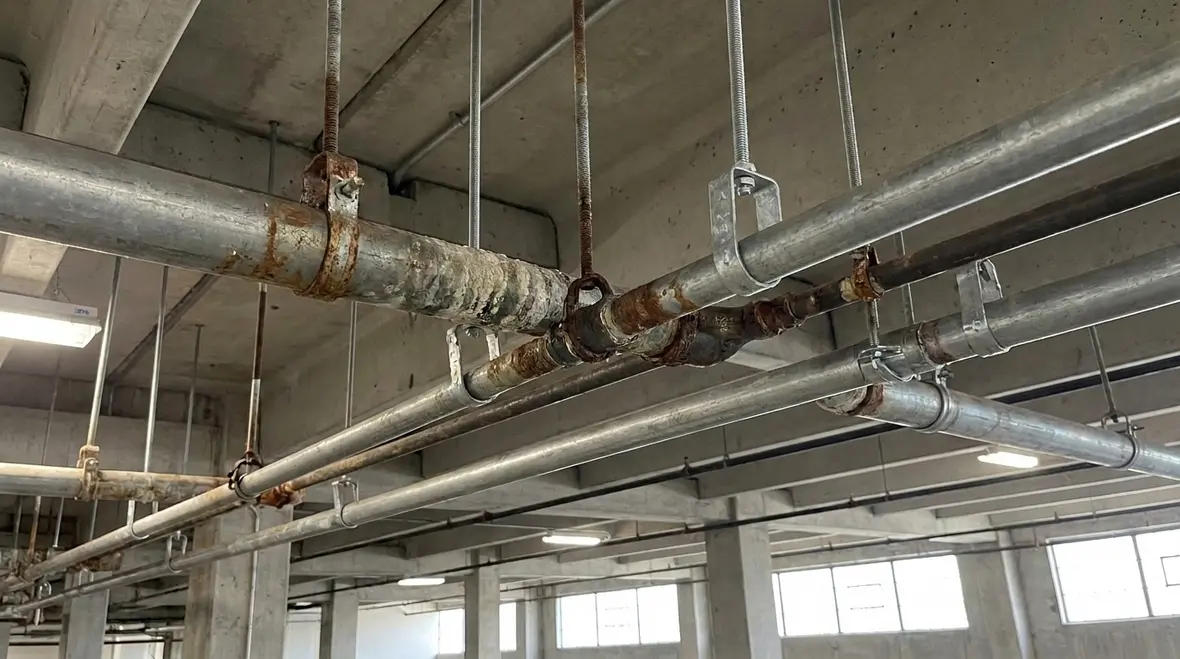
NFPA 15 Section 5.6 Hangers: Support Types and Corrosion Protection
Quick Answer
NFPA 15 Section 5.6 requires piping hangers and supports that maintain proper sprinkler and pipe positioning while resisting corrosion and deterioration. Selecting the right support type and corrosion protection system, then verifying during inspections, prevents misalignment, leaks, and impaired water delivery.
For facilities building a stronger maintenance and compliance program, it helps to pair hanger review with a broader fire sprinkler service support plan so inspection, repair coordination, and documentation stay organized instead of becoming a scavenger hunt with paperwork.
Why NFPA 15 5.6 hangers pipe support NFPA 13 corrosion-resistant requirements matter in real buildings
Commercial facilities routinely face conditions that accelerate corrosion, including condensation, chemical vapors from retail cleaning products, rooftop exposure, and cyclical wet and dry operation. NFPA 15 governs water based fixed systems, so hanger integrity directly affects hydraulic performance, sprinkler alignment, and long term reliability. When hangers fail or supports degrade, pipes can drift, nozzles can misorient, and water delivery can become uneven.
For design and maintenance teams managing multi code installations, NFPA 15 5.6 hangers pipe support NFPA 13 corrosion-resistant expectations often intersect with NFPA 13 corrosion resistant considerations. This is especially common in mixed occupancies, renovations, and facilities transitioning from older hanger systems to current standards.
What Section 5.6 expects from pipe supports and hangers
NFPA 15 Section 5.6 addresses how sprinkler system piping gets restrained and supported. The intent focuses on preventing movement beyond allowable limits and maintaining consistent spacing and alignment through thermal cycling, vibration, installation loads, and long term aging.
Support performance requirements most teams miss during field acceptance
Correct restraint function: Hangers and supports must do the job they were intended to do. Some components are designed for vertical load support, while others provide lateral restraint or limit pipe movement. Using the wrong device can allow drift.
Load path integrity: Supports must transfer pipe weight into the building structure. Improper anchorage to lightweight framing or misaligned attachments can loosen over time.
Compatibility with pipe material: Carbon steel hangers with no coating in corrosive environments can fail faster than the pipe, creating a weak link.
Installation and adjustment quality: Over tightened rods, missing hardware, or sloppy leveling can create stress concentrations or prevent proper thermal movement.
Support types under NFPA 15 5.6 and when each one is appropriate
Although building layouts and contractor practices vary, hanger and support selection generally clusters into a few functional categories. The correct choice depends on system layout, pipe size, vertical routing, and the expected corrosion exposure.
1) Fixed supports and rigid bracing
Fixed supports limit movement and keep a defined location. They are typically used where directional changes, offsets, or structural restraints require stable positioning. In commercial spaces with frequent building sway or equipment vibration, fixed bracing can reduce cumulative misalignment risk.
Compliance challenge: Fixed support assemblies that are not installed with the intended fasteners or embedment depth can loosen. Over time, pipe position changes and can complicate sprinkler escutcheon alignment and inspection access.
2) Adjustable hangers and threaded rod systems
Adjustable hangers help contractors set elevation and maintain consistent pipe slopes and clearances. Threaded rod assemblies are common, but corrosion control for the rod, nut, and coupling becomes critical in wet or humid environments.
Compliance challenge: Inadequate coating on threaded portions and the common practice of reusing hardware can create localized corrosion at joints where water and debris collect.
3) Seismic and bracing elements where required
Where seismic or lateral bracing applies, supports often include additional bracing members. These components must withstand dynamic loads without losing their corrosion resistance. Even if the pipe material survives, bracing failure can cause directional movement that affects sprinkler discharge patterns.
Compliance challenge: Substitutions during installation, such as changing bracing materials without an equivalent corrosion resistant rating, can break the system protection intent.
4) Support spacing and load capacity coordination
Support spacing ties directly to allowable pipe deflection and long term sag. When spacing is too wide, stresses increase and hanger loads grow. When spacing is too tight, installation can disrupt thermal movement and increase constraint stresses at joints.
Practical field verification: Kord Fire Protection typically confirms support spacing, hardware condition, and alignment during recurring service inspections so issues are detected before they become structural or system flow problems.
Corrosion protection for hangers: what to specify and how to verify
Corrosion protection must match the environment. NFPA 15 5.6 corrosion resistant intent is not limited to the pipe. Hangers, rods, nuts, clamps, and any contact surfaces require compatible corrosion control so the support system does not become the failure point.
Common corrosion mechanisms in sprinkler and piping spaces
Condensation and wetting: Cooling coils, poorly insulated ceilings, and seasonal humidity drive repeated wetting and drying.
Chemical exposure: Cleaning agents, pool or industrial vapors, and aerosolized substances can accelerate coating breakdown.
Galvanic corrosion: Dissimilar metals in contact, especially when wet, can create preferential corrosion at the less noble component.
Crevice corrosion: Clamps and bracket interfaces can trap moisture and debris.
Corrosion resistant approaches that maintain hanger performance
In practice, corrosion protection strategies often include coating systems, stainless hardware, hot dip galvanizing where appropriate, and protective sleeves or coverings at vulnerable interfaces. Selection also considers how coatings behave on cut edges, drilled holes, and threaded connections.
Critical verification point: Many corrosion issues originate at the small details. Inspections should focus on threads, contact surfaces, hardware under paint or sleeves, and areas that appear “dry” but show early oxidation or pitting.
Inspection and maintenance routines that prevent hanger failures
Routine service should include visible condition assessment and targeted checks in high risk zones, including near rooftop equipment, mechanical rooms, exterior building penetrations, and areas with recurring condensation. When corrosion is detected, the service plan typically includes replacement of affected hardware and confirmation that pipe alignment remains correct after repairs.
For teams coordinating ongoing compliance, Kord Fire Protection supports commercial facilities with maintenance planning, inspection documentation support, and corrective action scheduling to reduce downtime and operational risk. For broader technical context on water spray fixed systems, see: NFPA 15 enhancing fire safety with water spray fixed systems.
Common failure points in NFPA 15 5.6 hanger applications
The following issues repeatedly show up during inspections and maintenance across retail, industrial, and office environments.
1) Hardware substitution without equivalency
Replacing galvanized or stainless components with standard carbon steel hardware may pass initial visuals but fail rapidly in corrosive or humid spaces. Substitution also creates uncertainty about coating thickness, compatibility, and long term corrosion rate.
2) Coating damage during installation
Drilling, field cutting, or improper handling can damage coatings. Thread engagement and cut edges become corrosion hotspots. Verification after installation is essential.
3) Misalignment and slack introduced during maintenance
After ceiling access work, contractors may inadvertently move pipe position. Slack in hanger systems can accumulate slowly and create a measurable offset from the intended alignment.
4) Neglected high moisture zones
Hangers near exterior walls, roof curbs, and condensate pathways frequently experience moisture accumulation. These zones should receive more frequent checks as part of a risk based maintenance plan.
Operational compliance: how facilities should manage hanger integrity over time
Commercial fire protection compliance typically involves inspection, testing, and documentation. Hanger and corrosion protection management fits into that lifecycle as a prevent failures component rather than a purely corrective step.
Document the baseline: Maintain as built drawings or field verification notes that identify support types and corrosion protection approach used at installation.
Use targeted inspection zoning: Increase inspection frequency for corrosive or wetting conditions rather than checking every hanger the same way.
Track corrective actions: Record which hangers and hardware were replaced, the corrosion condition observed, and the location of repairs.
Coordinate with other trades: Alert maintenance teams and contractors before ceiling work, insulation replacement, or rooftop maintenance so hanger position and coatings do not get disturbed.
For facility teams who want a baseline understanding of related water delivery maintenance concepts, industry resources can complement internal procedures. One starting point is FirePumps.org, which provides educational material connected to water based fire protection performance and system considerations.
Frequently Asked Questions
Conclusion and call to action
NFPA 15 5.6 hangers pipe support NFPA 13 corrosion-resistant compliance depends on more than initial installation. It requires the right support types, verified restraint function, and corrosion protection that survives condensation, chemical exposure, and field installation conditions. Kord Fire Protection can help commercial facilities maintain hanger integrity through inspection, documentation support, and corrective action planning before hanger degradation compromises system alignment and reliability. Contact Kord Fire Protection to schedule a targeted hanger and corrosion assessment.

Join Our Newsletter!
Get the latest fire safety tips delivered straight to your inbox From our Newsletter.



