
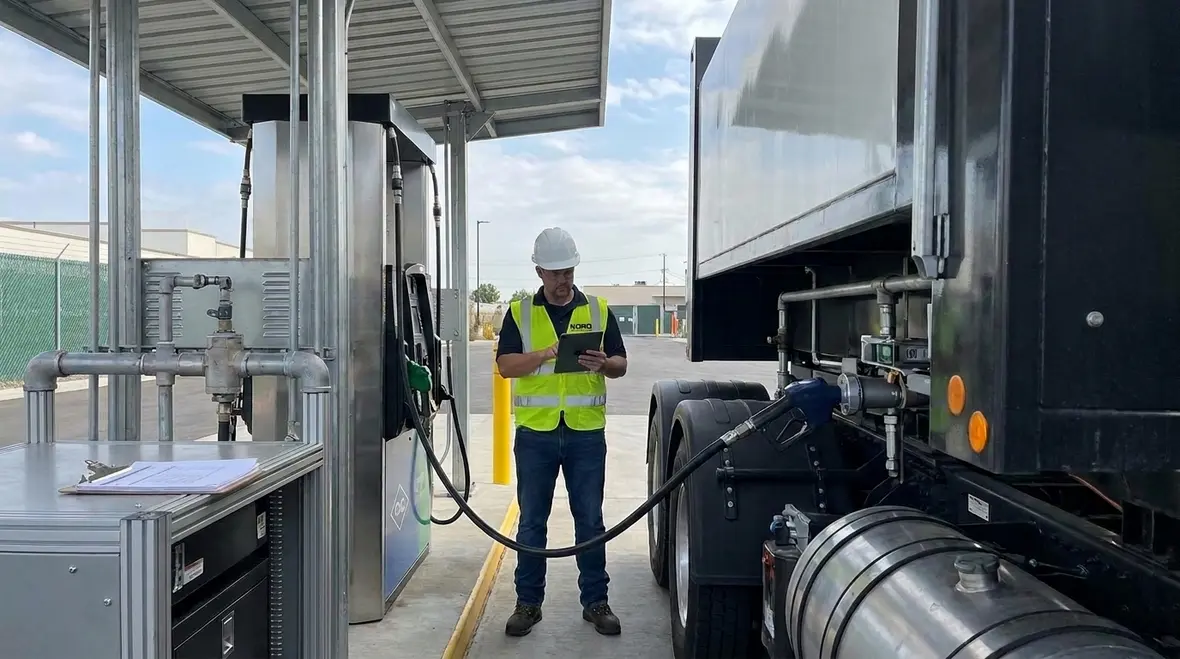
NFPA 52 Section 1.4 Alternate Provisions: Alternative Compliance for Natural Gas Vehicle Fueling
Quick Answer: NFPA 52 Section 1.4 allows facilities to pursue alternate provisions alternative compliance when strict prescriptive requirements do not fit site conditions. The authority having jurisdiction evaluates an engineered equivalent approach tied to safety performance, operating controls, and verifiable reliability.
Why NFPA 52 Section 1.4 matters for natural gas vehicle fueling
Natural gas vehicle (NGV) fueling sites often face real world constraints: existing building layouts, limited pavement space, utility placement, vehicle approach geometry, and phased construction. NFPA 52 Section 1.4 provides a structured pathway to address those constraints through alternate provisions alternative compliance rather than abandoning safety objectives.
For commercial, industrial, and retail facilities, the practical challenge is not only proposing an alternative. The challenge is demonstrating that the alternative achieves equal or greater safety performance across hazards, ignition control, protection of equipment, and ongoing operational reliability.
For organizations building a stronger long-term compliance program, review Kord Fire Protection’s full fire protection services to support inspection planning, maintenance coordination, and documentation readiness.
What Section 1.4 actually requires during evaluation
Section 1.4 does not offer a simple waiver. It requires a documented basis that the proposed alternative provides equivalent protection. In practice, the authority having jurisdiction (AHJ) expects an engineered approach that maps safety goals to specific design and operational features.
- Defined safety equivalency: The design must address the same hazards and mitigation intent as the prescriptive requirements.
- Evidence and documentation: The proponent must provide calculations, listings, engineering judgments, and maintenance rationale sufficient for review.
- Verifiable operation: Controls, monitoring, and protective functions must work reliably in normal and off normal scenarios.
- Ongoing compliance support: Inspection and testing methods must confirm continued performance.
For facilities planning NFPA 52 alternate provisions alternative compliance, early coordination with the AHJ reduces rework. Kord Fire Protection supports that process by translating code intent into actionable inspection, testing, and maintenance requirements that align with real site operations.
Where alternate compliance commonly shows up at NGV sites
Alternate provisions alternative compliance most often arises when the fueling system must integrate with existing conditions or when the site design uses innovative configurations. Common drivers include:
1) Facility layout and siting constraints
Existing canopy structures, restricted setbacks, or encroachment on required clearances may push teams toward alternate arrangements. An AHJ review typically focuses on whether exposure control and emergency access are equivalent.
2) Venting, drainage, and accumulation control
Natural gas hazards depend heavily on detection, ventilation, and prevention of accumulation. If conventional venting approaches are impractical, the alternative must demonstrate equivalent dispersion and mitigation under expected wind and site airflow conditions.
3) Detection and emergency shutoff strategies
Alternate approaches may involve different detector locations, control logic, or shutdown sequences. The AHJ typically expects a functional safety basis that includes nuisance alarm control, fail safe behavior, and maintainable testing methods.
4) Protection of equipment from damage and environmental exposure
Mechanical protection, corrosion resistance, and weatherproofing can vary by site. The alternative compliance review will look for equivalent survivability of safety critical equipment.
Operational procedures: the part many proposals underestimate
Proposals often focus on hardware. The strongest safety basis also includes how the fueling site operates every day. For NFPA 52 alternate provisions alternative compliance, operational procedures become part of the proof of equivalency.
- Start up and shutdown routines: Sequences must ensure stable control states before fueling begins and safe states after fueling ends.
- Emergency response triggers: Staff must understand detector alarms, abnormal pressures, and shutdown indications, including escalation pathways.
- Maintenance controls: Service intervals must match manufacturer requirements and verify that protective features remain within design parameters.
- Work order discipline: Any modifications, detector swaps, sensor calibration changes, or control logic updates should follow a controlled process with documentation.
Common failure points include delayed alarm response, incomplete calibration records, incorrect shutdown verification, and maintenance activities that do not restore the tested configuration. Kord Fire Protection helps commercial operators close those gaps by developing inspection and maintenance workflows that support continuous code compliance.
Inspection, testing, and maintenance requirements for alternate systems
Alternate provisions alternative compliance succeeds only if the facility can prove continued performance. The AHJ usually expects a testing and inspection plan that covers both routine and conditional scenarios.
Testing focus areas typically include
- Gas detection performance: Functional testing, alarm thresholds verification, and verification of signal paths to the control system.
- Emergency shutoff functionality: Confirmation that valves and control outputs actuate correctly and return to intended safe conditions.
- Communications and power integrity: Checks that safety critical circuits remain monitored and that backup power concepts, if used, perform as designed.
- Protection integrity: Inspection of barriers, weather sealing, mechanical protection, and cable management where relevant to hazard control.
- Documentation management: Records of testing frequency, calibration history, corrective actions, and part traceability.
Commercial facility implications
For retail and industrial owners, maintaining tested performance is not a one time event. Fueling operations run on tight schedules. That reality increases the risk of shortcuts such as missed calibration windows, incomplete alarm functional tests, or rushed restoration after maintenance. Structured service planning and clear roles reduce that risk.
To strengthen ongoing compliance readiness, Kord Fire Protection provides recurring service support, test documentation organization, and field level verification aligned with how NFPA 52 safety features operate in practice. For a broader view of ongoing system care, see the full lifecycle of fire protection servicing.
Helpful reference: For commercial fire protection services and maintenance support that align with code driven equipment reliability, review Kord Fire Protection.
How to prepare an alternate provisions submittal that the AHJ can approve
A high quality submittal for NFPA 52 alternate provisions alternative compliance follows a repeatable approach. It translates code intent into a hazard based equivalency narrative tied to testable performance.
- Start with hazard mapping: Identify the natural gas hazards relevant to the alternative scope, including ignition sources, accumulation potential, and emergency control needs.
- State the prescriptive gap clearly: Explain which section requirements are not feasible and why.
- Describe the engineered alternative: Detail the configuration, including equipment selections, placement logic, control sequences, and expected behavior during alarms.
- Provide equivalency evidence: Include manufacturer data, engineering analysis, and reliability rationale that connects to safety performance.
- Define inspection and testing: Provide a testing schedule and acceptance criteria that confirm the alternative continues to perform.
- Include maintenance and corrective actions: Specify how the facility restores compliance after any maintenance activity and how it tracks recurring issues.
Kord Fire Protection can strengthen the submittal by aligning the proposed approach with field testing realities, ensuring that inspection and maintenance steps support the approval basis.
Frequently Asked Questions
Next step: strengthen your compliance path
If your NGV fueling project needs NFPA 52 alternate provisions alternative compliance, plan for an engineered equivalency submittal backed by practical testing and maintenance. Engage Kord Fire Protection early to align safety critical functions with field verification, documentation, and ongoing inspection routines. Contact Kord Fire Protection to review your scope, build a defensible compliance strategy, and reduce schedule risk with actionable service planning.

Join Our Newsletter!
Get the latest fire safety tips delivered straight to your inbox From our Newsletter.


