
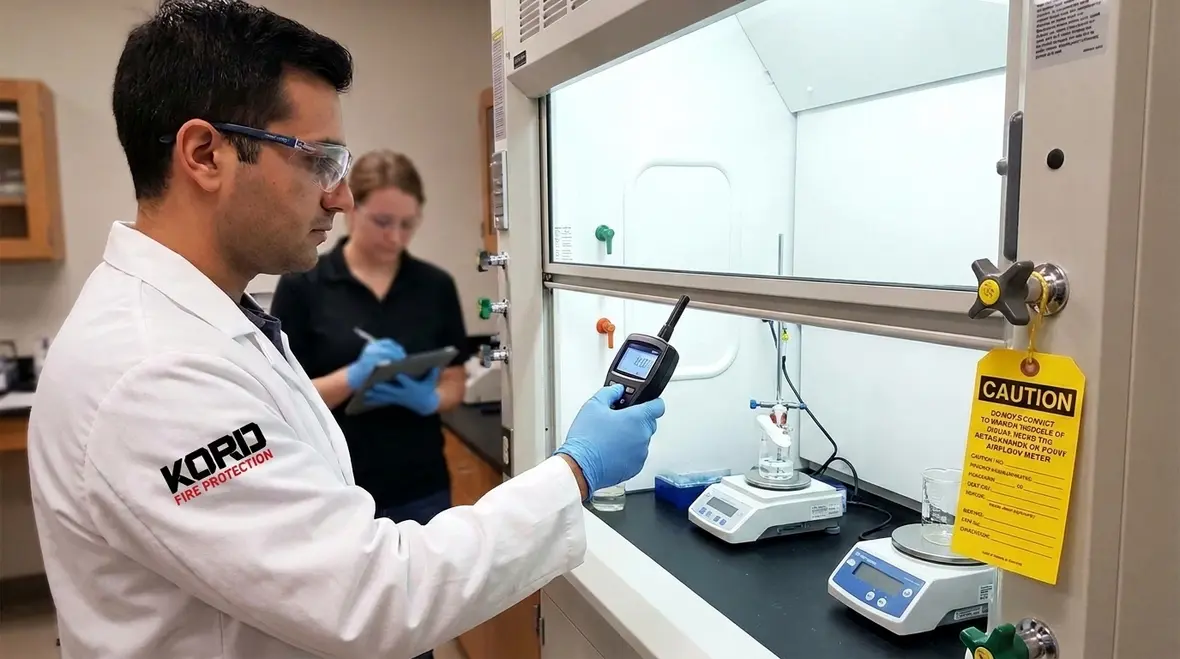
NFPA 45 Section 7.14: Inspection, Testing, and Maintenance for Lab Ventilation
Quick Answer
NFPA 45 Section 7.14 sets practical requirements for inspecting, testing, and maintaining laboratory ventilation systems, including fume hoods. Facilities must verify performance, document results, correct deficiencies, and maintain ongoing schedules to protect occupants and ensure compliance.
For broader inspection, testing, and maintenance support that fits naturally into a facility wide compliance program, fire protection inspection testing and maintenance services can help teams keep documentation, scheduling, and corrective action tracking aligned across systems.
What NFPA 45 Section 7.14 Requires for Lab Ventilation
NFPA 45 Section 7.14 drives a performance based maintenance approach for laboratory ventilation, with an emphasis on keeping engineered airflow controls reliable over time. For organizations managing commercial, industrial, and retail laboratory spaces, this section functions as a compliance roadmap that ties system operation to documented inspection, testing, and maintenance outcomes.
In practical terms, NFPA 45 fume hood inspection testing maintenance means more than checking that equipment powers on. It focuses on whether hoods and ventilation components continue to perform as designed, including airflow capture performance, control stability, and the ability to respond to changes in operating conditions.
Why Compliance Fails in the Real World
Many facilities meet initial commissioning requirements but struggle during year to year operations. Common drivers of nonconformance include process changes, modifications to ductwork, control drift, and maintenance gaps that delay corrective action.
Common failure points
- Airflow drift over time: Fans change speed, filters load, and dampers wear, shifting face velocity and containment performance.
- Control system instability: Sensors can go out of calibration, causing supply or exhaust to overcorrect.
- Improper hood usage conditions: Sash position, room pressure, or ventilation offsets may diverge from what the system was set to achieve.
- Damper sticking or linkage issues: Mechanical wear can prevent full travel during normal control sequences.
- Penetrations and duct integrity problems: Seals, joints, or transitions can leak, degrading airflow and containment.
Section 7.14 expects facilities to treat these as maintenance and verification problems, not as occasional troubleshooting items.
Inspection: What to Verify During NFPA 45 Fume Hood Inspections
Inspection activities under NFPA 45 Section 7.14 typically focus on confirming system condition, verifying operational readiness, and identifying defects before they translate into unsafe or out of specification performance.
Operational checks and physical condition
- Hood configuration verification: Confirm correct sash operation and that hood components remain installed and aligned.
- Damper and airflow path observation: Check accessible dampers, linkages, and related duct connections for condition and proper response.
- Control panel functionality: Confirm alarm behavior, control setpoints access, and that status indicators correspond to actual operating modes.
- General system condition: Review fan condition, electrical components, and visible wear points that can impact reliability.
For commercial and industrial facilities, inspection programs often fail when teams cannot show consistent, traceable evidence of what was checked and what criteria were used. A strong program includes standardized procedures and clear documentation that ties observations to required corrective actions.
Testing: Measuring Performance, Not Just Operation
Testing under NFPA 45 Section 7.14 is the performance verification layer. It establishes whether the ventilation system achieves the intended containment and airflow control when it matters most: during actual operating conditions.
Key testing considerations for fume hoods
- Airflow measurement consistency: Measure hood performance with appropriate instruments and repeatability so results can be trended over time.
- Control response evaluation: Confirm that controls react as expected and stabilize without oscillation.
- System balance verification: Validate that room or zone effects, supply and exhaust relationships, and pressure control do not undermine hood capture.
- Documentation for defensibility: Capture instrument calibration references, test conditions, and results that can be used for compliance review.
A common compliance challenge in multi tenant and retail adjacent industrial environments involves shared spaces, variable occupancy, or HVAC balancing changes that alter ventilation behavior. Testing under those conditions helps facilities address real operational variability rather than relying only on ideal conditions from initial commissioning.
Maintenance: Keeping Ventilation Systems Stable Between Tests
Maintenance actions support the stability of ventilation performance over time. Under NFPA 45 Section 7.14, maintenance programs should prevent degradation and ensure that corrective actions do not merely mask symptoms.
Maintenance activities that protect hood performance
- Filter and fan service: Address loading effects and verify that fan operation remains within expected parameters.
- Control calibration and verification: Recalibrate sensors and verify setpoints align with design intent.
- Mechanical inspection and repair: Service dampers, linkages, and motor drive components to prevent partial travel and sticking.
- Leak and integrity checks: Repair ductwork leaks at joints, transitions, and penetrations that can reduce containment effectiveness.
- Corrective action tracking: Maintain a closed loop from identification to repair to retest, with documented evidence of completion.
Kord Fire Protection supports ongoing commercial compliance by combining field inspection discipline with practical maintenance coordination. This approach helps facilities maintain safe performance, reduce downtime caused by last minute failures, and improve documentation quality for audits and internal reviews.
How Facilities Build an Auditable NFPA 45 Program
An auditable program under NFPA 45 Section 7.14 includes more than test results. It demonstrates that the facility has a plan, executes it consistently, corrects deficiencies, and verifies that repairs restore performance.
Program elements that auditors expect to see
- Defined scope and system inventory: Identify which hoods and ventilation components fall under the program.
- Schedules that match risk and operating conditions: Align inspection testing and maintenance with actual usage intensity and system complexity.
- Standard operating procedures: Use consistent measurement methods and acceptance criteria.
- Change management: Reevaluate ventilation performance after renovations, duct modifications, or control system updates.
- Evidence based recordkeeping: Maintain reports that include test conditions, calibration references, and corrective actions.
To strengthen internal coordination on fire and life safety impacts of ventilation systems, facilities can also review NFPA 45 Section 1.5 equivalency alternative compliance for laboratories and laboratory unit hazard classification guidance from Kord Fire Protection.
Frequently Asked Questions
Next Steps: Schedule Compliance Verification
Facilities that operate lab ventilation systems should confirm their NFPA 45 Section 7.14 inspection testing and maintenance program is auditable, current, and performance based. Engage Kord Fire Protection to coordinate field inspections, testing, and maintenance documentation with clear corrective action tracking and retest verification. Take the next step by scheduling a ventilation compliance assessment and building a defensible maintenance plan tailored to your hood inventory and operating conditions.
If your team is also tightening adjacent compliance processes, full fire protection services can support coordinated readiness across inspections, maintenance, and documentation.

Join Our Newsletter!
Get the latest fire safety tips delivered straight to your inbox From our Newsletter.



