
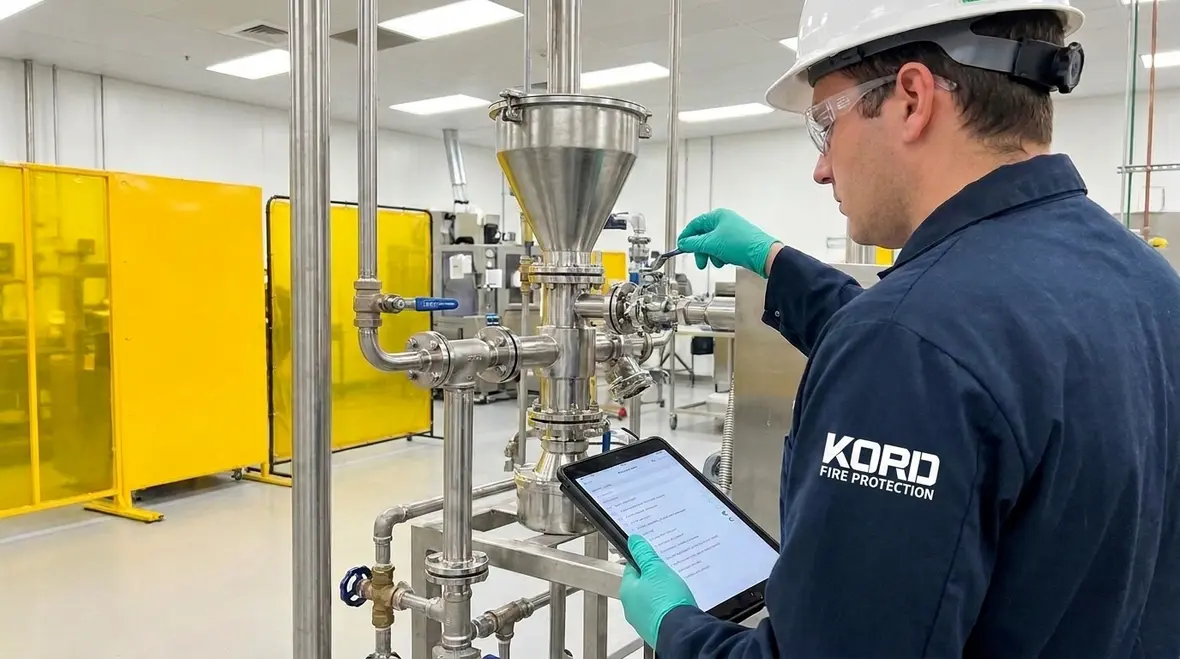
NFPA 35 Section 6.4: Dispersion Equipment Requirements
Quick Answer: NFPA 35 Section 6.4 sets performance and safety expectations for dispersion equipment used with combustible dust, vapor, or aerosol-forming systems. The rules focus on reliable operation, protected placement, sound installation, and documented inspection and maintenance to prevent unsafe accumulation, ignition sources, and system failure.
For a broader look at how inspection planning and maintenance records support defensible compliance in real facilities, see ITM fire protection inspection, testing, and maintenance. It fits naturally with the code-focused discussion here, especially when dispersion equipment reliability depends on consistent checks and documented corrective action.
What NFPA 35 dispersion equipment requirements cover in Section 6.4
NFPA 35 dispersion equipment requirements apply to the devices that spread, meter, or convey hazardous materials so the process produces predictable outcomes instead of unintended releases. In practical terms, Section 6.4 addresses how dispersion equipment must be built, installed, and maintained to control ignition hazards, limit malfunction risks, and support safe operation in commercial, industrial, and retail settings.
Because dispersion is often the most failure-prone stage in a process, compliance usually depends less on theory and more on operational details: alignment of components, integrity of enclosures, correct placement relative to ignition sources, reliable actuation, and a maintenance program that verifies performance over time.
Where dispersion equipment fits into a hazardous process
Dispersion equipment typically supports controlled distribution of a material into a process stream or into a defined area where the hazard is managed by system safeguards. Even when the overall design includes detection and suppression, Section 6.4 requirements matter because equipment malfunction can bypass the assumptions used during hazard evaluation.
Common commercial facility use cases
Industrial operations that handle combustible liquids, powders, or aerosols and rely on repeatable delivery to prevent off-nominal concentrations.
Retail and light industrial environments where dispersion systems may be integrated into packaging, cleaning, or specialty material handling processes.
Contract manufacturing spaces that run multiple SKUs and frequently adjust process parameters, increasing the risk of configuration drift.
In all cases, facility leaders should treat dispersion equipment as a system component that must remain dependable under normal operation, cleaning cycles, and routine maintenance.
Key compliance expectations under Section 6.4
Section 6.4 emphasizes control of dispersion behavior and protection of equipment. The core compliance themes typically include reliable operation, appropriate installation, safeguarding from ignition sources, and verification through inspections and maintenance.
1) Equipment performance must remain predictable
Dispersion equipment is expected to deliver material in a controlled pattern and flow condition consistent with the system design. Facilities often struggle with performance drift caused by wear, fouling, damaged seals, partial blockage, or incorrect maintenance intervals. These issues can change particle size distribution, throw distance, or concentration uniformity, which can move the process outside safe operating assumptions.
2) Installation must protect against ignition and unsafe release
Location and mechanical protection matter. Dispersion equipment should be installed so it does not expose the process to ignition sources or create conditions that promote accumulation outside the intended area. Tight space clearances, unsealed penetrations, and poor cable management can create hidden ignition opportunities or allow leakage that defeats the intended dispersion envelope.
3) Safeguards must support safe operation during upset conditions
Many facility designs depend on interlocks, shutdown logic, and emergency response. Section 6.4 expectations generally align with the requirement that dispersion equipment must support those safeguards, not undermine them. For example, equipment that continues to run after a fault condition or that fails to shut down reliably can create an ongoing hazard even while other protection systems activate.
Operational procedures that typically make or break compliance
NFPA 35 dispersion equipment requirements are not satisfied by hardware alone. Day to day procedures determine whether the dispersion equipment consistently performs as intended. Facilities that pass inspections usually implement structured operating practices, including startup verification, change control, and disciplined cleaning.
Startup and verification steps
Pre use inspection for visible damage, leaks, loose fittings, and abnormal vibration or noise.
Function checks for valves, pumps, fans, actuators, or metering components tied to dispersion performance.
Process parameter confirmation to ensure that changes in concentration, flow rate, or cycle timing remain within validated operating limits.
Change control for commercial environments
Retail and industrial facilities often modify process variables due to demand, product changes, or vendor recommendations. Each change can affect dispersion behavior. Compliance programs should require documentation of configuration updates, including nozzle or nozzleless head selection, spray pattern changes, and any adjustment that impacts output rate or droplet or particle distribution.
Cleaning and maintenance procedures that prevent recurring failures
Cleaning is both necessary and risky. The process should prevent accidental introduction of ignition sources, avoid damaging seals and gaskets, and ensure that reassembly returns equipment to its verified configuration. Many recurring failures trace back to improper reinstallation, incorrect torque, substitution of non equivalent parts, or failure to clear residual buildup that affects flow.
Inspection and maintenance: how facilities demonstrate ongoing compliance
Section 6.4 expectations typically translate into inspection and maintenance practices that confirm equipment integrity and performance over time. Commercial compliance teams should focus on evidence: documented checks, measurable verification where practical, and rapid correction of defects that can change dispersion behavior.
What inspectors and auditors commonly look for
Condition of nozzles, diffusers, or dispersion heads, including signs of clogging, erosion, corrosion, and misalignment.
Integrity of seals and joints, including visible leakage points and evidence of material migration.
Mechanical protection such as guarding, enclosure condition, and secure fasteners.
Actuation reliability including response time to shutdown or control signals.
Maintenance records showing frequency, scope, parts used, and verification steps.
Common failure points that trigger noncompliance
Fouling and buildup that changes flow pattern and concentration distribution.
Worn moving parts that degrade metering accuracy and repeatability.
Damaged wiring or control components that prevent safe shutdown sequences.
Unverified replacements using non equivalent parts that alter performance.
For facilities building a defensible compliance program, Kord Fire Protection supports ongoing inspection, testing, and maintenance planning. This includes helping align service documentation with the operational reality of commercial systems where schedules, production demands, and cleaning cycles can otherwise create gaps.
If you also need guidance on related inspection planning, see commercial fire safety audit step by step process for a practical look at records, inspection intervals, and corrective action history.
How to reduce risk during renovations, retrofits, and contractor work
Dispersion equipment often changes during renovations, tenant improvements, or production upgrades. These activities raise the risk of non equivalent parts, altered installation clearances, and missed updates to operating procedures. Section 6.4 compliance depends on controlling these transitions.
Best practices for facility teams
Pre work hazard review to confirm the dispersion envelope and ignition control assumptions remain valid.
Verified cutover procedures that include startup checks, leak verification, and confirmation of control interlock behavior.
Documentation retention including installation details, parts identifiers, and commissioning records.
Contractor coordination that prevents hidden noncompliance
Facility owners should require that contractors follow the approved configuration and provide as built information. A frequent failure pattern involves returning equipment to “similar” conditions rather than “verified” conditions, leading to subtle performance changes that become apparent only during inspection or operational upset events.
Frequently Asked Questions
Conclusion and call to action
NFPA 35 Section 6.4 requirements for dispersion equipment demand more than installation checklists. Commercial facilities must maintain predictable performance through disciplined operating procedures, documented inspections, and corrective maintenance that prevents fouling, wear, and control failures. Kord Fire Protection helps teams build and sustain defensible compliance programs by supporting ongoing testing, inspection planning, and maintenance documentation. Contact Kord Fire Protection to validate your dispersion equipment program and close common risk gaps before they surface during audits.

Join Our Newsletter!
Get the latest fire safety tips delivered straight to your inbox From our Newsletter.



