
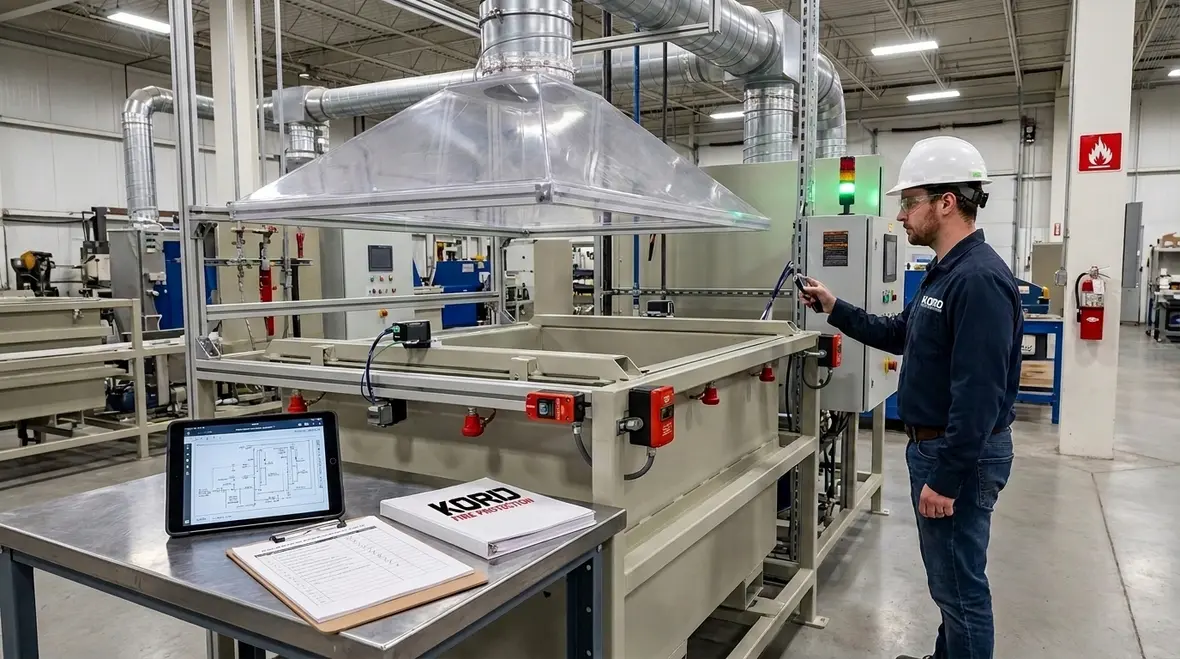
NFPA 34 Section 1.5 Equivalency: Alternative Compliance for Coating and Dipping
Quick Answer
NFPA 34 Section 1.5 enables facilities to meet safety outcomes using equivalent methods instead of prescriptive requirements. When coating or dipping processes cannot follow the listed approach, owners must document engineering rationale, demonstrate equal or greater protection, and maintain inspection and performance controls.
For related fire safety planning and system coordination, see specific process protection for spray operations and how it connects to coating hazards and protective system performance. ([kordfire.com](https://kordfire.com/nfpa-33-section-9-6-specific-process-protection-for-spray-operations/?utm_source=openai))
What does NFPA 34 equivalency actually mean for coating and dipping?
NFPA 34 equivalency alternative compliance coating processes allow a commercial, industrial, or retail facility to deviate from a specific prescriptive requirement when the authority having jurisdiction can verify that the alternative provides a level of protection that is equal to or better than the code intent. In coating and dipping operations, that typically affects how flammable liquid vapors are controlled, how ignition sources are managed, and how fire protection and ventilation performance are maintained.
In practical terms, equivalency is not a “permission slip.” It is a structured compliance pathway that requires technical justification, traceable documentation, and ongoing verification. This approach commonly comes into play when legacy equipment, proprietary application systems, or modified operating envelopes make strict adherence to a specific section impractical.
When facilities request equivalency: common triggers
Facilities usually pursue NFPA 34 equivalency alternative compliance coating processes when the existing process footprint, equipment design, or operational constraints conflict with the prescriptive wording. The following scenarios frequently drive equivalency discussions with the AHJ:
1) Modified dipping or coating equipment layout
Coating lines and dip tanks may be installed with non standard clearances, unique ventilation pathways, or atypical drainage and recirculation systems. Equivalency may be needed if vapor control strategies still achieve equivalent containment and exposure reduction, but cannot match exact installation details.
2) Alternative application methods and automation
Robotic spray, precision flow coating, electrostatic systems, or enclosed application chambers can change how overspray and mist behave. Even when overall fire risk is lower, the facility must show that protections are equivalent in likelihood of ignition and consequences of a fire event.
3) Proprietary coatings, additives, or temperature profiles
New formulation chemistries can shift flash point considerations, drying kinetics, and evaporation rates. If those changes alter the hazard analysis, the facility may request equivalency for ventilation, control interlocks, or suppression arrangements while demonstrating equal protection.
4) Legacy systems and retrofit limitations
Some commercial operations cannot retrofit ductwork, fire doors, or suppression piping without significant downtime. Equivalency discussions may allow alternative engineering solutions, provided that documented performance is equal or superior and that inspection and testing requirements remain enforceable.
How to build a strong equivalency package (what the AHJ expects)
A successful equivalency submittal uses a defensible, evidence based chain from hazard to protection. Kord Fire Protection often sees equivalency requests fail when documentation focuses on intent but lacks performance proof, test methods, or acceptance criteria. A strong package typically includes:
Step 1: Define the prescriptive requirement being deviated from
The submittal should clearly identify the section and the exact prescriptive elements that cannot be followed. It should then specify the operating condition where the conflict exists, such as vapor generation rate, enclosure status, or ignition source control.
Step 2: Document the hazard analysis for the coating and dipping process
Provide the technical basis for equivalent risk. Include at minimum:
- Flammable liquid properties relevant to the process, such as flash point and expected temperature range
- Process description: application method, dwell times, heating, agitation, and drying
- Fuel load contributors: coatings, solvents, mist, vapor accumulation potential, and waste handling
- Ignition source inventory: electrical equipment, heaters, motors, static control measures, and traffic patterns
Step 3: Describe the alternative protection method and performance basis
The facility must explain what changes operationally and why those changes produce equivalent fire safety outcomes. For example, an enclosed dipping area with controlled ventilation can be acceptable only if the facility can demonstrate airflow effectiveness, pressure relationships, and interlock logic that prevent hazardous vapor accumulation.
Step 4: Provide acceptance criteria, test protocols, and ongoing verification
Equivalency requires maintenance of protection performance over time. The package should include:
- Inspection checklist items and frequency
- Testing procedures for interlocks, ventilation alarms, suppression systems, and any monitoring devices
- Clear pass fail criteria and calibration management
- Corrective action steps when drift or failure is detected
To support documentation and lifecycle readiness, Kord Fire Protection can assist with program development, commissioning support, inspection planning, and ongoing testing coordination. For facilities seeking a broader understanding of commercial fire systems performance, refer to Kord Fire Protection. ([kordfire.com](https://kordfire.com/?utm_source=openai))
Where equivalency most often breaks down in coating and dipping operations
Even well intentioned submissions can stall during review or fail during inspection. These are the most common failure points:
Ventilation claims without measurable performance proof
Facilities sometimes assert “adequate ventilation” without defining measurement methods, target airflow, or verification frequency. AHJ review typically expects measurable effectiveness tied to hazard control. The facility must specify how vapor control is confirmed after maintenance, filter changes, or duct modifications.
Interlocks that are not tested under real operating sequences
Interlock logic must align with how the equipment is used in daily operations. If interlocks are bypassed during production start up or require manual overrides, the equivalency narrative weakens unless bypass rules are controlled, logged, and risk assessed.
Static and ignition controls treated as optional
In coating and dipping, static charge and ignition sources are persistent concerns. Equivalency must show that bonding, grounding, humidity or control measures, and equipment selection are addressed as enforceable controls, not informal practices.
Suppression or detection provided but not integrated
Some facilities install fire detection or suppression hardware but do not demonstrate coverage, actuation timing, or coordination with ventilation and process shutdown. Equivalent protection needs system integration, not standalone devices.
Maintenance gaps that erode the original safety basis
Filters clog, nozzles degrade, curtains shift, drains clog, and sensors drift. If the facility does not maintain an inspection and testing plan aligned with the equivalency acceptance criteria, the alternative no longer proves equal protection.
Operational controls and inspection readiness for equivalency approvals
Once equivalency is approved, the facility’s ability to demonstrate ongoing compliance becomes the real test. Commercial and industrial occupancies typically require repeatable, auditable execution across production shifts.
Build an inspection and testing matrix
Create a matrix that ties each protective feature to:
- Responsible person and vendor
- Frequency and conditions for testing
- Pass fail criteria
- Records retention and access for AHJ review
Train operators on the safety basis, not just the procedure
Operator training should include why shutdown sequences, ventilation setpoints, and access controls matter. Training should also address what actions are prohibited during abnormal conditions, such as continuing spray while alarms indicate out of range vapor control.
Control change management for coatings, solvents, and operating envelopes
Equivalency depends on defined operating conditions. Any change in solvent chemistry, heating temperatures, batch size, or ventilation duct routing should trigger a review to confirm the equivalency basis still holds.
Use a lifecycle maintenance approach for reliability
To maintain NFPA 34 equivalency alternative compliance coating processes over time, the facility should maintain preventative schedules for fans, dampers, sensors, suppression components, and enclosure integrity. Kord Fire Protection can help commercial facilities maintain system reliability through structured inspection and testing planning and dependable documentation support.
If you want a practical service overview near the top of your planning stack instead of buried in a binder no one opens until inspection week, review fire protection services in Southern California for inspection, testing, troubleshooting, and repairs support. ([kordfire.com](https://kordfire.com/fire-protection-services-southern-california/?utm_source=openai))
Frequently Asked Questions
Conclusion and next step
For coating and dipping operations, NFPA 34 Section 1.5 equivalency can work when the facility builds a measurable safety case and sustains performance through documented inspections and testing. Engage Kord Fire Protection early to structure an equivalency-ready plan, align inspection and testing protocols with the safety basis, and support ongoing maintenance documentation. Contact Kord Fire Protection to evaluate your process, identify equivalency gaps, and build an approval support package.

Join Our Newsletter!
Get the latest fire safety tips delivered straight to your inbox From our Newsletter.



