
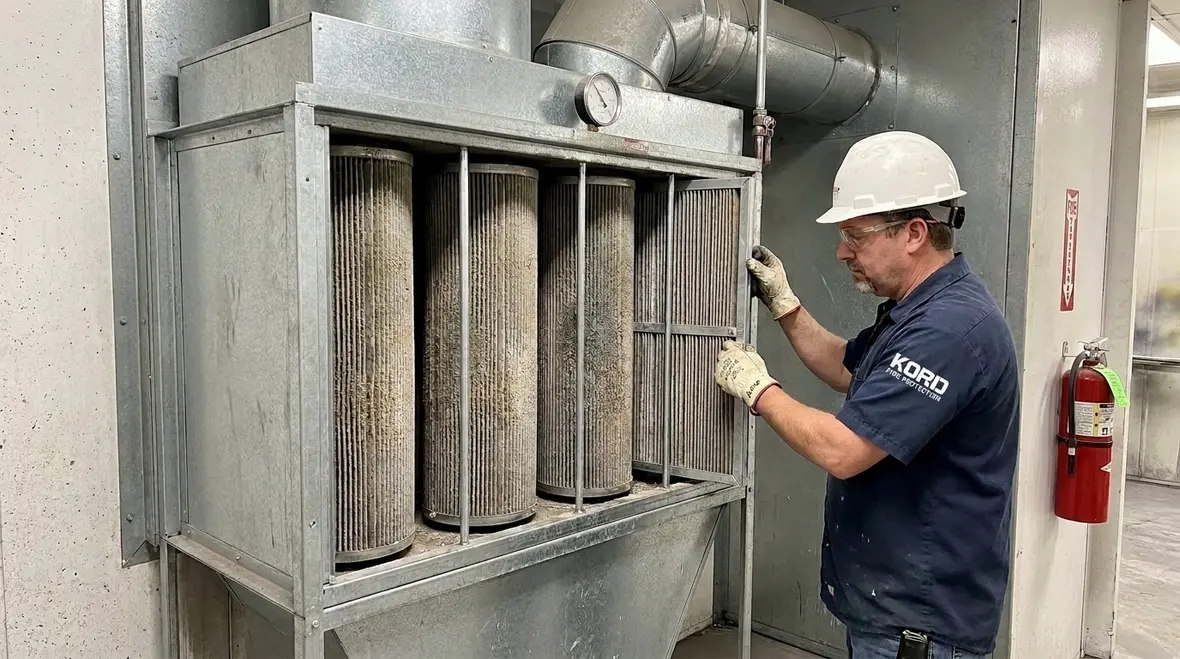
NFPA 33 Section 9.8: Protecting High-Capacity Dry Paint Arrestors
Quick Answer: NFPA 33 Section 9.8 requires facilities to protect high-capacity dry paint arrestors using safeguards that maintain fire-resistance, prevent damaging airflow, and reduce ignition risk from dust, hot particles, or abnormal operating conditions. Proper protection depends on arrestor design, installation, and maintenance.
Facilities tightening inspection routines around paint exhaust hazards often benefit from broader fire suppression inspection planning, especially when documentation, airflow conditions, and maintenance follow-through all need to stay aligned.
What does NFPA 33 Section 9.8 require for dry paint arrestors?
NFPA 33 Section 9.8 focuses on hazards unique to dry paint collection systems that handle high air volumes. High-capacity dry paint arrestors accumulate combustible residues and can experience upset conditions such as abnormal airflow, hot particles, or ignition sources migrating through the duct and collection medium.
Effective NFPA 33 high-capacity dry paint arrestor protection supports three outcomes: controlling the conditions that allow ignition to develop, reducing the likelihood that burning material can escape the arrestor, and maintaining the arrestor in a condition that continues to perform as designed. Commercial facilities often treat Section 9.8 as both an engineering requirement and an ongoing maintenance obligation rather than a one-time installation step.
Why protection matters: common ignition and failure mechanisms
Dry paint arrestors typically collect overspray and dry particulate using mechanical separation or media-based filtration. While the arrestor reduces combustible loading in the exhaust stream, it creates a concentrated accumulation zone where ignition can occur if a heat source or capable ember reaches the inlet.
1) Hot particles and ember migration
Hot particles can enter paint exhaust systems from upstream processes, malfunctioning equipment, or accidental ignition events. If the arrestor is not adequately protected, those particles can heat collected material and progress toward smoldering or flaming.
2) Upset airflow and poor operating conditions
Many collection systems rely on stable airflow to keep particulate moving through the duct and into the arrestor without creating localized overheating or stagnant deposits. Fans, dampers, and duct leakage can produce noncompliant operating modes. When airflow drops below design levels, deposited dust can become more susceptible to ignition.
3) Accumulation, bridging, and media degradation
Even when the arrestor design is appropriate, accumulation patterns can change over time. Dust can bridge, overload specific sections, or collect in a way that reduces separation efficiency. Filters, replaceable elements, and internal surfaces may degrade from moisture, cleaning chemicals, or abrasive dust. Degraded components can compromise protection performance.
Practical compliance: how facilities implement NFPA 33 high-capacity dry paint arrestor protection
NFPA 33 Section 9.8 is not satisfied by “having an arrestor” alone. Facilities commonly implement a layered protection strategy that combines protective design features, operational controls, and inspection and testing routines.
Design and installation controls that prevent unsafe conditions
-
Maintain required spacing and installation integrity: Ensure arrestors are installed as designed with clear access for inspection and safe pathways for airflow and maintenance activities.
-
Protect against propagation: Use appropriate protective arrangements so burning material does not progress from the arrestor into ductwork or into adjacent combustible areas.
-
Control exhaust pathways and pressure balance: Confirm the duct and fan arrangement supports stable operation and does not create backflow or recirculation conditions.
Operational practices that keep the system in compliance
-
Interlocks and operating limits: Many facilities use controls that prevent operation outside safe parameters, such as low airflow conditions or abnormal fan behavior.
-
Work practices for changeovers: Switching paint types, cleaning procedures, or maintenance routines can change particulate characteristics and ignition behavior. Document these changes and verify the system remains within operating controls.
-
Coordination with hot work and process interruptions: Ensure hot work permits and process upset procedures account for the presence of combustible residues and the arrestor protection scheme.
Inspection, testing, and maintenance: where compliance often breaks down
For many commercial, industrial, and retail facilities, the highest risk period is not the original installation, but the maintenance cycle. Dust loading, component wear, and procedural drift can reduce the effectiveness of the protection measures required under Section 9.8.
Inspection checkpoints that reflect real-world conditions
-
Visual verification of accumulation patterns: Inspect for bridging, uneven loading, or areas where residue collects unusually due to duct geometry or airflow imbalances.
-
Condition of arrestor components: Verify that collectors, media elements, internal baffles, or separation components remain intact and properly installed.
-
Duct and connection integrity: Check for leaks, loose joints, or damaged sections that can alter airflow and compromise the intended protection scheme.
-
Airflow indicators and operating logs: Review performance indicators to confirm the system operates within established limits during production.
Common failure points and how they affect protection
-
Delayed filter or media replacement: Over time, loading can increase pressure drop and reduce airflow, raising ignition susceptibility and reducing separation performance.
-
Improper cleaning methods: Aggressive cleaning can damage components or redistribute residue in ways that defeat the original protective design.
-
Bypass conditions: Temporary ducting changes, unsealed access panels, or disabled controls can produce unprotected operating modes.
Kord Fire Protection supports facility teams with practical compliance services such as inspection planning, condition-based maintenance verification, and documentation support that aligns with the realities of industrial production schedules. This helps organizations maintain reliable protection performance rather than relying on infrequent checks.
Teams dealing with recurring gaps, deferred service, or inspection uncertainty may also want to review how fire suppression deficiencies found during inspections can affect long-term readiness and corrective action planning.
Coordination with facility standards and documentation
Section 9.8 compliance works best when it fits into a documented safety management framework. Commercial facilities often need cross-functional coordination among fire safety, EHS, facilities maintenance, and operations leadership.
What to document for defensible compliance
-
System description: Arrestor model, duct configuration, airflow targets, and operating limits.
-
Inspection and maintenance records: Dates, results, corrective actions, and component replacements.
-
Test results and calibrations: Airflow checks, sensor verification, and performance trending.
-
Change control: Paint material changes, process modifications, or ductwork alterations that can impact particulate behavior.
For many teams, better records are what separate smooth inspections from stressful cleanup after the fact. That is also why internal procedures often improve when documentation standards are treated like a living part of operations rather than paperwork that only appears when an auditor does.
Frequently Asked Questions
Call to action
Ensure your dry paint collection system delivers sustained NFPA 33 high-capacity dry paint arrestor protection by validating installation integrity, verifying operating conditions, and tightening inspection and maintenance workflows. Contact Kord Fire Protection to schedule an assessment, build a defensible maintenance plan, and confirm your documentation supports ongoing compliance across commercial, industrial, and retail operations.

Join Our Newsletter!
Get the latest fire safety tips delivered straight to your inbox From our Newsletter.



