
NFPA 33 Section 7.11: Exhaust Fans and Their Drives for Spray Operations
Quick Answer
NFPA 33 Section 7.11 focuses on ensuring exhaust fan systems remain reliable, adequately powered, and properly maintained for spray operations. The rule addresses fan drive performance, safe operation, and dependable control. Compliance hinges on correct equipment selection, functional verification, and documented inspection and maintenance.
Why NFPA 33 exhaust fan drive requirements spray operations matter
Spray operations depend on continuous removal of flammable or combustible residues and vapors. NFPA 33 exhaust fan drive requirements spray operations support that objective by requiring exhaust fans and their drives to perform as intended and to remain dependable throughout operation. Facilities often treat fans as “set and forget” equipment, but real compliance risk comes from drive degradation, control failures, and maintenance gaps that reduce capture and exhaust effectiveness.
Commercial facilities also face practical pressure: production schedules, shared HVAC spaces, and limited maintenance windows. A compliant program must therefore include operational checks that validate the exhaust system is still performing after routine wear, belt stretch, motor aging, and component replacement.
If your team is reviewing broader spray booth fire suppression support for paint operations, it makes sense to evaluate the exhaust side at the same time rather than discovering later that the booth protection plan is solid while the ventilation side is quietly doing improv.
What Section 7.11 covers: the exhaust fan drive as a safety-critical component
NFPA 33 Section 7.11 addresses exhaust fans and their drives. In practice, the “drive” includes components that transmit power to the fan and enable the fan to run when required, such as motors, motor starters, belts and pulleys (where used), couplings, gearboxes, and associated controls.
From a fire safety perspective, the drive is safety-critical because a fan that cannot reach or maintain design airflow can allow flammable atmospheres to form. For spray applications, reduced exhaust performance can occur without obvious visual cues, especially when systems rely on ducting that gradually loads up with overspray residue.
Compliance expectation: drive reliability and performance stability
Section 7.11 expectations typically translate into three outcomes during inspections and audits:
- Rated components remain capable of delivering required performance, including after normal aging and service.
- Drive systems do not introduce unsafe failure modes, such as loss of power transmission, misalignment, or uncontrolled operation.
- Controls interlock safely with spray operation, so exhaust runs as required and does not create new ignition risk.
Drive types you must evaluate: direct drive, belt drive, and mixed configurations
NFPA 33 exhaust fan drive requirements spray operations should be assessed based on how the fan is actually driven. Different drive types present different failure points that inspectors commonly observe in commercial, industrial, and retail settings.
Direct drive motors
Direct drive setups usually place the motor directly coupled to the fan. Common concerns include motor bearing wear, shaft alignment issues, and deteriorating electrical insulation. Even small performance losses can show up as reduced exhaust velocity at the duct interface and slower clearing of spray aerosols.
Inspection focus should include condition of bearings, evidence of overheating, and verification that the motor operates within expected parameters during spray cycles.
Belt-driven fans
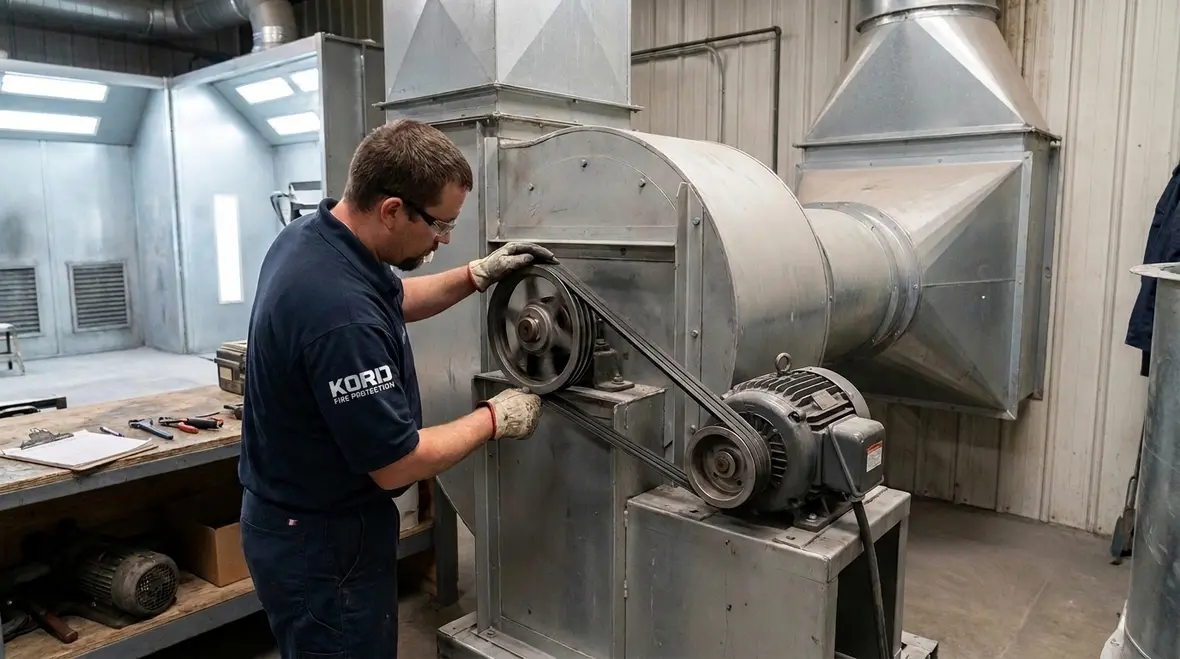
Belt and pulley arrangements are common in retrofit exhaust systems and lower-cost installations. However, belt drives can drift out of compliance due to belt stretch, glaze, fraying, pulley wear, and misalignment. In spray operations, these issues may develop slowly and remain undetected until airflow measurements, duct checks, or smoke tests reveal deficiencies.
Key checks include belt condition, tension setting, pulley alignment, and verification that the drive transmits required power under peak conditions.
Couplings, gearboxes, and mixed drives
Where couplings or gearboxes are installed, alignment and lubrication practices become critical. Inspectors frequently encounter performance degradation after maintenance shortcuts, incorrect lubricant selection, or missed lubrication intervals. Misalignment can also increase vibration and accelerate wear in the fan assembly.
Common compliance gaps in spray exhaust drive systems
NFPA 33 exhaust fan drive requirements spray operations are often missed not because teams ignore the rule, but because preventive maintenance does not match how the system actually operates in production. The following gaps show up during real-world assessments.
1) Inadequate preventive maintenance and drive inspections
Facilities often document generic “fan maintenance” without addressing drive-specific items. For belt drives, that means no scheduled belt tension and no structured review of pulley alignment. For motors, it means no practical verification of thermal condition and no trend analysis when repeat failures occur.
2) Controls do not reliably tie exhaust operation to spray
Some systems run exhaust at a fixed schedule or through a local switch, which can fail to maintain the needed exhaust state during all spray modes. Compliance requires the exhaust system to run when spray operations generate vapors and residues, including startup, shutdown, and changeover sequences.
3) Overspray residue reduces duct and fan effectiveness while the drive “still runs”
A fan can operate while delivering reduced airflow if ductwork loads up. This can force the drive to work harder, increasing heat and wear. Over time, drive degradation can further reduce airflow, creating a compounding failure cycle.
4) Electrical and mechanical modifications not validated for performance
After maintenance or upgrades, drives may be replaced with components that do not match original specifications. Even small mismatches, such as belt sizing changes or motor parameter differences, can shift system performance away from design intent.
Inspection, testing, and documentation: how facilities prove compliance
To support NFPA 33 readiness, facilities must maintain documentation that demonstrates the exhaust fan drive remains suitable for spray operations. Compliance proof comes from a combination of visual inspections, functional checks, and maintenance records.
Operational checks during spray cycles
- Confirm the exhaust system starts and maintains operation during spray conditions.
- Verify drive stability under operating load, including absence of excessive vibration, abnormal noise, and overheating indicators.
- Check that fan system response aligns with spray start and stop sequences.
Mechanical condition verification
Drive inspections should include belt and pulley evaluation where applicable, fan and motor alignment review, and examination of bearings and couplings. Where duct loading is likely, drive checks should not replace duct inspection. Instead, duct condition must be evaluated because it impacts airflow and fan loading.
Maintenance documentation that auditors expect
Records should include what was inspected, what corrective actions were taken, component replacements, and any performance verifications performed after service. Kord Fire Protection can support commercial compliance by providing structured inspection and maintenance documentation workflows that align with facility audit needs and NFPA 33 safety intent.
For additional background on related fire protection practices, see Kord Fire Protection services for commercial fire safety compliance.
How to build an effective compliance program for exhaust drives in spray environments
Facilities that maintain compliance over time treat exhaust drive systems as part of an integrated spray safety network, not as standalone equipment. A practical program includes these elements.
1) Establish drive-critical preventive maintenance intervals
Set intervals based on production intensity, overspray conditions, and equipment design. For belt systems, include belt condition checks, tension verification, and pulley inspection. For motors, include thermal observations and bearing condition evaluation aligned with manufacturer guidance and operating realities.
2) Perform performance verification after any drive work
Any change that affects power transmission, rotation speed, or control logic should trigger follow up checks. This includes belt replacement, motor swaps, starter changes, and control panel modifications.
3) Train supervisors on “run state” versus “performance state”
Operators may see the fan running and assume compliance. Training should clarify that drive health does not guarantee airflow effectiveness. Performance state verification must include checks that reflect actual exhaust performance, not only motor operation.
4) Use a compliance partner to manage recurring risk
Commercial spray facilities often face multi-trade scheduling conflicts. Kord Fire Protection helps facilities coordinate inspections, documentation, and maintenance verification so exhaust drive systems remain compliant between audits and after each service event.
Frequently Asked Questions
Get your spray exhaust drive program audit ready
Facilities can reduce compliance risk by validating fan drive reliability, confirming control logic, and ensuring maintenance aligns with how spray production impacts exhaust performance. Kord Fire Protection can support on-site inspections, documentation review, and maintenance verification to help keep your system compliant between audits. Contact Kord Fire Protection today to schedule a technical assessment of your exhaust fan drive and spray exhaust safety program.

Join Our Newsletter!
Get the latest fire safety tips delivered straight to your inbox From our Newsletter.



