
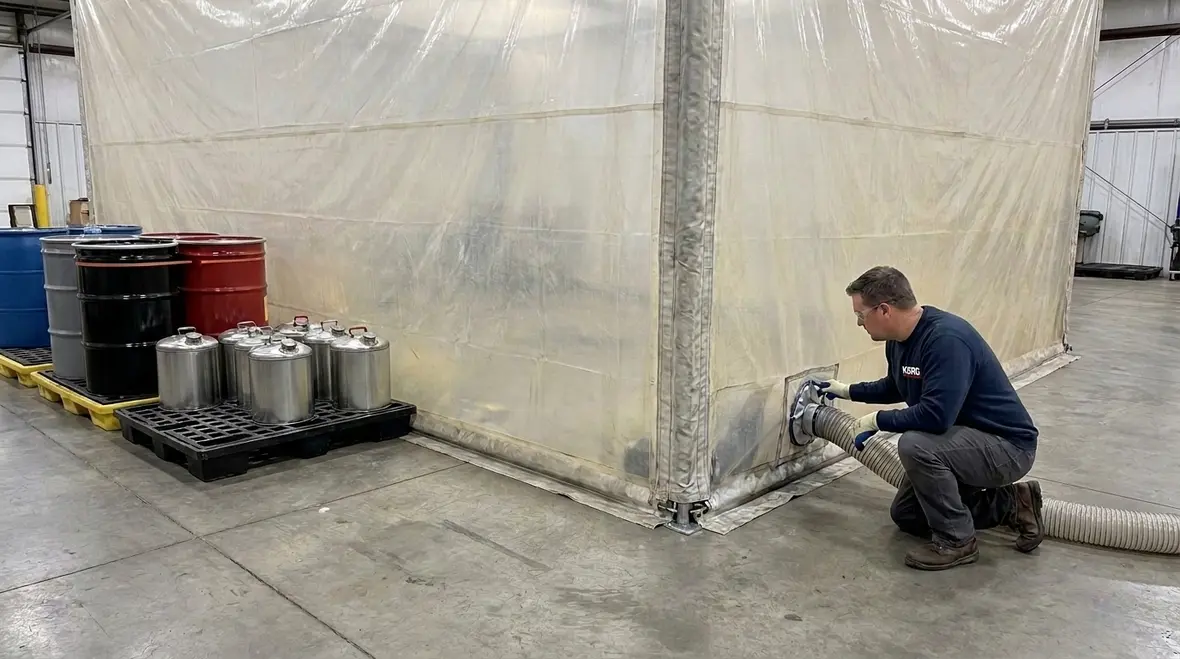
NFPA 33 Section 18.9: Ignitible Liquid Storage in Membrane Enclosures
Quick Answer: NFPA 33 Section 18.9 addresses how ignitible liquids can be stored when facilities use membrane enclosures. It focuses on limiting ignition sources, managing vapor risk, maintaining containment integrity, and ensuring inspection and maintenance controls that prevent concealed failure.
If your team is reviewing broader fire protection services in Southern California, it helps to connect this topic with inspection planning, deficiency correction, and documentation support early, not after the membrane enclosure starts acting suspicious.
What NFPA 33 Section 18.9 Requires for Membrane Enclosure Storage
NFPA 33 governs spray application using combustible or ignitible materials, including engineering controls intended to prevent fire and flash fire. In that context, NFPA 33 membrane enclosure ignitible liquid storage under Section 18.9 is not a simple “container rules” item. It is a performance expectation: the enclosure and its operating and maintenance practices must manage both liquid leakage and vapor accumulation that can increase ignition hazard during normal operations and abnormal conditions.
Commercial facilities often adopt membrane enclosure concepts to support containment, housekeeping reduction, and process flexibility. However, membrane systems can develop hidden pathways for leakage, restricted ventilation, or mechanical degradation, especially where liquids are frequently transferred, cleaned, or drained. NFPA 33 Section 18.9 aligns these risks with inspection, integrity testing, and operational controls.
Why Membrane Enclosures Change the Fire Risk Profile
Membrane enclosures alter hazard exposure compared with rigid wall containment. The enclosure is typically flexible, relies on seam integrity, and may include penetrations for piping, hoses, power, and drainage. Those characteristics can create specific failure modes that inspection teams frequently miss.
Common operational conditions that drive risk
- Vapor trapping: Membranes can reduce mixing with room air. If ventilation or exhaust fails, vapors can accumulate in low or enclosed zones.
- Hidden liquid escape: Small leaks around seams or at clamps can wet membrane surfaces without immediately dripping out.
- Contaminated surfaces: Overspray residues and cleaning chemicals can degrade membranes, reduce friction in seals, or affect drainage behavior.
- Drainage and collection issues: If drains clog or slope changes, liquids can pool and increase evaporation.
- Penetration sealing failures: Hose connections and flexible couplings can loosen during maintenance cycles, vibration, or repeated make and break operations.
Implication for compliance
Compliance requires more than “having a membrane enclosure.” NFPA 33 expectations typically translate into documented controls for storage arrangement, limits on how much ignitible liquid can be held within or associated with the enclosure system, and verification that the enclosure continues to perform under routine wear and process stress.
Engineering Controls and Storage Practices that Support Section 18.9
Facilities typically meet Section 18.9 intent through a combination of containment integrity, controlled storage quantity and placement, and ignition source management. The goal is to prevent credible leak and vapor scenarios from turning into an ignitable mixture with an ignition opportunity.
1) Storage arrangement and quantity control
Commercial application areas often store small quantities of ignitible liquids for production continuity. Section 18.9 arrangements generally require that storage within the membrane enclosure system remains limited and controlled to the minimum required for safe operation, with clear segregation from heat, electrical sources, and activities that increase spill probability.
Operational controls should also address:
- Where drums, totes, or small containers may be placed relative to process equipment and drainage paths.
- How transfers are performed to avoid spills that the membrane cannot reliably contain.
- Labeling, container condition, and secondary containment where applicable.
2) Ventilation, vapor management, and pressure behavior
Membrane enclosures commonly depend on ventilation or exhaust to prevent vapor accumulation. A key compliance challenge is that ventilation performance can degrade without obvious warning. Filters loading, fan belt wear, damper mispositioning, or duct damage can shift the enclosure from safe dilution to hazardous concentration conditions.
Best practice controls align with:
- Documented fan and airflow verification schedules
- Alarm and interlock logic tied to enclosure ventilation where required by the facility’s fire safety design basis
- Procedures that require a safe state before starting spray operations or liquid transfers
3) Ignition source control inside and associated with the enclosure
Even if the enclosure performs as intended, ignition sources remain a major determinant of incident severity. Facilities should ensure electrical equipment selection, grounding and bonding practices, and hot work controls reflect the ignitible liquid hazards.
Practical controls frequently include:
- Classified electrical components where applicable to the hazard assessment
- Strict housekeeping to prevent residue buildup that can contribute to ignition and complicate maintenance
- Hot work permit requirements that explicitly address membrane enclosure operating states
Inspection, Testing, and Maintenance: The Compliance Core
Section 18.9 compliance in membrane systems typically comes down to verification of integrity over time. Membranes change. Seams relax. Penetrations wear. Drainage systems clog. The enclosure can appear intact while still failing at critical points.
Inspection focus areas that should appear in the program
- Membrane integrity: Tears, thinning, discoloration, punctures, and seam failures.
- Penetration sealing: Cable seals, piping boots, hose connections, and any gaskets used to maintain containment.
- Drainage performance: Outlet clearances, slope maintenance, drain cleanliness, and evidence of pooling.
- Ventilation system status: Duct condition, fan operation, airflow indicators, and damper positions.
- Container condition: Corrosion, cap integrity, and compatibility with the stored liquid.
Maintenance triggers that commonly prevent “surprise” failures
Facilities often improve compliance outcomes by defining triggers that initiate corrective action before a failure becomes an incident. Examples include:
- Repeated small spills or cleaning events that increase membrane exposure to solvents
- Any loss of ventilation effectiveness, even if temporary
- Changes in product chemistry that may affect membrane compatibility or residue behavior
- Maintenance activities that disturb penetrations or seals
To support ongoing compliance, many commercial operators rely on Kord Fire Protection for inspection program development, documentation support, and verification-oriented service. This includes reviewing enclosure-related fire protection design assumptions, coordinating with facility maintenance teams, and maintaining traceable records that inspectors expect to see during audit cycles.
For a related Kord Fire resource, facilities can also review NFPA 33 Section 8.3: Handling and Using Ignitible Liquids at the Point of Use to compare storage and point-of-use controls in areas where liquid hazards overlap.
Compliance Challenges in Commercial Facilities (Retail, Industrial, and Mixed Use)
Membrane enclosure implementations appear across industrial coating, automotive, electronics manufacturing, and some retail-facing finishing operations. The compliance burden increases when staffing is lean, shift turnover is high, or multiple contractors perform maintenance in the same controlled area.
Where facilities most often fall short
- Incomplete training: Operators may understand spray procedures but not the enclosure integrity rules for storage and transfers.
- Maintenance communication gaps: Facilities might replace a seal or re-route a hose without updating the risk controls tied to Section 18.9.
- Inadequate recordkeeping: Auditors typically expect documented inspection results and corrective action tracking.
- Compatibility oversights: Some membranes fail faster when exposed to certain solvents or cleaning agents.
How to operationalize Section 18.9 safely
Effective implementation uses a closed loop: documented procedures, field verification, and rapid correction. The facility should maintain a written standard operating procedure for how ignitible liquids are stored and transferred in membrane enclosure areas, including what “abnormal conditions” mean and what actions staff must take immediately.
To ensure that the program remains reliable through the life of the equipment, Kord Fire Protection can support commercial teams with inspection planning, compliance documentation, and field verification that aligns with how enforcement and insurance partners review fire risk controls.
Frequently Asked Questions
Call to Action
If your facility uses membrane containment and stores ignitible liquids within or associated with that system, you need a practical, inspection-driven compliance program aligned with NFPA 33 Section 18.9. Contact Kord Fire Protection to review your enclosure integrity and maintenance approach, strengthen your documentation package, and schedule verification support that reduces hidden failure risk and audit exposure.

Join Our Newsletter!
Get the latest fire safety tips delivered straight to your inbox From our Newsletter.



