
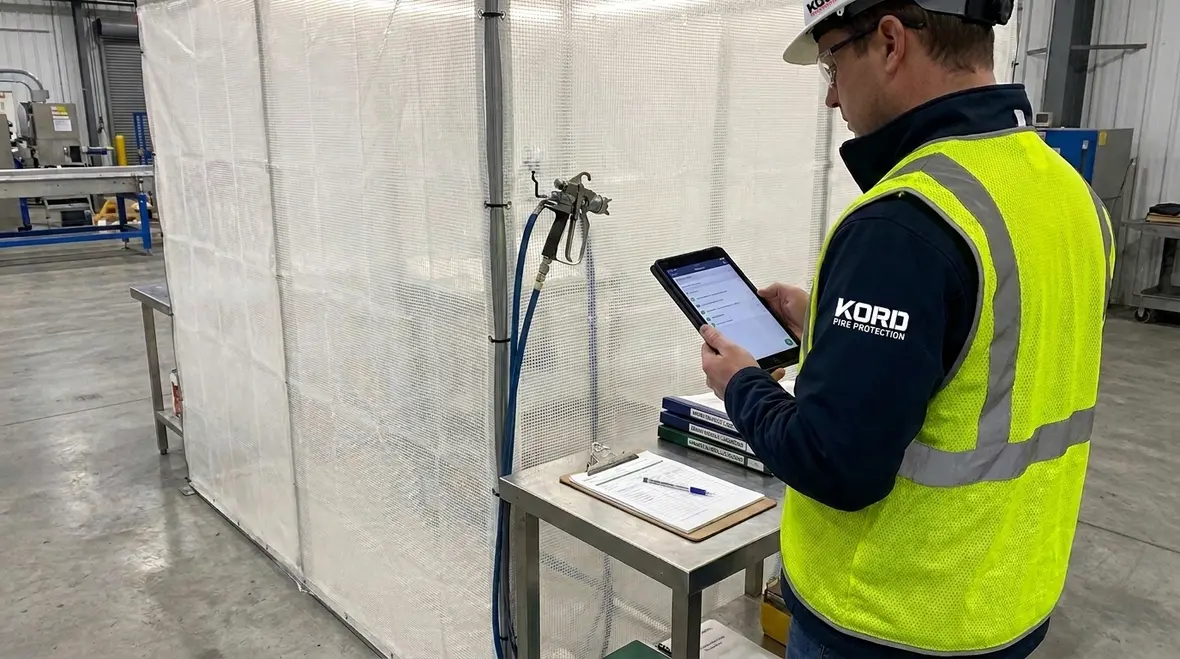
NFPA 33 Section 18.8: Recordkeeping for Membrane Spray Enclosures
Quick Answer
NFPA 33 Section 18.8 requires that operators maintain records demonstrating membrane spray enclosure maintenance, inspection, and configuration status. These records help validate that enclosures remain suitable for spray operations, support audits, and reduce the risk of unrecognized deterioration or improper setup. Strong documentation also streamlines incident and insurance reviews.
NFPA 33 membrane enclosure recordkeeping requirements apply to facilities using membrane spray enclosures to control overspray and protect personnel and property. For commercial, industrial, and retail operations, the challenge typically is not understanding the intent of documentation, but implementing a practical system that stays current, ties to actual maintenance work, and survives real world turnover.
Facilities managing broader inspection and maintenance coordination can also review fire protection services in Southern California when building a compliance process that keeps spray enclosure documentation aligned with actual field work.
What Section 18.8 Records Must Prove in the Real World
Section 18.8 focuses on maintaining documentation that shows the membrane spray enclosure remains in serviceable condition and is used as intended. For auditors, insurers, and fire officials, recordkeeping is evidence that the enclosure performs its safety function over time, not just at initial installation.
In day to day operations, this typically means your records must support four operational claims:
- Inspections occurred as required and identified deficiencies were addressed.
- Membrane condition stays within acceptable limits based on observed wear, damage, or loss of integrity.
- Critical components remain correctly installed, including anchorage, framing, seals, and connections.
- Any adjustments or maintenance actions were completed and verified after work.
Facilities often underestimate how frequently membrane systems change in practice. Technicians may reconfigure airflow, change spray patterns, replace worn sections, or temporarily modify setups to support production. Recordkeeping must capture these changes so a reviewer can trace the enclosure’s status to the operation happening at the time.
How NFPA 33 Documentation Typically Fits a Membrane Enclosure Maintenance Program
Effective compliance documentation aligns with the maintenance lifecycle for membrane spray enclosures. A strong program does not treat recordkeeping as a separate clerical task. It ties records directly to inspection mechanisms and maintenance triggers.
1) Start with a controlled baseline
Your records should begin with a baseline that identifies the enclosure and the installed configuration. At minimum, facilities should capture:
- Enclosure identification, location, and equipment description.
- Installation date and any commissioning documentation.
- Manufacturer information relevant to membrane material and recommended service intervals.
- Any site specific installation details affecting performance, such as support structure interface and duct connections.
2) Tie inspections to observable failure modes
Membrane enclosures fail gradually before they fail catastrophically. Common failure points include torn or abraded membrane areas, seam separation, damaged framing members, compromised seals, and loss of effective containment geometry. Your inspection records should link directly to these risks by using checklists and documented observations.
3) Record maintenance actions and post maintenance verification
When repairs occur, your records should show not only what was replaced or adjusted, but how you confirmed the enclosure is again suitable for use. In practice, that can include verifying membrane tension, checking seam alignment, confirming connections are secure, and documenting any rechecks of airflow performance if required by your written procedures.
If your facility runs multiple shifts, the most frequent compliance breakdown happens when the inspection responsibility shifts hands but the documentation system does not. A shared log, consistent inspection form, and clear sign off requirements reduce gaps.
If your team is already reviewing adjacent spray area compliance topics, you may also find it useful to read NFPA 33 Section 10.2: Inspection, Testing, and Maintenance Schedules for related documentation practices.
Operational Compliance Challenges in Commercial and Industrial Settings
Many facilities understand the concept of documentation but struggle with consistent execution across production schedules, staffing changes, and facility layouts. Typical challenges include:
- Production pressure overrides documentation during peak spray days, leading to incomplete logs or missing signatures.
- Untracked temporary changes such as repositioning curtains, adjusting openings, or altering setup during short work orders.
- Membrane replacements without verification that the enclosure is correctly tensioned and re sealed.
- Inconsistent criteria for “acceptable condition”, especially when different technicians interpret defects differently.
- Record storage failures where electronic logs exist but are not retained, searchable, or linked to the enclosure asset ID.
Commercial facilities and retail operations often add complexity because membrane enclosures may support higher frequency, smaller batch cycles. That increases the number of inspection opportunities, but also increases the likelihood that records lag behind production activity. Industrial plants may have similar issues, especially when multiple spray booths share maintenance resources.
Kord Fire Protection helps facilities build a compliance workflow that reflects how the enclosure is actually used. The goal is to make NFPA 33 membrane enclosure recordkeeping requirements practical, auditable, and repeatable across shifts and seasons.
For facility teams coordinating fire protection documentation and compliance support, Kord Fire Protection can integrate inspection findings into an organized maintenance and recordkeeping approach. To explore related documentation and service support, visit Kord Fire Protection.
What to Include in Your Records: A Field Ready Checklist
Your records should be structured so a reviewer can quickly answer, “Is this enclosure safe to operate today, and how do you know?” The following categories reflect the information most facilities need to meet the intent of Section 18.8.
Asset and configuration details
- Enclosure asset ID, room or location, and system type.
- Documented configuration reference, including applicable manufacturer model and setup details.
- Dates of membrane installation or major modifications.
Inspection data
- Inspection date and inspector name or identifier.
- Observation results tied to known failure modes (tears, abrasion, seam integrity, seal condition).
- Measured or assessed status (pass, conditional, fail) with clear notes.
Deficiency tracking and corrective actions
- Deficiency description and location on the membrane or enclosure structure.
- Risk assessment or operational restriction taken, if any.
- Corrective action description, including replacement parts used and repair method.
- Verification after corrective action, including who confirmed the fix and when.
Retention and audit readiness
- Document storage location, retention period, and version control practices.
- How records are made available to auditors, internal safety teams, and emergency responders.
- How electronic and paper records stay consistent.
Common gap: records that show a technician “inspected” but do not describe what was found, what was repaired, and what verification occurred afterward. For enforcement or insurance reviews, that gap increases the chance that a reviewer will treat the enclosure history as incomplete.
Verification and Maintenance: Preventing the Most Common Breakdown Points
Membrane systems can drift out of safe operating condition without obvious “instant failure.” Recordkeeping reduces risk when it captures both the symptoms and the corrective path. The most common breakdown points are below.
1) Torn or weakened membrane areas
Small tears can expand quickly under airflow and handling. Records should capture the exact location and decision taken, such as immediate repair versus continued operation with restrictions. Documentation should include verification that repairs restore containment effectiveness.
2) Seam and attachment degradation
Seam separation and failed attachments often occur along high stress edges. When technicians replace membrane sections, the record should document tensioning approach, attachment method, and post repair checks.
3) Seal and connection compromise
Connections between the membrane enclosure and surrounding structure can leak overspray containment or alter airflow patterns. Records should confirm the integrity of interfaces after any maintenance and document any changes to sealing materials.
4) Documentation disconnected from workflow
Some facilities use paper logs but do not link them to the enclosure asset ID. Others log inspections but do not record repairs in the same system. Kord Fire Protection supports facilities by helping align field inspections, corrective actions, and ongoing compliance reporting into one defensible documentation trail.
For related commercial compliance services, facilities often coordinate with Kord Fire Protection for integrated fire protection support. Start with a review of your current record structure and inspection workflow by contacting Kord Fire Protection.
Frequently Asked Questions
Call to Action
Facilities that want reliable compliance should standardize inspections, deficiency tracking, and post repair verification tied to each enclosure asset. Kord Fire Protection can help align your membrane enclosure documentation practices with real operational workflows so your NFPA 33 membrane enclosure recordkeeping requirements stay audit ready. Schedule a recordkeeping and maintenance workflow review to identify gaps, improve traceability, and reduce compliance risk.

Join Our Newsletter!
Get the latest fire safety tips delivered straight to your inbox From our Newsletter.



