
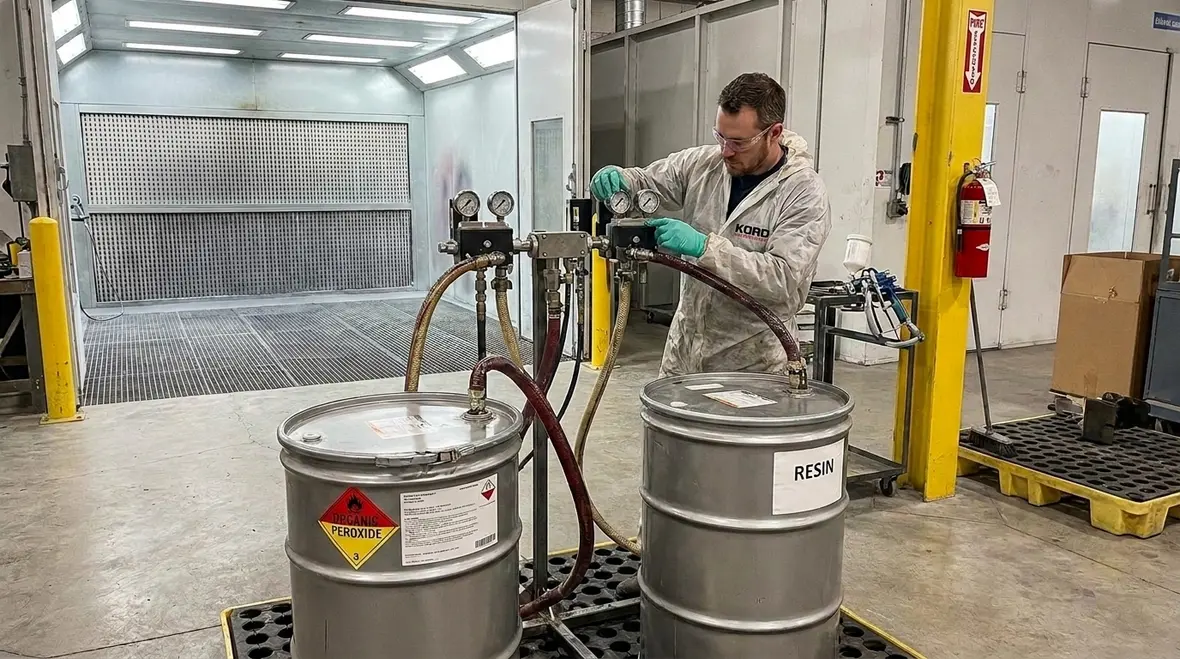
NFPA 33 Section 16.1 Scope: Organic Peroxides and Plural Component Coatings
Quick Answer
NFPA 33 Section 16.1 establishes the fire protection scope for processes that handle organic peroxides and related plural component coating systems. The section focuses on hazards, operational controls, and protective measures required to prevent ignition and limit fire growth in commercial, industrial, and retail environments.
For facilities building a stronger compliance program around these hazards, Kord Fire Protection’s NFPA 33 services and broader fire protection services offer a useful starting point for aligning inspections, testing, maintenance, and documentation with real operating conditions.
Why NFPA 33 Section 16.1 matters on the floor
Facilities that store, meter, mix, or spray organic peroxides or plural component coatings often treat “paint room rules” as an inventory issue rather than a process hazard issue. NFPA 33 Section 16.1 shifts the focus to how materials behave in real operations: transfer, dosing, agitation, pot life, purge cycles, and cure reactions. That operational reality creates recurring compliance gaps in commercial paint finishing, industrial coating lines, and high throughput retail maintenance operations that use proportioning systems.
In practical terms, the NFPA 33 organic peroxide plural component scope influences where ignition sources must be controlled, how equipment is selected and maintained, and how emergency readiness supports fast interruption of hazardous conditions.
What “scope” covers in Section 16.1
Section 16.1 is not limited to the presence of a peroxide container. It covers the conditions under which organic peroxides and plural component coatings are handled and processed, including the equipment, operational sequencing, and protection concepts that reduce the likelihood of ignition and help control escalation if abnormal conditions occur.
Organic peroxides: process hazard, not just storage hazard
Organic peroxides can decompose under heat, contamination, confinement, or shock. That means compliance depends on controlling heat input, preventing cross contamination, managing container integrity, and ensuring the system does not create conditions that accelerate decomposition.
Plural component coatings: mixing and activation risks
Plural component coatings create a hazard profile tied to mixing, metering, and cleanup. During activation, components combine to form a reactive mixture. Improper purging, residual accumulation in hoses, blocked flow paths, or inadequate ventilation can increase ignition probability and create rapid fire growth potential.
Within the NFPA 33 organic peroxide plural component scope, compliance planning typically requires mapping the entire process from receipt through dispensing, application, curing, and waste handling.
Common compliance challenges facilities run into
Commercial and industrial sites frequently fail inspections not because they lack written procedures, but because the procedures do not match how the line behaves during production variability, maintenance, or cleaning.
1) Equipment selection and condition drift
- Improper electrical classification for the coating area or incorrect grounding and bonding verification for transfer hardware.
- Wear in pumps, valves, hoses, and proportioners that increases leak frequency and creates unintended spill patterns.
- Out of spec purge cycles that leave reactive residue in lines and manifolds.
2) Process sequencing and operator handoffs
- Start up procedures that do not confirm correct component routing before activation.
- Changeover steps that leave unmixed material in low points, dead legs, or capped sections.
- Inadequate controls for maintenance work that disrupts line integrity, seals, or venting.
3) Ventilation and heat management gaps
- Ventilation rates that meet normal production but degrade during filter loading or malfunctioning dampers.
- Localized heating from blocked airflow, improperly installed heaters, or recirculation that increases material temperature.
- Uncontrolled hot work exposure during periods when peroxides or reactive coating mixtures are present.
4) Housekeeping and waste system failures
- Improper containerization of peroxide contaminated materials or mixed waste.
- Accumulation of cured residues that obstruct drainage and increase spill duration.
- Missing spill response supplies matched to the actual process hazards.
Operational controls that make Section 16.1 workable
Compliance succeeds when the facility treats NFPA 33 as an operational system. The controls below support inspections by connecting equipment, procedures, and records.
Control plan for storage, transfer, and dosing
- Use approved storage and secondary containment practices designed for organic peroxide stability needs.
- Maintain transfer lines to minimize contamination risk and reduce residual carryover between batches.
- Verify dosing accuracy and purge volume so the process ends in a safe condition, not a partially activated state.
Dispensing, mixing, and purge reliability
- Implement start up verification that confirms correct routing prior to initiating activation and flow.
- Lock purge logic to validated production settings, with documented changes for any tuning.
- Train operators on the full cleanup sequence including hoses, manifolds, and quick connects.
Ignition source management
- Ensure equipment inside the process area meets the appropriate design intent and remains in maintained condition.
- Prohibit ignition generating activities when reactive materials are present unless risk controls are in place.
- Use bonded and grounded transfer paths where applicable, and verify during periodic inspections.
Emergency readiness tied to process realities
- Provide fire response guidance that recognizes the process hazard, including safe interruption of feeding and activation.
- Maintain clear access to control stations, shutoffs, and suppression interfaces where required.
- Conduct drills that reflect actual line startup and shutdown states, not only normal operations.
Inspection, testing, and maintenance: where most failures hide
Section 16.1 compliance relies on ongoing evidence that controls remain effective. The inspection and maintenance plan should include both fire protection systems and process equipment that can create ignition or worsen escalation.
Records and documentation that inspectors expect
- Inspection logs for proportioning systems, pumps, valves, and hoses including changeout dates and leak history.
- Ventilation performance verification records and filter maintenance documentation.
- Maintenance procedures that include verification steps for grounding, bonding, and line integrity.
- Training records that show operators received update instruction after process or equipment changes.
Common “hidden” failure points
- Residual buildup in low points and dead legs that escapes notice during routine visual checks.
- Partial hose replacements with non matching materials that affect chemical compatibility.
- Incorrect purge chemistry or insufficient purge time that leaves reactive material in the system.
- Worn seals and fittings that create intermittent leaks, increasing risk during production peaks.
For commercial facilities that need consistent outcomes across multiple shifts, Kord Fire Protection helps organizations keep documentation and field conditions aligned through targeted compliance services, testing support, and maintenance planning. This reduces the gap between “paper compliance” and operational readiness.
Teams that want a broader program view can also review Kord Fire Protection’s article on consistent testing preventing costly system failures, which fits naturally with the inspection, verification, and maintenance themes behind this section.
How to build an NFPA 33 action plan for plural and peroxide processes
A practical action plan starts with risk mapping and ends with verification. Facilities can use the steps below to operationalize the NFPA 33 organic peroxide plural component scope into a repeatable program.
Step 1: Map the full process workflow
Document each stage from receiving through mixing, application, curing, and cleanup. Include maintenance states that allow temporary bypasses or line disconnections.
Step 2: Identify where reactive conditions occur
Mark activation points, purge cycles, and any opportunities for mixing to occur outside normal dosing logic.
Step 3: Verify protective measures against real equipment condition
Confirm ventilation, ignition source controls, and any protective systems match the actual installed configuration.
Step 4: Close gaps with maintenance and training
Update procedures, lock in change control for process parameters, and train operators on verified cleanup sequences.
Step 5: Schedule evidence based inspections
Create a calendar that includes verification of conditions that drift over time: seals, hose routing, filter loading, and purge performance.
If your organization requires support aligning process operations with code expectations, review Kord Fire Protection resources such as their NFPA 33 services to understand how commercial facilities structure ongoing compliance.
Frequently Asked Questions
Conclusion and call to action
NFPA 33 Section 16.1 scope requirements for the NFPA 33 organic peroxide plural component scope become manageable when a facility connects process controls, equipment condition, and verification records. Kord Fire Protection can help your team close common gaps by aligning inspections, testing, and maintenance with how your line actually runs. Schedule a compliance review to identify risk points, confirm protective measures, and build an evidence based program that holds under real production conditions.

Join Our Newsletter!
Get the latest fire safety tips delivered straight to your inbox From our Newsletter.



