
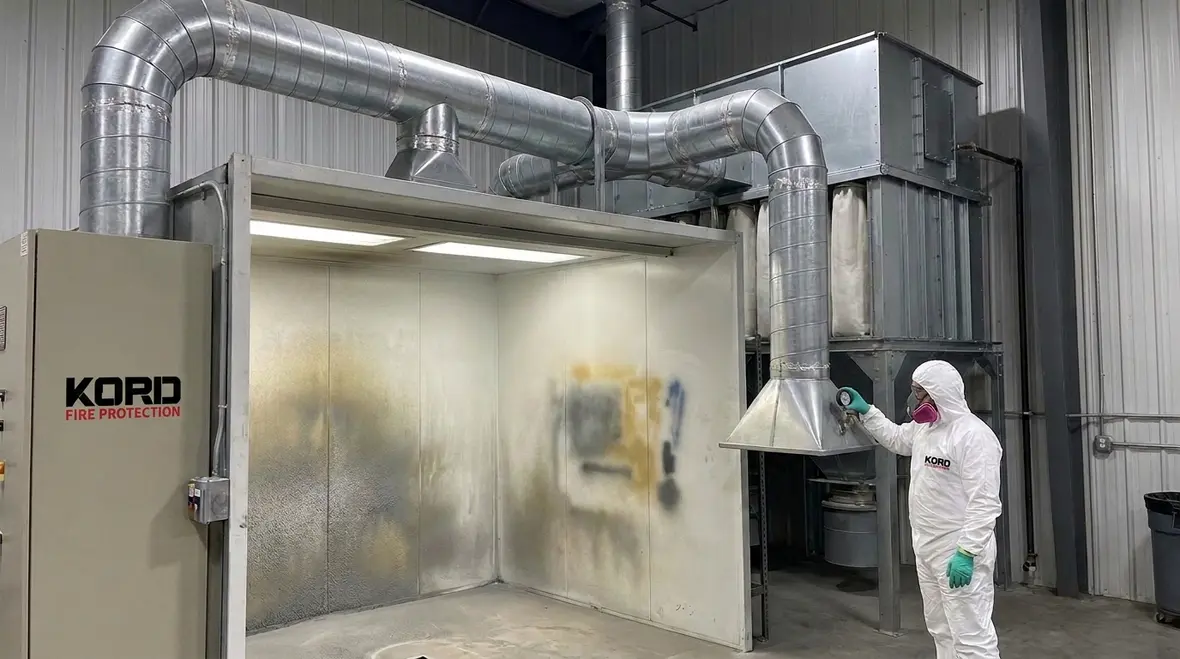
NFPA 33 Section 15.7: Ventilation and Dust Collection for Powder Coating
Quick Answer
NFPA 33 Section 15.7 sets performance focused requirements for ventilation and dust collection in powder coating operations to control combustible dust accumulation, protect workers, and maintain safe system operation. Compliance depends on proper hooding, airflow, ducting, filtration, housekeeping, and ongoing inspection and maintenance.
If you’re reviewing how ventilation performance fits into broader spray operation fire protection, Kord Fire Protection also covers protecting ventilation systems in spray operations and supports commercial facilities with inspection, testing, and maintenance planning.
What NFPA 33 Section 15.7 expects from powder coating ventilation
NFPA 33 powder coating ventilation dust collection is not treated as a “set it and forget it” utility. Section 15.7 centers on controlling airborne and settled powder so ignition and propagation risk stays low. That means the ventilation system must capture dust at the source, move it through ducting without excessive leakage, filter it effectively, and support safe disposal. The standard also expects the facility to verify the system continues to perform as designed through inspection, maintenance, and corrective actions.
In real commercial facilities, compliance usually fails at the integration points: retrofit duct runs that reduce airflow, filters that load faster than the plan, poor hood placement, and housekeeping practices that allow settled powder to accumulate where it can re-entrain.
How ventilation should be arranged and how hoods and capture points are evaluated
Section 15.7 requirements typically drive a common practical design logic. The system must provide sufficient capture at generation points such as booth openings, spray areas, reclaim zones, and conveyor transfer points. Capture efficiency depends on hood configuration, placement relative to airflow patterns in the booth, and how the system balances with makeup air.
Key operational elements
- Source capture: Hoods must be positioned to intercept powder at or near where it becomes airborne, not only where it eventually settles.
- System balance: The ventilation system must maintain predictable airflow so dust does not escape into the work area. Imbalanced systems can create eddies that pull powder out of capture zones.
- Makeup air coordination: Where negative pressure is used, makeup air must be controlled to avoid driving dust into other rooms or toward ignition sources.
- Backflow and leakage control: Duct joints, fittings, and access panels require integrity. Leakage increases room contamination and creates hotspots of accumulation.
Common failure points seen during audits
- Hoods moved or partially blocked during production changes.
- Booth operating practices that alter airflow patterns, such as improper air curtains or incorrect exhaust set points.
- Retrofitted installations where duct velocity drops due to undersized duct or excessive elbows.
For commercial and retail operations, these failures often appear after layout changes, new product lines, or workforce turnover. A compliant inspection program must therefore include operational verification during actual production modes, not only during “idle” testing.
Ducting and airflow performance: what must be controlled in powder systems
NFPA 33 Section 15.7 focuses on functional performance that supports hazard control. Ducting must convey powder safely to the dust collection device while maintaining airflow adequate for dust transport. This matters because insufficient duct velocity can cause dust accumulation within the duct itself, which becomes a secondary ignition and re-entrainment source.
Mechanisms that drive compliance risk
- Velocity loss: Airflow decreases from blocked sections, damper changes, or filter loading.
- Leaks and ingress: Poor seals allow powder to escape into the facility envelope.
- Condensation and moisture exposure: Moisture can change powder behavior and increase residue buildup.
- Improper transitions: Sharp changes in duct size or direction can create deposition points.
Commercial facility standards typically require documented performance checks that confirm airflow where it matters most. Many facilities maintain records for fan speeds, static pressure, differential pressure across filters, and results of periodic inspections. These records support both internal safety programs and third party compliance reviews.
If the facility needs to strengthen its ventilation program documentation and field verification approach, Kord Fire Protection supports commercial compliance with testing, inspection planning, and maintenance coordination designed for real production schedules.
Dust collection equipment: filtration, discharge, and safe operation
Dust collectors serve as the barrier between powder generation and the building environment. Under NFPA 33 Section 15.7, collection systems must function effectively to limit the release of combustible dust and reduce the quantity of settled material. The system design must also address what happens to captured dust, including safe containment and disposal.
Filters and loading: why differential pressure trends matter
Filtration performance degrades as dust loads. Many installations control airflow indirectly by monitoring pressure drop across filters. When differential pressure exceeds design limits, the system can lose conveyance velocity, create bypass release paths, or require corrective action such as filter cleaning or replacement.
- Filter integrity: Damaged bags or cartridges can release dust to downstream ducting.
- Cleaning cycle effectiveness: Pulsing or mechanical cleaning must be tuned so it removes dust from the media without damaging it.
- Collector fan operation: Fan speed and motor performance must match the design basis.
Disposal and safe containment
Captured powder must be handled and removed in a way that prevents secondary accumulation. Common best practice controls include sealed collection containers, defined transfer areas, and procedures that prevent re-entrainment during emptying.
For facilities with multiple booths or reclaim systems, the dust collection strategy must address where powder travels after collection. Failure to control these pathways often results in dust build up in unexpected areas such as transfer stations, maintenance corridors, or storage rooms.
To align documentation and maintenance records with a robust compliance posture, Kord Fire Protection can help commercial operators structure inspection and preventive maintenance activities around equipment condition, airflow verification, and collection effectiveness.
Maintenance, inspection, and housekeeping: sustaining compliance between tests
NFPA 33 Section 15.7 compliance depends on sustained performance. Ventilation systems deteriorate due to normal use, filter loading, duct contamination, and maintenance shortcuts. A strong program uses a mix of routine checks and scheduled servicing tied to real operating hours and production intensity.
What inspections should include
- Physical inspection: Check hoods, duct joints, access doors, and collector connections for leakage and buildup.
- Operational readings: Verify airflow and static pressure trends against the established baseline.
- Filter condition: Evaluate differential pressure patterns and media integrity.
- Discharge and dust handling: Confirm containers, closures, and transfer practices prevent escape.
- Housekeeping verification: Validate that settled dust is removed before it reaches unsafe accumulation levels.
Housekeeping failure is often the hidden trigger
Many powder coating facilities focus on the collector and overlook settled dust on structural surfaces, lights, beams, overhead piping, and floors around the booth. Even a properly sized collector can fail hazard control if powder accumulates and becomes re-entrained by traffic, fans, or cleaning practices.
Commercial compliance programs should also define cleanup methods that minimize dust disturbance. Dry sweeping or compressed air practices can increase airborne dust loads if not controlled correctly. A documented cleaning method supports both risk reduction and consistent training.
For internal continuity and defensible compliance, Kord Fire Protection provides support for field inspection coordination, maintenance guidance, and documentation practices that reflect how systems perform in daily production.
Practical compliance checklist for commercial powder coating facilities
The following checklist translates NFPA 33 Section 15.7 intent into actions a facility can assign to responsible teams. It also supports audit readiness across industrial and retail commercial environments.
| System Area | What to verify | Why it matters |
|---|---|---|
| Hoods and capture points | Placement, obstructions, and airflow response during spray | Prevents escape of powder into the work area |
| Ducting integrity | Seals, joints, access covers, and accumulation inside runs | Reduces leakage and secondary dust reservoirs |
| Airflow and conveyance | Air velocity indicators, static pressure, and fan condition | Maintains transport to avoid duct deposition |
| Collector filtration | Media condition, differential pressure trends, cleaning function | Limits dust release and maintains system performance |
| Dust disposal | Container integrity, transfer method, and housekeeping around discharge | Prevents re-entrainment and uncontrolled accumulation |
| Housekeeping | Scheduled cleaning, dust removal verification, training for safe methods | Controls settled dust that can ignite or re enter airflow |
To strengthen long-term compliance, establish baseline performance measurements and document deviations. Kord Fire Protection can assist commercial facilities with structured compliance support that aligns maintenance activities to actual ventilation system condition and inspection findings.
Frequently Asked Questions
Need a compliance-ready ventilation and dust collection program?
Schedule a Kord Fire Protection review of your NFPA 33 powder coating ventilation dust collection controls to confirm capture effectiveness, airflow performance, collector condition, and housekeeping integration. Kord can help you organize inspections, documentation, and maintenance activities around real production conditions, reducing audit risk and improving operational safety. Contact Kord Fire Protection today to start a practical compliance path.
For broader compliance support, explore Kord Fire Protection’s fire protection services for commercial facilities to connect ventilation risk management with inspection-ready system maintenance.

Join Our Newsletter!
Get the latest fire safety tips delivered straight to your inbox From our Newsletter.



