
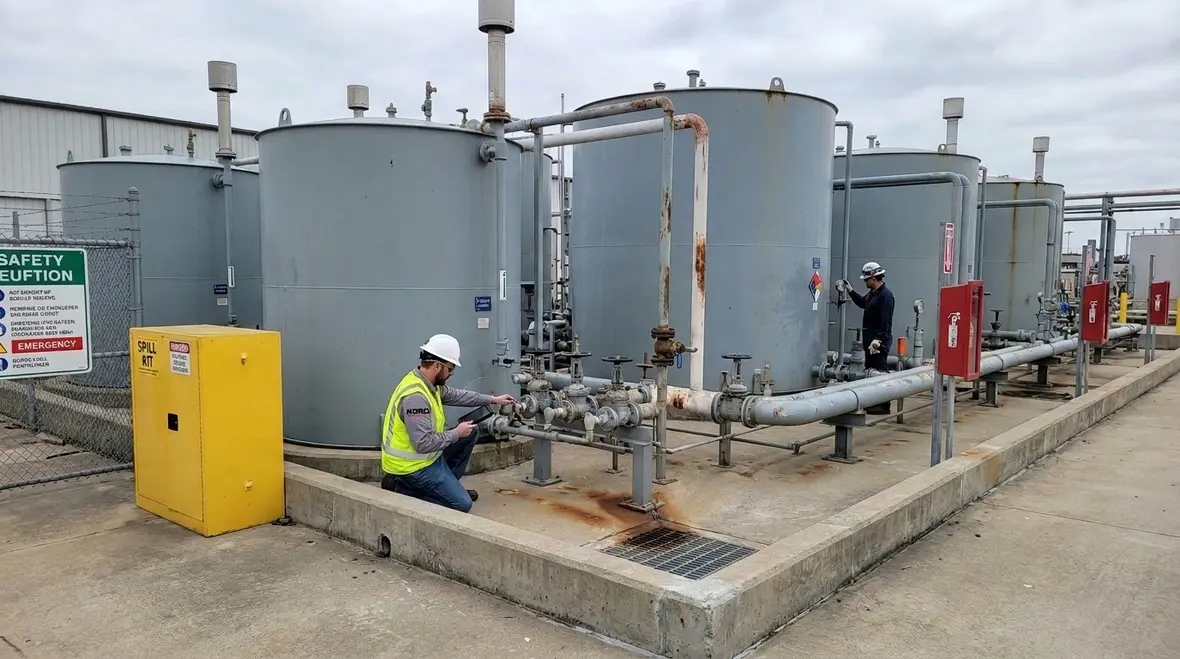
NFPA 32 Section 7.5 Storage Tanks for Type II Facilities
Quick Answer
NFPA 32 Section 7.5 sets requirements for storage tanks serving Type II facilities, focusing on tank placement, construction, corrosion control, secondary containment, piping integrity, and inspection readiness. Compliance hinges on documented maintenance, routine checks, and prompt correction of defects that could release flammable or combustible liquids.
For facilities tightening up inspection readiness, it also helps to build your tank program into a broader inspection, testing, and maintenance plan so findings, repairs, and follow-up checks do not drift into the “we meant to get back to that” pile.
What Section 7.5 is trying to prevent in Type II operations
NFPA 32 Type II solvent storage tanks operate in real world commercial and industrial environments where tanks, piping, valves, and transfer components experience vibration, temperature cycling, and exposure to weather or cleaning agents. Section 7.5 addresses failure pathways that lead to flammable vapor release, liquid escape, and fire growth. For facility teams, the highest risk items typically include loss of containment at fittings and joints, undetected corrosion under insulation or coatings, and compromised venting or pressure relief functions.
In practical terms, Section 7.5 pushes operators to maintain tank integrity as a system, not as a standalone vessel. That system includes foundations, spill control measures, piping routes, valves, vents, pumps, and inspection documentation that ties observed conditions to corrective actions.
Core compliance scope: how Section 7.5 treats tanks and their operating context
Section 7.5 requirements apply to how tanks are designed, installed, and maintained at Type II facilities. Compliance considerations often show up during plan review and field inspections as questions about:
- Tank installation details that affect stability and fire exposure protection
- Secondary containment performance and integrity, where required
- Piping and appurtenances that can create release points
- Venting and relief arrangements that prevent unsafe pressure or vacuum conditions
- Inspection access for evaluation, testing, and repair work
- Documentation, labeling, and maintenance records for auditable proof
Commercial facilities frequently underestimate the operational impact of these requirements. A tank can be compliant at installation but become noncompliant after modifications, coating degradation, or repeated transfers that stress hoses, couplings, and gaskets.
Installation and layout: where field conditions break compliance
Tank siting, access, and fire exposure
NFPA 32 Section 7.5 expects installations to minimize the likelihood that external conditions will compromise the tank or containment. Field realities often include tight loading areas, vehicle traffic near manifolds, and storage racks that block inspection access. Facility teams commonly discover that clearance, access pathways, or protective barriers do not match the approved installation drawings.
For Type II operations, the most common layout compliance issues include:
- Restricted access for gauge reading, visual inspection, and leak detection checks
- Improper protection for valves and piping against impact damage
- Drainage patterns that route spills away from secondary containment as intended
- Insufficient clearance for fire control equipment or emergency response
Secondary containment and spill control performance
Section 7.5 emphasizes containment concepts that align with controlling the consequences of a release. In the field, containment often fails due to small but critical issues such as cracks, compromised liners, clogged drains, incorrect slopes, or damaged seals around penetrations.
Operators should treat secondary containment as an engineered system with ongoing verification, not as a passive feature. Routine checks should include integrity of drains, observation of pooling conditions during simulated or documented transfers where permitted, and inspection of penetrations around pipe sleeves and instrumentation lines.
Maintenance, inspection, and testing: the operational backbone of Section 7.5
Most compliance shortfalls do not come from misunderstanding the code language. They come from inconsistent inspection discipline, weak maintenance triggers, and incomplete corrective action tracking. A strong program aligns tank condition assessment with transfer activity patterns, environmental exposures, and known weak points.
Common failure points in NFPA 32 Type II solvent storage tanks
- Corrosion under insulation or coatings: Surface appearance may look acceptable while internal or hidden corrosion progresses. Solvent vapors can also accelerate degradation in certain configurations.
- Valve stem and packing leakage: Repeated thermal cycling and contamination from process residue can cause weeping that becomes a larger leak under sustained operation.
- Joint and flange seepage: Gasket aging, bolt relaxation, and improper torque history can produce chronic minor releases.
- Hose or flexible connection wear: Transfers create mechanical stress and abrasion. Aging hoses and worn couplings commonly develop leaks first at the ends.
- Vent and relief pathway limitations: Blockage from debris or improper installation can disrupt safe pressure management.
- Foundation settlement and alignment drift: Settlement can load piping and stress nozzles, increasing failure risk at penetrations.
What a defensible inspection plan looks like
A defensible Section 7.5 inspection plan ties procedures to specific tank components and expected conditions. It should include:
- Planned visual inspections for corrosion, staining, wetness, and coating breakdown, with clear acceptance criteria.
- Leak investigation workflow that does not stop at observation. The plan should define how teams identify the source at fittings, valves, gauges, and connections.
- Verification of venting and relief readiness, including checks for obstructions and evidence of tampering or improper modifications.
- Documentation controls that link inspection findings to repairs, re acceptance, and follow up verification.
- Maintenance trigger points based on observed degradation, transfer frequency, and environmental exposure.
When these elements are not standardized, facilities often experience repeated “find, patch, repeat” cycles that accumulate risk and increase downtime costs.
Commercial service integration: how Kord Fire Protection supports ongoing compliance
NFPA 32 compliance for Type II tank systems depends on consistent field execution and auditable maintenance. Kord Fire Protection supports commercial, industrial, and retail facilities with practical fire protection services that align inspections and maintenance with day to day operations. Their approach helps facilities reduce downtime, close documentation gaps, and address component level issues before small leaks become incidents.
For teams building or refreshing an internal compliance program, Kord Fire Protection can assist with ongoing testing, inspection coordination, and service planning based on the specific tank configuration and usage profile.
Learn more about Kord Fire Protection services
How to prepare for audits and field inspections: quick operational checklists
Facilities that pass inspections consistently share a common trait: they can demonstrate that maintenance actions match observed conditions. A short readiness routine typically improves audit outcomes.
Day to day readiness items
- Up to date tank and piping labeling that matches current equipment configuration
- Access routes maintained for inspection and emergency response
- Vent discharge areas kept free of obstructions and debris
- Recent work orders for repairs and gasket or seal replacement tied to specific locations
- Leak response records that show source identification and corrective closure
After changes and repairs
Any modification to tank appurtenances, piping runs, valves, gauges, or connection assemblies can affect compliance status. Facility teams should verify that the “as found” condition is corrected and that post repair verification is performed and recorded, including confirmation that containment and venting functions remain in place and undisturbed.
Frequently Asked Questions
Call to action: Review your NFPA 32 Type II solvent storage tanks program for inspection coverage, containment integrity verification, and documentation closure. If you want stronger compliance defensibility and fewer repeat findings, contact Kord Fire Protection to align ongoing testing and maintenance with your tank configuration, transfer practices, and audit requirements.

Join Our Newsletter!
Get the latest fire safety tips delivered straight to your inbox From our Newsletter.



