
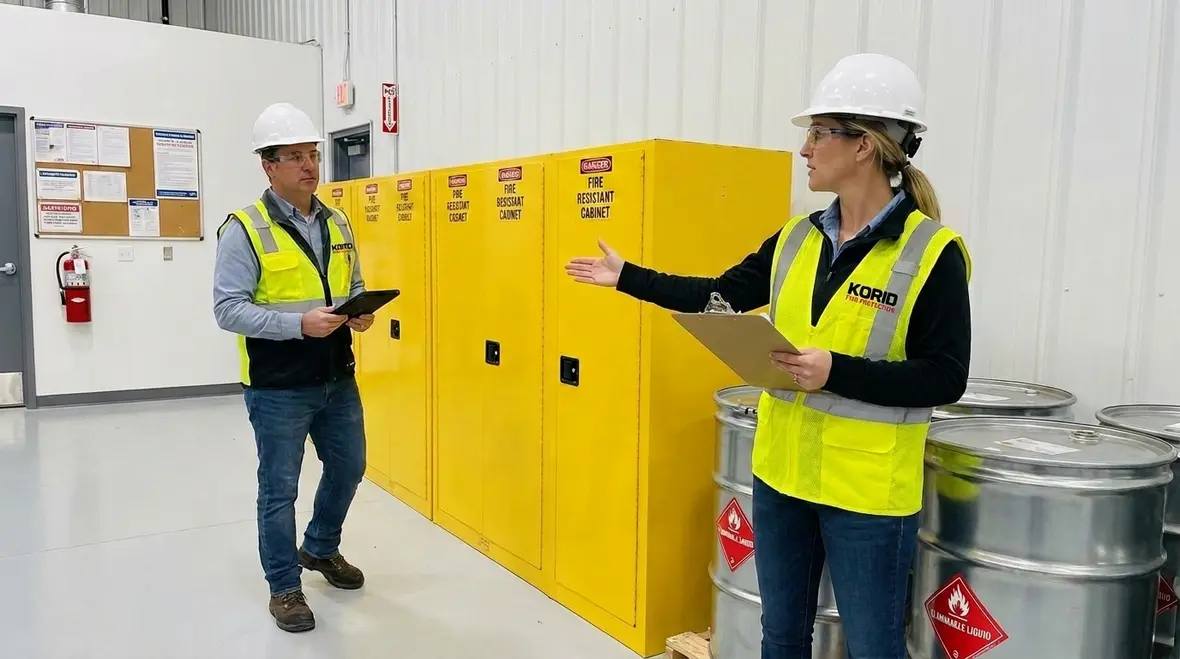
NFPA 30 Section 3.1: How Definitions Apply Across the Code
Quick Answer: NFPA 30 Section 3.1 establishes how the code’s definitions control meaning across all chapters. When terms are defined, the defined wording governs compliance decisions, inspections, signage, and enforcement. This section reduces ambiguity for flammable liquid storage, handling, and fire protection requirements.
If your facility also needs broader fire protection inspection, testing, and maintenance support, align that service work early with the same NFPA terminology your compliance records rely on.
NFPA 30 Section 3.1 general rules for code definitions, and why they matter
Commercial fire and safety teams often treat NFPA definitions as “reference only.” In practice, NFPA 30 Section 3.1 general rules for code definitions determine what your procedures, equipment selection, inspection checklists, and documentation mean when regulators review your site.
When a facility adopts an internal compliance standard based on NFPA 30, the team must ensure every operational document uses the same defined terms. This prevents gaps where staff interpret a requirement differently than the code intends, especially during commissioning, maintenance, and incident response.
What Section 3.1 actually controls across NFPA 30
Section 3.1 serves as the interpretive backbone of NFPA 30. It clarifies that definitions are not suggestions. They set the meaning of terms used throughout the standard. In day to day operations, that translates into consistent classification, consistent application of requirements, and consistent enforcement outcomes.
1) Defined terms override everyday language
Many operational terms in commercial environments overlap with common wording, but they do not always match code intent. Section 3.1 requires that the defined term controls how the code is applied. For example, a label used by production staff, inventory systems, or chemical vendors might not align with the code’s definition used for design and protection decisions.
Common compliance challenge: Facilities update chemical suppliers, product names, or storage labels without revalidating code classification. The result is a mismatch between what employees think the product is and how the code defines it for storage and fire protection.
2) Classification decisions depend on accurate definitions
NFPA 30 uses definitions to drive requirements for containers, storage location, ventilation, spill management, and emergency response planning. When definitions apply across the code, the classification you select becomes a controlling input for multiple downstream sections.
Operational failure mode: A facility revises storage practices, adds secondary containment, or changes arrangement, but the site basis of classification remains unchanged. During an inspection, the defined term interpretation can trigger re-scoping of the hazard classification and associated protection systems.
3) Defined meanings affect inspection and testing scope
Inspectors typically look for evidence that the site matches the code intent reflected in the definitions. That includes how you document compliance for:
- Container condition and compatibility with the material as defined by the code
- Storage configuration, including layout and clearances tied to code terminology
- Fire protection features connected to defined system or hazard attributes
- Training and operating procedures that use the defined terms consistently
Because Section 3.1 general rules for code definitions apply across the code, a “minor” terminology inconsistency can expand into a broader compliance finding when an authority reviews your documentation package.
How this impacts commercial facility operations
In commercial, industrial, and retail settings, the definitions in NFPA 30 shape both engineered and procedural controls. The largest risk appears where multiple departments touch flammable liquid systems, such as procurement, operations, EHS, maintenance, and contractors.
Documentation and asset management
Many facilities rely on spreadsheets, ERP fields, or Safety Data Sheet references to describe storage and handling. Section 3.1 general rules for code definitions require that the code meaning drives classification and labeling in your compliance records.
Practical requirement: Your asset register should map each storage area and container type to the defined terms used by NFPA 30, not just to vendor descriptions. This includes recording review dates when products change and noting who approved reclassification.
Maintenance procedures must stay definition aligned
Fire protection systems and impairment management depend on accurate hazard identification. When maintenance teams do not use the code definitions, they may service systems under the wrong hazard assumptions. Even when the equipment is functioning properly, misalignment can invalidate the compliance basis.
High frequency issue: After a retrofit, contractors update hardware but site staff keep the previous terminology in inspection checklists. Regulators often treat this as incomplete demonstration of compliance because Section 3.1 requires consistent interpretation across the code.
Training and operating practices
Procedures for receiving, transferring, storing, and responding to releases must use the same terminology that drives the code requirements. Staff should understand the defined term language well enough to follow the correct workflow.
Example scenario: Transfer operations using temporary containers can create classification differences depending on how the code defines the container and the storage arrangement. If procedures do not track those definitions, the facility can exceed intended operational boundaries during peak workflow periods.
Where teams get tripped up during inspections
Regulatory reviews frequently reveal issues tied to definition usage rather than hardware. Inspectors may focus on whether the facility correctly demonstrated code intent by using definitions consistently.
1) Vendor documentation drift
Chemical product names and SDS content can change. If the facility does not revalidate classification and update compliance records, the definition match can deteriorate over time. This creates an audit trail gap that becomes visible when questioned.
2) Mixed storage categories in the same area
Commercial sites often store multiple products in close proximity. Defined terms can impose different handling and protection requirements. If signage, segregation approach, or inspection routines do not reflect those definitions, the facility can fail to demonstrate compliance for the higher risk category.
3) Inconsistent use of defined terms in plans and procedures
When drawings, emergency plans, and operating procedures use different wording, teams cannot show that the code definitions match the facility’s implemented controls. Section 3.1 general rules for code definitions require that the defined meanings remain consistent wherever the term appears.
4) Incomplete impairment and commissioning checklists
Maintenance and commissioning checklists often verify equipment condition without confirming definition based assumptions. If the hazard basis changes, checklists must also change. Otherwise, the facility can conduct technically correct work while still failing the broader compliance intent.
Using Kord Fire Protection to keep definitions, classification, and protection aligned
NFPA 30 compliance depends on more than installing equipment. It depends on maintaining a consistent code meaning across hazard identification, documentation, inspection scope, and ongoing maintenance cycles. Kord Fire Protection helps commercial sites close definition driven gaps that commonly appear during audits and re certifications.
For practical context on how NFPA 30 regulates flammable liquids at an operational level, see:
How NFPA 30 regulates flammable liquids and what facilities must control
From compliance support to recurring inspection and maintenance coordination, Kord Fire Protection positions your facility to interpret NFPA requirements the same way every time. That reduces rework, shortens corrective action cycles, and improves the defensibility of your documentation package across commercial, industrial, and retail operations.
Frequently Asked Questions
Next step
If your facility stores, handles, or manages flammable liquids, align your NFPA 30 compliance documentation and operating procedures with the defined terms that control Section 3.1 interpretation. Kord Fire Protection can help you verify classification consistency, tighten inspection scope, and support ongoing maintenance and audit readiness. Contact Kord Fire Protection to schedule a definition alignment and compliance review for your site.

Join Our Newsletter!
Get the latest fire safety tips delivered straight to your inbox From our Newsletter.



