
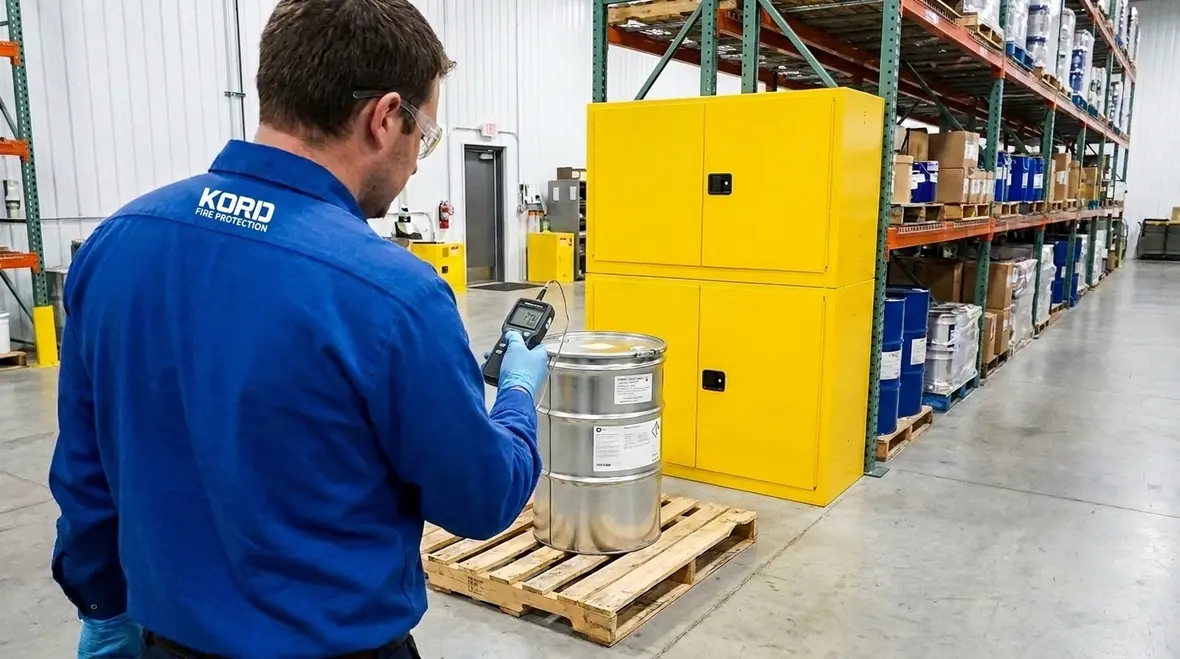
NFPA 30 Section 3.3: Flash Point, Boiling Point, and Liquid Classes Defined
Quick Answer: NFPA 30 Section 3.3 defines key thermodynamic terms, including flash point and boiling point, and ties them to how liquids are classified. These general definitions flash point liquid classes support correct storage, ventilation, ignition control, and hazard communication requirements across commercial and industrial sites.
If your team is reviewing flammable liquid hazards as part of a broader compliance program, fire suppression system services can help support the inspection, testing, and maintenance side that keeps those hazard assumptions connected to real-world protection.
Why NFPA 30 Section 3.3 matters to real world compliance
Many compliance gaps do not come from missing paperwork. They come from misclassification. When a facility assigns the wrong liquid class, it can cascade into incorrect tank limits, inadequate ventilation, improper ignition control, and storage arrangements that fail inspection. NFPA 30 Section 3.3 general definitions flash point liquid classes provide the measurement and classification foundation that the rest of the standard builds on.
Commercial facilities commonly encounter this during changeouts of solvents, coatings, cleaning agents, and fuels used in operations like maintenance, janitorial chemical management, and retail back of house storage. Accurate classification also reduces downtime during audits because the hazard basis aligns with the design intent of the installation.
What Section 3.3 defines: flash point and boiling point
Flash point definition in operational terms
NFPA 30 Section 3.3 addresses flash point as the critical temperature behavior that indicates how readily a liquid can produce ignitable vapor. Practically, flash point answers a safety question: when the liquid is heated or exposed to ambient temperatures, will it generate enough vapor to ignite if an ignition source is present?
Facilities use this definition to control ignition risk through three common levers:
- Temperature control and monitoring to prevent vapor generation above design expectations.
- Ignition source management through equipment selection, grounding and bonding, and hot work controls.
- Segregation and storage arrangement to limit the size and exposure of vapor generating sources.
During inspections, the flash point value becomes a key reference for reviewing container labeling, SDS data, and storage configuration. A frequent failure point is using an outdated SDS, assuming a generic product, or recording a flash point without verifying the source method and conditions.
Boiling point definition and why it affects hazard assessment
Boiling point is the temperature at which a liquid transitions to vapor rapidly, increasing the likelihood of sustained vapor formation. While flash point indicates the onset of ignitable vapor generation, boiling point informs the facility risk posture when conditions approach elevated temperatures such as heated transfer lines, process equipment, or uncontrolled fire exposure.
Commercial and industrial operators use boiling point concepts to evaluate:
- Exposure during fire scenarios, where adjacent heat can raise liquid temperature.
- Ventilation assumptions for storage areas that may experience temperature rise.
- Compatibility with transfer and handling practices, especially for heated pumps and recirculation systems.
How liquid classes connect to flash point and facility controls
Liquid class as a compliance driver
NFPA 30 Section 3.3 general definitions flash point liquid classes translate thermodynamic measurements into standardized hazard categories. Those categories then drive the design requirements that follow throughout NFPA 30, such as permitted storage arrangements, limitations on quantity, and protective provisions.
Because liquid classes function as a “common language” across engineering, operations, and inspection teams, misclassification usually shows up in multiple places at once:
- Improper cabinet, room, or outdoor storage segregation.
- Incorrect maximum container sizes and storage limits.
- Ventilation requirements not aligned with vapor potential.
- Missing or mismatched ignition control controls relative to expected vapor conditions.
Common real world classification challenges
Commercial facilities frequently face classification risk due to these conditions:
- Product reformulation: Manufacturers can change additives and volatile content, shifting flash point values.
- Blended products: Custody transfers, dilutions, and in house mixing can produce a different flash point than the original concentrate.
- Documentation mismatch: Facility records may reference an old SDS or internal datasheet version.
- Storage temperature assumptions: Indoor environments can exceed expectations, especially near HVAC discharge, heat loads, or direct sun.
- Container variability: Bulk tanks versus drums can alter vapor behavior during handling and venting, even when the chemistry is the same.
Inspection readiness: what auditors typically validate
Most enforcement actions are not solely about whether the facility “knows” the flash point and boiling point. They focus on whether the facility can demonstrate consistent classification and control implementation. A strong compliance posture ties the definitions in NFPA 30 Section 3.3 to controlled storage practices and documented inspection processes.
Documentation controls that reduce inspection delays
- Maintain an SDS-controlled flash point record with version control and procurement link to the exact SKU.
- Use product specific data, not generic category approximations.
- Document how the facility determined liquid class and who approved the classification.
- Track changes when products are reformulated, relabeled, or replaced.
Equipment and layout checks that tie back to Section 3.3
To align with general definitions flash point liquid classes, a facility typically verifies:
- Storage segregation by compatible hazard grouping and separation distance requirements where applicable.
- Ventilation function, including fan operation, duct integrity, and verification of intended airflow patterns.
- Grounding and bonding continuity procedures for transfer points and dispensing areas.
- Spill control that limits vapor release and prevents pool formation near ignition sources.
- Ignition control programs such as hot work permits, equipment ratings, and housekeeping audits.
Common failure point: maintenance teams focus on mechanical upkeep but do not confirm that the operational conditions still match the hazard assumptions used for classification and storage design.
How Kord Fire Protection supports ongoing compliance
Correct classification is only the start. Commercial facilities need an ongoing system that keeps hazard data current, verifies storage and ventilation performance, and closes the loop between procurement, operations, and fire protection engineering. Kord Fire Protection supports facilities with practical compliance planning, inspections, and maintenance coordination so teams can sustain readiness between formal audits.
For additional context on how NFPA 30 regulates flammable liquids, see how NFPA 30 regulates flammable liquids.
Commercial and retail environments also benefit from a controlled workflow that updates liquid class records whenever chemicals change, ensures staff training aligns with the current hazard profile, and verifies protective systems remain within intended operating parameters.
Frequently Asked Questions
Next step: confirm your liquid class and keep it current
Facilities should treat NFPA 30 Section 3.3 general definitions flash point liquid classes as a living compliance requirement, not a one time documentation exercise. Kord Fire Protection can help review your hazard data controls, align storage and protective measures with the current liquid class basis, and support inspection readiness through practical testing and maintenance coordination. Contact Kord Fire Protection to schedule a compliance and hazard classification review.

Join Our Newsletter!
Get the latest fire safety tips delivered straight to your inbox From our Newsletter.



