NFPA 30 Section 17.12: Spill Control in Processing Areas
Quick Answer: NFPA 30 Section 17.12 establishes expectations for containing, controlling, and managing spills in processing areas for flammable and combustible liquid operations. It requires systems and procedures that prevent liquids from spreading, support safe response, and remain reliable through inspection and maintenance.
Why NFPA 30 Section 17.12 spill control processing matters in real facilities
Commercial, industrial, and retail sites that process flammable and combustible liquids face a predictable risk pattern: small releases happen often, and the hazard escalates when liquids spread beyond the immediate area. NFPA 30 Section 17.12 spill control processing is designed to reduce that escalation by requiring spill control methods that contain liquid, limit migration, and support timely response.
In practice, compliance fails most frequently where spill controls are treated as “one time install” projects instead of a living part of the process safety system. Sediment buildup in sumps, damaged berm surfaces, clogged drains, missing absorbents, and out of tolerance drainage design all degrade performance. A compliant program ties spill control hardware to inspection frequency, documented maintenance, and trained response procedures.
For facilities tightening overall readiness, Kord Fire Protection also offers inspection, testing, and maintenance support that fits naturally alongside spill control oversight in real operating environments.
For broader context on how NFPA 30 regulates flammable liquids, facilities can reference this overview: how NFPA 30 regulates flammable liquids.
What “spill control” typically means under Section 17.12
NFPA 30 Section 17.12 focuses on processing areas where liquids can spill due to transfer, equipment operation, hoses and connections, valves and fittings, pumps, and handling activities. The intent is to ensure spilled liquid does not freely migrate into uncontrolled areas such as drains that discharge to lower grades, pits, or external spaces where ignition sources may exist.
For many facilities, spill control measures are built from layered elements that work together:
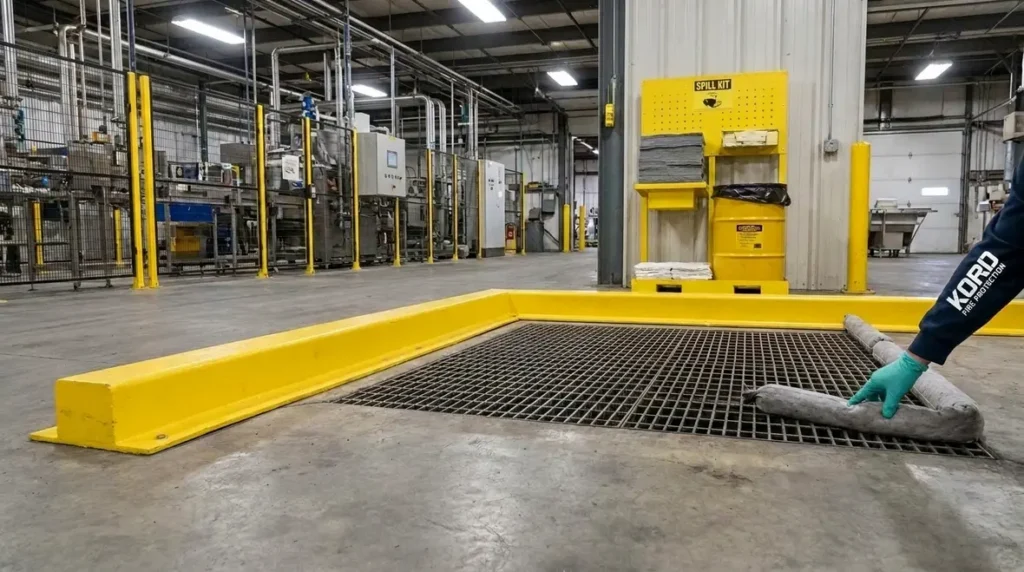
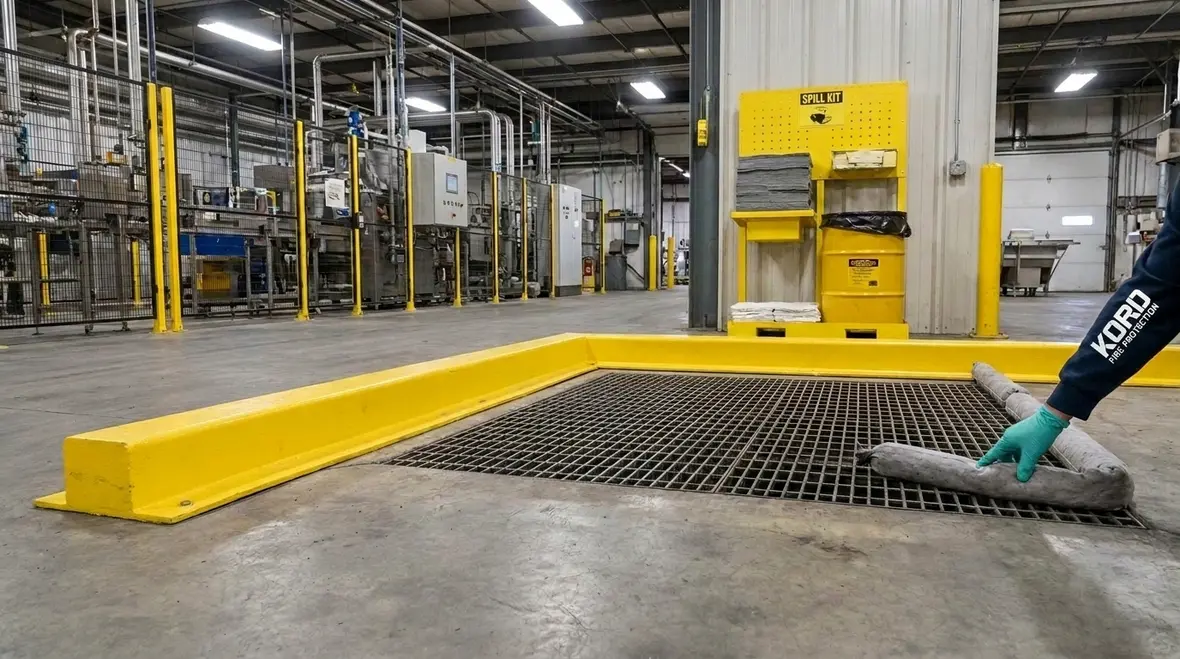
- Secondary containment concepts in the processing area using curbs, ramps, or berms that retain released liquid.
- Drainage control that limits or redirects flow so spills remain within the designed area.
- Retention and isolation equipment such as spill containment systems, closed drains, catch basins, or sump management aligned with the process hazard.
- Physical housekeeping controls that prevent spread through debris, pooled residue, or compromised floor coatings.
- Response readiness including absorbent materials and safe cleanup procedures consistent with the site’s hazards.
Because Section 17.12 applies to processing areas, facilities must align spill control with operational realities, including how product lines drain after shutdown, where hoses are stored, how maintenance is performed, and how quickly operators can initiate cleanup without creating additional ignition risk.
Containment and drainage: the mechanisms that make spill control work
Containment without functional drainage control often fails during real events. A common scenario involves a processing bay with curbing or berming, but with floor drains that allow liquid to escape before responders can isolate flow. Another scenario involves catch basins or sumps that accumulate water and residue, causing limited retention capacity when it is needed.
1) Berms, curbs, and rated floor integrity
Berms and curbs must retain the spilled liquid long enough for safe response. Their effectiveness depends on surface integrity, correct height, continuity at expansion joints, and resistance to chemical attack from the stored product. Floor coatings and sealants also matter. Cracks, lifted sealant, or degraded coatings can allow lateral migration under containment features.
Common failure points: missing end caps, sealant deterioration at penetrations, damaged berm corners where forklifts or maintenance traffic hit, and improper slope that encourages bypass flow around containment.
2) Drainage isolation and controlled routes
Spill control processing requires a drainage arrangement that matches the hazard profile. Facilities often use closed drain systems, normally closed isolation devices, or controlled diversion to retention so that spilled product remains in a defined boundary. Where drains exist, they must not undermine containment performance.
Common failure points: strainer baskets removed during routine cleaning, valve handles left in the open position, automatic devices obstructed, and spill routing that sends liquids to areas with ignition potential.
3) Sumps and retention sizing and maintenance
If the design relies on a sump or collection system, the retention capacity must remain available. That requires disciplined housekeeping and maintenance so residue does not consume volume. Sump pumps also introduce reliability concerns, including check valve failure, float switch fouling, and electrical protection mismatches.
Operational control requirement: facilities should ensure that sump operation, pump performance checks, and residue removal schedules are consistent with expected release frequency and product chemistry.
Compliance is not only hardware: procedures, training, and documentation
NFPA 30 Section 17.12 spill control processing expects the processing area to remain controllable during abnormal events. That means facilities must integrate spill control into operating procedures and emergency response planning. Inspectors routinely look for evidence that spill control systems are understood, maintain their intended function, and can support a safe response timeline.
Inspection expectations commercial facilities typically struggle with
- Berm and floor checks for cracks, holes, corrosion, and coating damage that could allow leakage paths.
- Drain and isolation verification that confirms valves, plugs, or automatic controls are functioning and accessible.
- Inventory checks for absorbents and compatible cleanup materials near the processing area.
- Condition of containment equipment such as catch basins, strainers, and sump internals that can block flow or reduce capacity.
- Recordkeeping that ties inspections and corrective actions to corrective work orders.
Training and “first 10 minutes” response
During a spill, the first operational decisions influence whether containment remains effective. Response training should cover when to activate isolation, how to prevent ignition sources from escalating risk, and how to stop the release safely when it is safe to do so. Procedures should specify roles and responsibilities for containment, cleanup, and escalation.
Facilities also need to control how cleanup waste is handled and stored. Cleanup materials that remain in open areas can create secondary hazards, especially if residue continues to evaporate or reacts with other materials.
Common failure points that trigger enforcement attention
Across audits and inspection support, the following issues often appear as root causes of noncompliance or repeat findings. They are not theoretical. They show up after maintenance activities, seasonal changes, and process modifications.
1) Renovations that alter floor drainage paths
Facilities frequently renovate processing bays, add equipment skids, replace flooring, or regrade areas. Even small changes can create new bypass routes around curbs and berms. Documentation must include drawings or revised layout confirmation so spill control processing remains aligned to the updated configuration.
2) Unmanaged penetrations and piping modifications
Additional piping, cable trays, and structural anchors create penetrations. Poor sealing around penetrations can enable slow seepage under containment, especially when product viscosity or cleaning agents change.
3) Drains left operational during steady state but unsafe during release
A facility may allow drains to operate during normal operations for water removal, then rely on manual isolation during incidents. If isolation devices are not readily accessible, not labeled, or not maintained, spill control processing fails when time matters.
4) Absorbent and cleanup materials treated as optional
Absorbents and cleanup kits must match the product hazards and be maintained in a usable state. Saturated materials, missing kits, or incompatible absorbents compromise response effectiveness and can increase exposure duration.
How Kord Fire Protection supports ongoing Section 17.12 readiness
Spill control requirements only remain effective when the facility maintains the system as designed, inspects it against practical failure modes, and documents performance. Kord Fire Protection supports commercial sites with compliance focused testing, inspection support, and maintenance guidance that aligns spill control processing with day to day operations.
Practical support typically includes:
- Verification support for drainage isolation approaches and containment integrity checks in processing areas.
- Inspection planning that targets known failure points such as sump performance, drain accessibility, and berm or floor damage.
- Corrective action tracking support so issues are closed with documentation that withstands audit scrutiny.
- Facility standardization assistance, helping sites maintain consistent spill response readiness during staffing and process changes.
This approach helps facilities reduce repeat findings, maintain readiness between maintenance cycles, and keep spill control as a reliable part of the fire and life safety management system.
Facilities dealing with broader liquid hazard protection may also want to review Kord Fire Protection’s article on foam fire suppression for flammable liquid hazards, especially where spill migration and suppression planning intersect.
Frequently Asked Questions
Next step: schedule a spill control compliance review
Facilities can reduce enforcement risk by validating that spill control processing systems match the current layout, drainage conditions, and maintenance practices. Kord Fire Protection can help assess practical failure points, support inspection and documentation readiness, and strengthen ongoing compliance. Contact Kord Fire Protection to arrange a site review and build an actionable maintenance and inspection plan for NFPA 30 Section 17.12 spill control processing.
To explore broader support options, visit Kord Fire Protection’s full fire protection services.

Join Our Newsletter!
Get the latest fire safety tips delivered straight to your inbox From our Newsletter.