
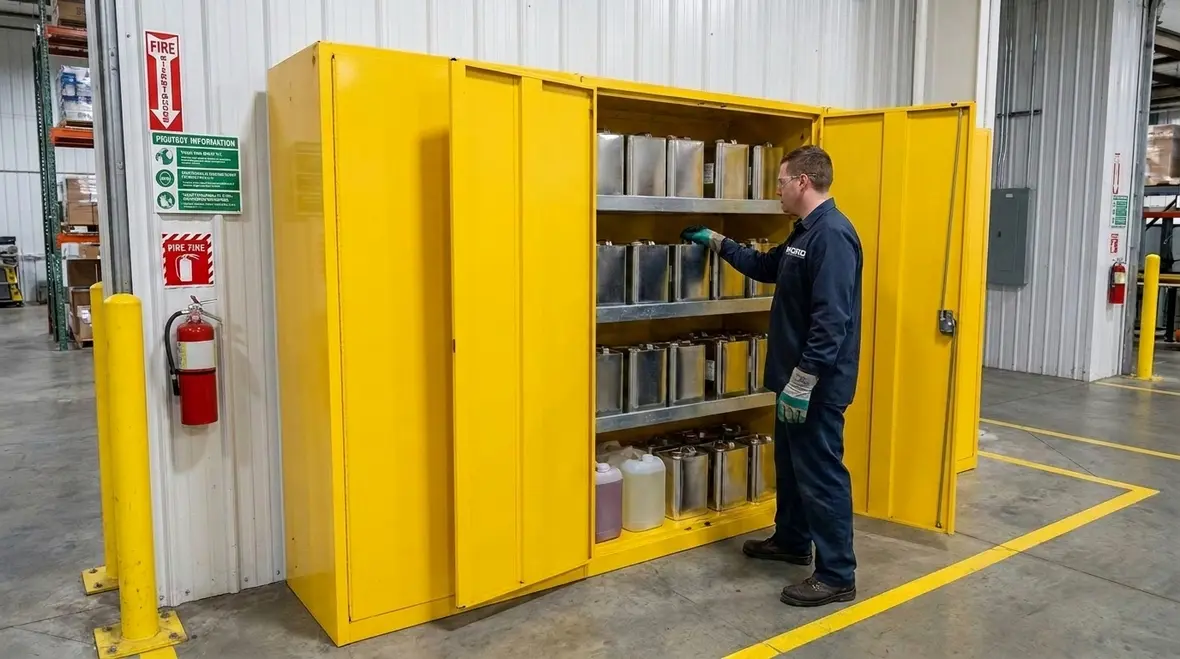
NFPA 30 Section 14.2: When Hazmat Locker Rules Apply
Quick Answer: NFPA 30 Section 14.2 applicability hazmat lockers apply when a facility stores, dispenses, or handles hazardous materials in ways that fall under the flammable and combustible liquids storage and handling framework. The trigger is not the locker label, but the material classification, container quantity, and usage pattern.
So, what does NFPA 30 Section 14.2 actually control?
NFPA 30 sets requirements for flammable and combustible liquids, including storage cabinets and hazards created by the way liquids are accumulated, transferred, and protected. Section 14.2 focuses on when specific locker rules apply, which typically drives how facilities must manage hazardous liquid containers in lockers, enclosures, or similar storage units.
For commercial sites, the compliance challenge is consistent: lockers get installed, but the operational rules that govern them are not always aligned with the actual liquids stored inside, the way staff access them, and the quantities used between deliveries. NFPA 30 Section 14.2 applicability hazmat lockers becomes a practical question during plan review, permitting, incident investigations, and routine inspection cycles.
Facilities can also benefit from broader context on how NFPA 30 regulates flammable liquids: how NFPA 30 regulates flammable liquids.
If your team is also validating quantity boundaries inside a facility, Kord Fire Protection’s guide to NFPA 30 control areas and storage limits pairs naturally with locker applicability and helps connect the locker decision to the bigger storage strategy.
When do hazmat locker rules start to apply?
NFPA 30 Section 14.2 applicability hazmat lockers is determined by the hazardous liquid situation at the site, not by the presence of a locker alone. In practice, compliance teams evaluate three core elements.
1) The liquid must fall into the scope of flammable or combustible liquid regulation
Locker rules only matter when the contents are liquids covered by NFPA 30’s framework. Classification depends on factors such as flash point and fire hazards identified through applicable product safety data. If the liquid is outside that scope, the locker still may need local code compliance, but the NFPA 30 Section 14.2 triggers will not drive the same requirements.
2) The quantity and container arrangement must match the section’s thresholds
Locker enforcement typically changes when container count, total volume, or the manner of storage pushes the facility into a regulated condition. Common failure points include:
- Using multiple small containers to remain under thresholds without consolidating to meet storage intent
- Stocking more than the locker rating or the quantity assumed during approval
- Staging containers near workstations in addition to locker inventories
3) The operating pattern creates a storage or handling hazard within the scope of Section 14.2
Facilities often assume lockers control “storage only,” but NFPA 30 enforcement considers how materials are handled and accessed. The rules apply more tightly when lockers are used for routine replenishment, dispensing, or frequent container exchange rather than occasional storage.
For example, a locker used as a daily supply for cleaning solvents, paints, degreasers, or lab reagents may effectively function as an active storage point, which increases the inspection scrutiny on doors, closures, labeling, and container condition.
How inspectors and AHJs evaluate hazmat lockers under Section 14.2
Even when the locker is the correct type, compliance commonly hinges on operational mechanics. NFPA 30 Section 14.2 applicability hazmat lockers is verified through practical, observable controls.
Locker construction and listing features
Inspectors expect lockers to provide the protection level the code intent requires, including credible fire resistance and appropriate design features for flammable liquid storage. Installations that rely on unlisted enclosures, damaged seals, missing hardware, or improvised modifications often fail because they cannot demonstrate the level of containment and hazard reduction required.
Closures, self closing performance, and door integrity
For many locker designs, correct closure performance is essential. Frequent failure points include:
- Door wedges used to keep doors open for workflow
- Worn gaskets that allow vapor leakage or undermine intended isolation
- Latches that do not fully engage after repeated container loading
- Obstructions inside the locker that prevent proper closing
Container condition, labeling, and compatibility
Inspectors look at whether liquids are in intact, compatible containers. Common deficiencies include:
- Containers with bulging, cracked caps, or degraded packaging
- Missing or illegible labels
- Mixing incompatible products that increases hazard severity
- Using containers not intended for the chemical class
Spill control and internal secondary containment
Many lockers incorporate features intended to reduce spill spread. Compliance often requires that these features remain serviceable. Oil soaked liners, blocked drain paths, missing trays, or altered internal configurations can convert a controlled storage arrangement into an uncontrolled one.
What operational procedures must match the locker rules?
NFPA 30 Section 14.2 applicability hazmat lockers usually requires documented operating controls. A facility may have the correct equipment, but noncompliant procedures still create risk and inspection findings.
Inventory limits and replenishment discipline
Facilities must manage quantities so the locker does not become an oversupply storage location. Procedures should define:
- Maximum container count and total volume
- Allowed refill frequency and delivery staging practices
- Whether partial containers are permitted and under what rules
- How staff handle “extra stock” when the locker is at capacity
Dispensing workflow and access control
Locker use should support safe dispensing practices. Staff procedures typically include:
- Opening the locker only as long as needed for transfer
- Keeping ignition sources controlled in the area
- Using approved containers and funnels or transfer pumps where required
- Immediate container closure after dispensing
Maintenance of hardware, signage, and inspection logs
Commercial sites should treat locker compliance as a maintained system. Maintenance responsibilities should include:
- Periodic checks of door closure and latching
- Inspection of seals, hinges, and gaskets for wear
- Verification that internal trays or liners remain in place and clean
- Confirming labels and hazard placards remain accurate and readable
These maintenance tasks frequently become gaps when facilities assume the locker is “installed once and forget.” In practice, closures degrade, seals tear, and replacement parts are not always equivalent.
Common compliance pitfalls in retail, industrial, and commercial spaces
NFPA 30 Section 14.2 applicability hazmat lockers often becomes contentious when departments operate independently. These pitfalls show up across commercial and industrial workflows.
- Locker used as general storage: Facilities store unrelated hazardous and non hazardous materials in the same locker compartment without compatibility review.
- Uncontrolled staging nearby: Additional containers accumulate outside the locker during deliveries, causing the total site quantity to exceed what the locker strategy assumes.
- Product substitutions: A procurement change swaps to a different liquid formulation with different hazard classification while the locker plan and documentation remain unchanged.
- Workflow workarounds: Staff keep doors open for convenience, disable closure features, or relocate containers to corners that block trays.
- Missing maintenance evidence: Inspections identify deficiencies, but corrective action tracking and follow up are not documented.
Kord Fire Protection typically supports facilities with compliance alignment across inspection readiness, documentation, and field verification. That includes evaluating how locker selection, placement, and operating procedures integrate with the broader flammable liquid program.
How to stay audit ready: the Kord Fire Protection approach
NFPA 30 Section 14.2 applicability hazmat lockers should be treated as an ongoing program, not a one time install decision. Kord Fire Protection helps commercial facilities maintain defensible compliance through practical service steps:
- Plan and content validation: Confirm the locker strategy matches the actual liquids stored, their classifications, and the quantities managed during normal operations.
- Field verification: Check door closure performance, hardware integrity, internal tray condition, labeling accuracy, and storage arrangements against the intended design.
- Inspection support: Provide documentation workflows and maintenance recommendations that reduce repeat findings.
- Corrective action follow up: Verify repairs are completed to a like for like standard and that procedures reflect the current setup.
For facilities operating across multiple units, Kord Fire Protection can also help standardize locker practices so departmental drift does not undermine compliance.
If you want additional context on NFPA 30’s overall control framework, review: how NFPA 30 regulates flammable liquids.
Frequently Asked Questions
Ready to confirm NFPA 30 Section 14.2 applicability to your hazmat lockers?
Facilities should verify the actual liquids, quantities, and operating pattern before relying on locker installation alone. Kord Fire Protection can help validate your hazmat locker program through field verification, documentation support, and maintenance guidance. Contact Kord Fire Protection to schedule a compliance review and close the gaps that typically trigger inspection findings, operational drift, and enforcement action.

Join Our Newsletter!
Get the latest fire safety tips delivered straight to your inbox From our Newsletter.



