
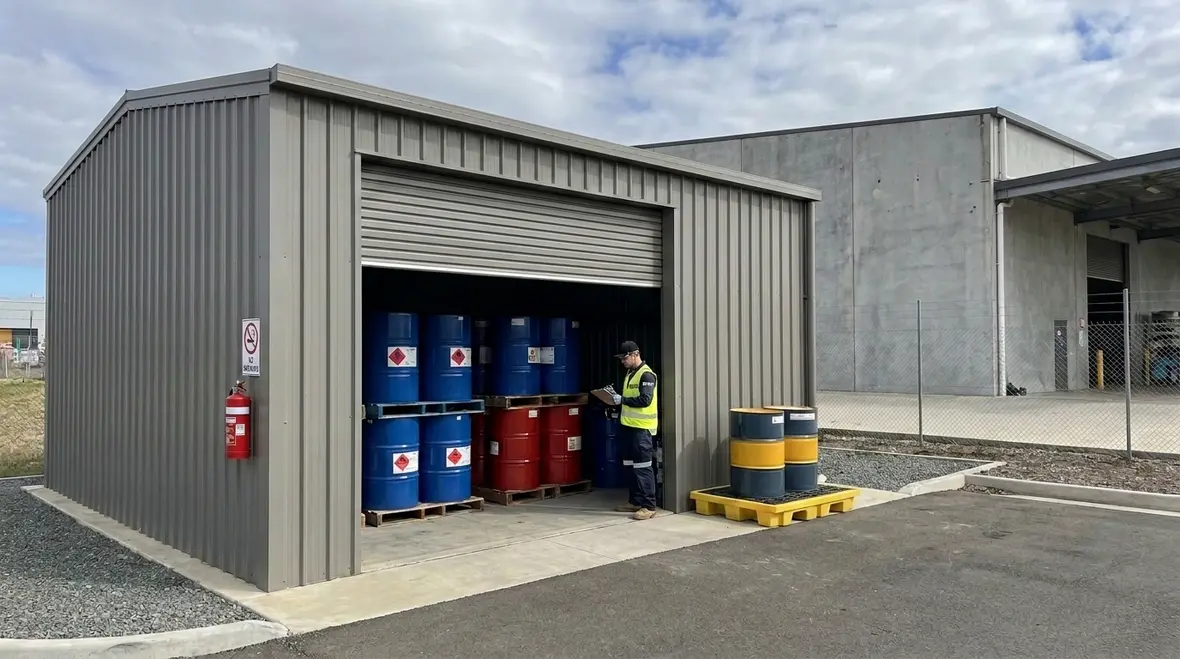
NFPA 30 Section 13.1 Scope: Detached Unprotected Building Storage
Quick Answer
NFPA 30 Section 13.1 scope detached building storage applies when a commercial facility stores flammable liquids in a detached, unprotected building. It sets expectations for separation, construction considerations, and operational controls to reduce ignition sources, limit fire spread, and support safe inspection and maintenance practices.
What does NFPA 30 Section 13.1 cover for detached, unprotected storage?
Facilities that use detached storage buildings for flammable liquids must treat fire separation and equipment integrity as primary risk controls. The NFPA 30 Section 13.1 scope detached building storage establishes the framework for how these storage arrangements function as a fire protection strategy when the building is not provided with the type of fire protection features used in protected construction.
In practical terms, compliance focuses on reducing the likelihood that a fire will escape the storage arrangement and become a facility wide event. That starts with correct classification and placement of containers, control of ignition and heat sources, and disciplined inspection and maintenance routines.
If you want broader context before getting too cozy with detached storage details, Kord Fire Protection’s NFPA 30 flammable and combustible liquids overview is a natural companion read.
Core compliance requirements facilities typically must operationalize
1) Separation and risk management around the detached building
Section 13.1 relates to detached unprotected building storage where the building itself does not provide the fire resistance assumptions used for protected storage. That drives a separation mindset: the facility must ensure enough distance and layout control so that exposure from the detached building does not cascade into adjacent occupancies, property lines, or critical operations.
Common operational challenges include overlooked site conditions such as seasonal stacking, temporary staging, landscaping growth near storage areas, and changes in adjacent tenant use. When the adjacent risk profile changes, the original layout can stop matching the assumptions used during compliance design.
2) Proper storage arrangement and container controls
Detached unprotected buildings usually rely on robust administrative and engineering controls because the building does not compensate for fire exposure. Facilities typically must verify that the storage system matches the permitted arrangement for the stored liquid type and quantity.
Operational controls usually include:
- Container integrity checks prior to placement, including closure quality and spill tightness.
- Limitation of incompatible product mixing through clear labeling and segregation practices.
- Staging discipline to prevent oversized obstructions around tanks, piping, and emergency access routes.
3) Ignition source control inside and around the storage footprint
Unprotected detached storage increases the consequences of ignition. Facilities should treat ignition control as a living program, not a one time installation task.
High risk failure points include:
- Improper electrical equipment placement or mismatched ratings near flammable liquid handling areas.
- Use of portable tools without documented hot work controls or gas testing procedures.
- Accumulation of combustibles such as rags, packaging, and dust in ventilation dead zones.
These issues frequently appear during shift transitions, contractors work, or storage practice changes, which is why inspections need scheduled frequency and documented follow up.
How inspections and maintenance support ongoing compliance
Inspection routines that withstand operational reality
Compliance relies on evidence that the system remains in a safe condition between formal reviews. For detached storage buildings, inspectors typically verify:
- General housekeeping and spill management around container stations and dispensing areas.
- Condition of secondary containment, where provided, including liner integrity and drain controls.
- Evidence of leaks from valves, hoses, fittings, and pump seals.
- Ventilation performance where required for safe dispersion and control.
To avoid “inspection drift,” commercial facilities should align inspection checklists with the actual work performed on site. If the facility uses different dispensing methods than originally assumed, the inspection program must reflect those methods.
For teams that need stronger audit evidence and less hopeful storytelling, Kord Fire Protection Australia also covers the documentation side of recurring maintenance in its AS 1851 fire pump maintenance testing and compliance article.
Maintenance mechanisms that reduce failure likelihood
Even when the storage arrangement matches the design, failure can occur through equipment aging and installation damage. Facilities should focus maintenance on:
- Hose aging, cracking, and abrasion. Replace on schedule, not after visible damage.
- Valve and actuator reliability, including lubrication or service performed in accordance with the manufacturer and safety procedures.
- Bonding and grounding continuity, where applicable to reduce static ignition risk during transfers.
Kord Fire Protection supports commercial, industrial, and retail facilities with ongoing inspection, testing, and documentation processes that align operational evidence with compliance expectations. That reduces the gap between what the facility believes it is doing and what inspectors expect to see.
Where facilities most often fall out of compliance
Detached unprotected storage invites specific vulnerabilities. The most frequent gaps involve site change, human factors, and documentation weaknesses.
Site changes that invalidate original assumptions
Examples include adding adjacent equipment, changing tenant operations, expanding staging areas, or introducing new ignition hazards nearby. Facilities should reassess the risk basis after layout modifications and after major work order changes.
Transfer and dispensing practices that introduce leaks or ignition risks
Transfer operations can become noncompliant when hoses are stored improperly, fittings are reused without verifying condition, or spill response materials are missing or expired.
Documentation that does not match field conditions
Facilities often maintain paper compliance but fail in field execution. Inspectors look for consistent labeling, maintained access routes, and evidence of corrective actions. A strong documentation system also improves training continuity during contractor mobilization and staffing changes.
Related guidance to support broader flammable liquid compliance
Section 13.1 scope detached building storage sits within NFPA 30’s larger framework for flammable liquid safety. For facilities building an integrated compliance strategy, it helps to map storage controls to the overall flammable liquids program. Learn how NFPA 30 regulates flammable liquids, including how requirements connect to practical site controls, at:
how NFPA 30 regulates flammable liquids
For Australian and New Zealand facilities seeking local service alignment, Kord Fire Protection can help coordinate compliant inspection, maintenance planning, and documentation workflows across commercial sites. Visit kordfire.com.au to review service capabilities.
Frequently Asked Questions
Next step: get a detached storage compliance check
NFPA 30 Section 13.1 scope detached building storage demands consistent execution, not just initial design compliance. Kord Fire Protection can review your detached storage layout and operating controls, then support ongoing inspections, testing, and documentation to keep risks controlled between formal assessments. Contact Kord Fire Protection through kordfire.com.au to schedule a compliance focused site review.

Join Our Newsletter!
Get the latest fire safety tips delivered straight to your inbox From our Newsletter.



