
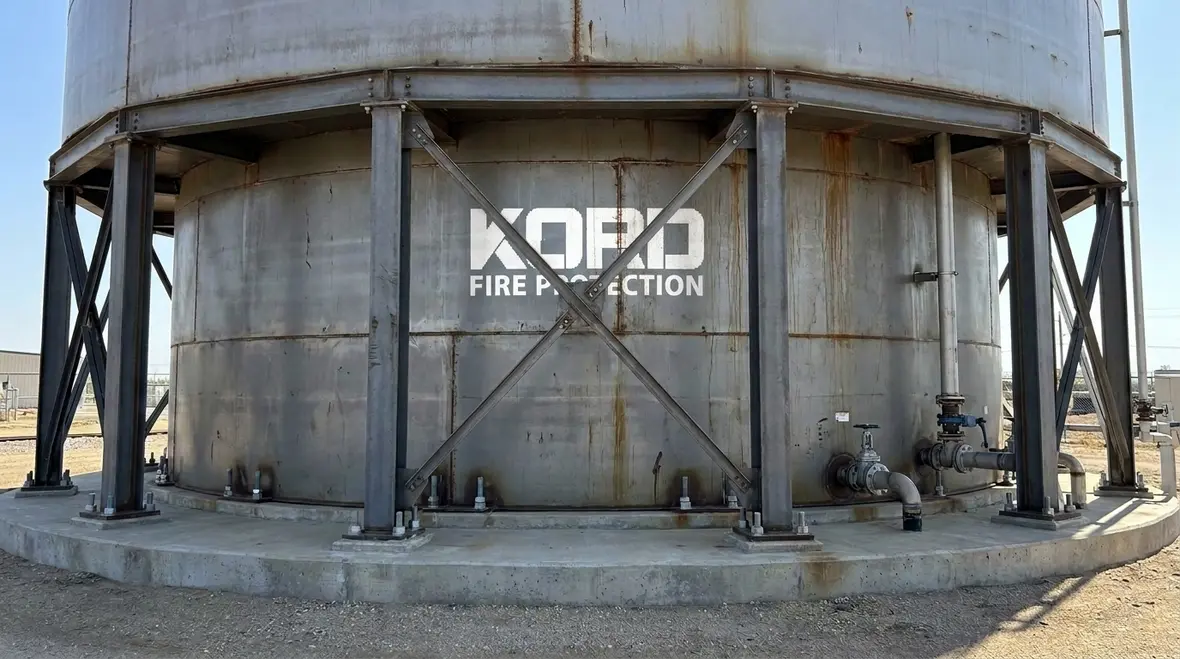
NFPA 22 Section 4.12: Load Requirements in Water Tank Design
Quick Answer
NFPA 22 Section 4.12 requires water tanks and their supporting structures to be designed for the actual loads they will experience, including full tank water weight, hydrostatic forces, environmental conditions, and structural continuity. Correct load design protects system reliability, reduces settlement and cracking, and supports inspection readiness.
If you’re reviewing broader compliance strategy around fire protection systems, Kord Fire Protection also offers complete fire protection services for commercial and industrial properties that naturally fit alongside water supply planning, inspections, maintenance, and deficiency correction.
Why NFPA 22 load rules drive real-world tank performance
For commercial and industrial facilities, water tanks function as critical fire protection water supplies. When tank foundations, supports, or anchorage are underdesigned, the most common symptoms show up later during operation: misalignment of appurtenances, leaking seams, impaired fill and drain flow, and compromised structural integrity. The goal of water tank design load requirements NFPA 22 is not only structural safety, but also system dependability under service conditions.
Facilities often discover load design gaps during renovations, seismic upgrades, roof or slab modifications, or changes in occupancy. NFPA 22 design expectations must align with site conditions and with how the tank will actually be installed, maintained, and inspected over time.
What Section 4.12 requires: loads you must account for
NFPA 22 Section 4.12 focuses on ensuring tanks and their supports resist the loads applied during normal and abnormal service. In practical terms, the design team must translate tank geometry and water storage into structural actions and then confirm that every load path stays intact.
1) Full water weight and gravity effects
When a tank is designed for fire protection duty, it must be evaluated in the filled condition. Engineers typically calculate dead load from the tank shell, floor or base, and attachments, then add hydrostatic effects from the water depth. The foundation and substructure must resist compressive stresses without excessive settlement that can crack structural elements or pull anchors loose.
2) Hydrostatic forces on walls, shell, and supports
Hydrostatic pressure increases with depth and generates lateral forces on tank walls and bracing members. The load design must address not only the wall bending, but also the connection details where walls transfer force into columns, frames, or base rings.
Common failure points include underdesigned anchor patterns at base ring supports, weak connection plates, or corrosion fatigue in tie-down systems that cycle through fill and draw events.
3) Dynamic effects during filling, draining, and fire flow
Load design also needs to consider how the tank behaves when it fills and when it discharges to the fire pump system. While the exact dynamic evaluation depends on the tank type and operating arrangement, designers should consider transient effects such as surge, vibration, and water hammer acting on piping penetrations and internal components.
4) Environmental loads that interact with tank mass
Structural loads from wind, seismic activity, snow, or temperature movement must be combined with the tank mass and water contents in a way that reflects the governing building and site requirements. In many facilities, the tank is the heaviest asset on the roof or on a slab, so load combinations often become the deciding factor for structural capacity.
Where compliance breaks in commercial builds (and why)
Design compliance fails most often at interfaces where the tank system meets the facility structure. Even when the tank manufacturer specifications look correct, the installed configuration determines the real load path.
Foundation and anchorage mismatches
Contractors may adapt anchor bolt locations, miss embedded tolerances, or substitute grout types. Any change that reduces effective embedment, undermines bearing surfaces, or disrupts continuity can create localized stress concentrations. Over time, these issues can lead to cracking, leakage, and movement that affects level indicators, strainers, and suction piping positions.
Piping and appurtenance penetrations that add unintended loads
Tank penetrations for fill, overflow, drains, alarm connections, and sight or sampling lines can introduce bending moments and pull loads if piping is poorly supported. Section 4.12 load intent matters because penetrations often become structural anchors for pipe forces rather than being treated as controlled connections.
Inspection-ready access and maintainability
Even perfect load design does not prevent recurring compliance problems if access is blocked. Poor access can delay inspection of supports, anchor systems, corrosion surfaces, and telltale signs of settlement. Over time, corrosion and biofouling can compromise valves and strainers, and small leaks can obscure structural degradation.
Tank type matters: common design implications for load transfer
Although Section 4.12 applies to tank design load evaluation, tank configuration changes how loads flow through the structure.
Elevated tanks
Elevated systems concentrate loads in columns and bracing. Lateral forces from wind and seismic events impose overturning actions that must be resisted through the entire frame system. Designers must confirm that bracing members and column bases provide adequate stiffness to limit damaging sway.
Underground and partially buried tanks
Buried installations add soil and groundwater interaction loads and can require careful evaluation of uplift and bearing capacity. Settlement and differential compaction can change pressure distribution on the shell and base, making load combinations and waterproofing details critical.
Aboveground on slabs or structural frames
For commercial and retail sites, aboveground tanks are frequently mounted on slabs or frames. In these cases, load design must address slab thickness, reinforcement, bearing plates, and any pedestal system. Facilities that remodel roofs or add equipment may unintentionally alter the load sharing or create clearance conflicts that lead to improper piping support.
For broader context on how NFPA 22 governs fire protection water tanks, including design and system coordination considerations, refer to: how NFPA 22 regulates fire protection water tanks.
Operational procedures and maintenance that verify load integrity
Load design only proves itself after installation through ongoing inspection and testing. Commercial facilities should treat the tank as a structural and fire protection component, not a passive container.
Routine inspection targets
- Observe tank level behavior for signs of settlement, uneven bearing, or structural movement.
- Inspect supports, base rings, and anchor assemblies for corrosion, looseness, or deformation.
- Verify that sight glasses, sampling lines, and valves align and operate without binding.
- Check overflow and drain paths for proper discharge behavior that does not cause localized washout or undermining of foundations.
Testing and functional verification
Fire protection systems rely on stable water supply characteristics. Qualified service should verify that fill operations maintain required water levels, that pumps can access suction conditions, and that drains and control valves operate correctly. Any recurring valve sticking, abnormal fill cycle times, or persistent leak patterns can indicate structural movement, misalignment, or seal degradation that started with poor load transfer.
Documentation and compliance support
Many facilities struggle to maintain a clear compliance audit trail that links tank condition, inspection findings, and corrective actions. A commercial partner such as Kord Fire Protection helps organizations maintain inspection readiness by coordinating water tank evaluations with fire protection system maintenance so that load related concerns are captured early, corrected efficiently, and documented for recurring compliance.
Frequently Asked Questions
Conclusion and next step
Tank failures rarely start with catastrophic collapse. More often, they begin with small load path weaknesses that develop into settlement, leakage, and maintenance burdens. The fastest way to protect compliance and performance is to validate load transfer details during design reviews and then confirm structural integrity through ongoing inspections and documented testing. Contact Kord Fire Protection to assess your water tank installation, verify NFPA aligned performance, and build a practical maintenance plan for sustained readiness.

Join Our Newsletter!
Get the latest fire safety tips delivered straight to your inbox From our Newsletter.



