
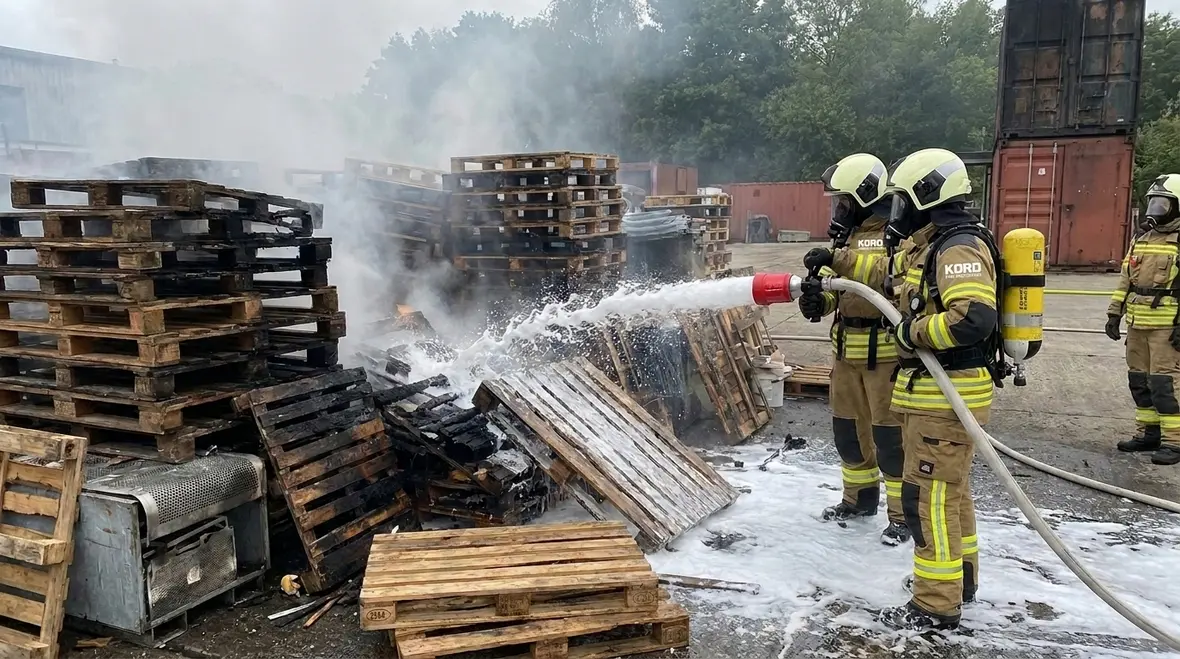
NFPA 18A Section 6.4: The Deep-Seated Fire Test for Water Additives
Quick Answer
NFPA 18A Section 6.4 establishes how to evaluate water additives using a deep-seated fire test that challenges extinguishing performance under realistic, embedded fire conditions. Facilities must follow the specified test method, documentation, and acceptance criteria to demonstrate ongoing compliance and product effectiveness.
Why NFPA 18A deep-seated fire test requirements matter for commercial water additive performance
Many facilities treat water additives as “plug and play” upgrades, but NFPA 18A deep-seated fire test requirements focus on what happens when fire is not surface-limited. When flames and heat penetrate deeper into the fuel, additive performance depends on correct formulation, proper application method, and repeatable fire conditions. This section drives defensible acceptance decisions and helps prevent field failures that stem from mismatched products, degraded concentrates, or inconsistent delivery hardware.
For commercial, industrial, and retail properties, the operational takeaway is clear: compliance is not achieved by purchasing an additive. It is achieved by performing and maintaining test evidence that the additive works as intended in deep-seated scenarios, and by ensuring the installation supports consistent discharge at the required concentration and flow profile.
To support a sustainable compliance program, organizations often engage Kord Fire Protection’s fire protection services in Southern California for code interpretation support, documentation control, and ongoing inspection and testing planning. For additional guidance on NFPA code implementation, see Kord Fire Protection’s resources for NFPA codes and guidelines.
What Section 6.4 evaluates: deep-seated conditions and additive effectiveness
NFPA 18A Section 6.4 uses a deep-seated fire test concept to stress the additive in conditions where the fire source is partially protected from direct agent contact. Water additives must perform by improving extinguishment and, depending on the additive type, reducing re-ignition potential or supporting cooling and suppression where heat has already penetrated.
Key performance outcomes you must be able to demonstrate
Extinguishment capability under embedded or deeply seated fire conditions, not only in shallow or quickly knocked down fires.
Control of re-ignition, where applicable, because deep-seated heating can drive renewed combustion after initial knockdown.
Repeatability that supports consistent results across tests and over time, reflecting stable concentrate quality and correct system operation.
Why this is operationally different from routine surface fire tests
In surface-limited scenarios, water delivery and basic cooling dominate. In deep-seated fires, contact and dwell time matter, and the additive has less direct exposure to the entire burning volume. Section 6.4 therefore acts as a technical gate: it verifies that the additive provides measurable benefit where suppression is harder.
How the test is typically executed in practice: setup, fuel exposure, and measured outcomes
While specific provisions and acceptance criteria are contained in the standard, the operational execution of Section 6.4 commonly requires a controlled test environment, defined fire loading or substrate, and a repeatable delivery method for the additive and water mixture. Commercial teams should plan for controlled staging, instrumented observation, and strict handling of concentrate and dilution.
Operational procedure controls that make or break results
Concentrate handling and verification: Teams must prevent contamination, temperature-related viscosity changes, and improper storage that can alter concentrate performance.
Dilution accuracy: The water additive must be mixed at the specified concentration. Small deviations can reduce effectiveness, while over-concentration can cause other operational issues, including equipment stress or undesired discharge characteristics.
Delivery and discharge profile: Test performance depends on discharge timing, flow stability, and the way the additive solution interacts with the deep-seated fire environment.
Defined ignition and evaluation windows: Test integrity depends on consistent ignition procedures and evaluation timeframes for knockdown and any subsequent re-ignition observations.
Instrumentation and documentation expectations
Facilities and product owners should expect test documentation to include enough information to validate that the additive was used as intended. That typically means recorded mixing parameters, discharge conditions, observed fire behavior, and a clear statement of the test outcome tied to the standard’s acceptance criteria.
From a compliance standpoint, weak documentation becomes a common failure point during audits or after changes in product supply. Kord Fire Protection supports commercial facilities by helping maintain organized, code-aligned test records and by translating technical test expectations into actionable maintenance and verification steps for installed systems.
Common compliance challenges: installed systems, maintenance, and concentration control
Many facilities can pass “paper compliance” but fail in field conditions because deep-seated fire performance relies on more than the additive product. The installed system must reliably generate and deliver the correct additive solution concentration during demand events.
Challenge 1: concentration drift in bulk storage and mixing equipment
Concentration drift occurs due to inaccurate dilution equipment, failed calibration, damaged proportioning devices, or procedural shortcuts during refill. Even when the additive is correct at purchase, improper mixing during service can defeat the deep-seated fire test basis.
Challenge 2: equipment degradation that changes discharge performance
Flow control components, injectors, check valves, and strainers can collect debris or wear out. These changes can alter discharge patterns and affect how the additive solution reaches and interacts with the deep-seated fire environment. This creates a gap between the test conditions and the real world.
Challenge 3: change control gaps after product replacement or system modifications
Deep-seated fire test results depend on the specific additive formulation and the delivery method used during testing. When facilities replace a concentrate without validating equivalency, or when system modifications change flow characteristics, the original test evidence may no longer match installed reality.
Challenge 4: inspection and maintenance schedules that do not verify additive solution delivery
Routine inspections often focus on general readiness. For additive systems, compliance should also confirm that mixing and proportioning remain within acceptable limits and that any sampling, calibration, or verification tasks are performed on schedule.
What good compliance looks like for commercial, industrial, and retail facilities
Strong compliance aligns three layers: code-based acceptance logic, installed system reliability, and ongoing maintenance verification. When these layers are coordinated, facilities reduce the likelihood that an additive will fail under the harder deep-seated conditions that Section 6.4 is designed to represent.
Recommended compliance actions organizations typically take
Confirm product and system compatibility so the installed additive matches the tested formulation and the delivery method assumptions.
Implement concentration verification procedures during routine service and after any component replacement that can affect proportioning.
Maintain calibration records for mixing and proportioning devices, including any adjustments or corrective actions.
Use change control to manage additive replacements, component swaps, and piping modifications that could alter discharge characteristics.
Schedule maintenance that targets known failure points, including injectors, check valves, strainers, sensors, and flow paths.
Kord Fire Protection can help facilities build a practical compliance workflow by coordinating inspections, documenting system conditions, and supporting ongoing maintenance that protects the intent of NFPA 18A deep-seated fire test requirements. This approach is especially valuable for sites that operate across shifting occupancy levels, seasonal storage changes, or multi-tenant environments where coordination failures are common.
Frequently Asked Questions
Next step: align your additive program with Section 6.4 in real operations
If your facility uses water additives, assign ownership to concentration control, calibration records, and change management for the installed system. Then partner with Kord Fire Protection to evaluate your current maintenance practices, verify documentation readiness, and align inspections with the intent behind NFPA 18A deep-seated fire test requirements. Contact Kord Fire Protection to schedule a compliance-focused review and build an ongoing testing and maintenance plan.

Join Our Newsletter!
Get the latest fire safety tips delivered straight to your inbox From our Newsletter.



