
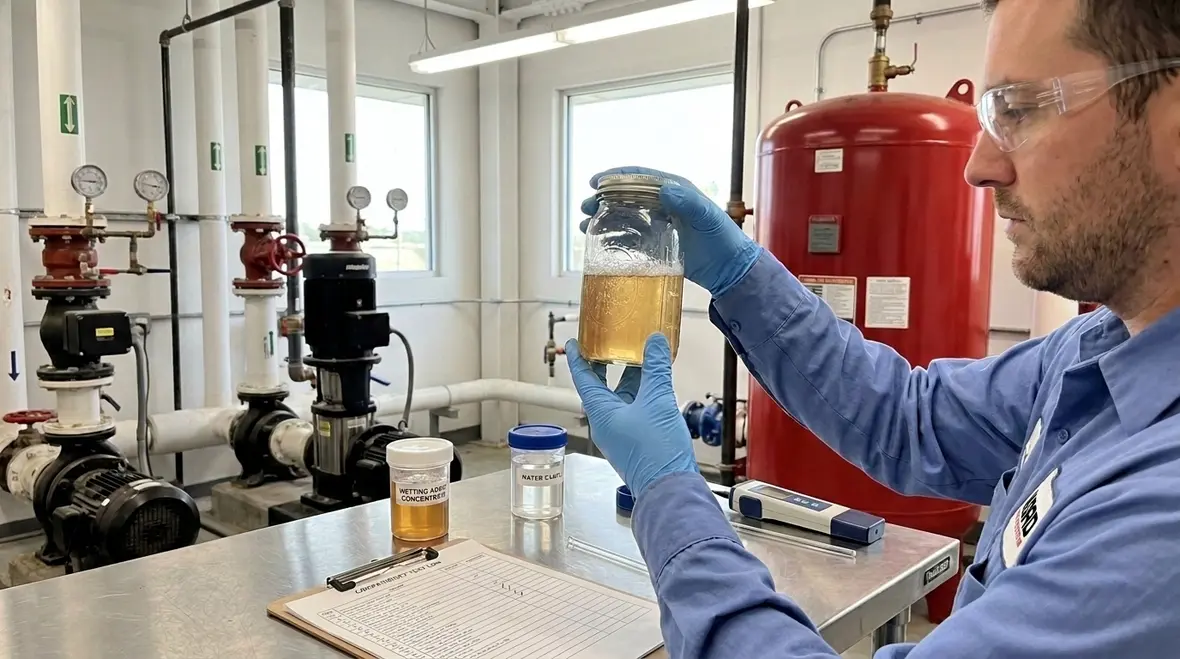
NFPA 18 Section 4.3: Compatibility of Wetting Agent Concentrates and Solutions
Quick Answer
NFPA 18 section 4.3 wetting agent concentrate compatibility testing ensures wetting agents remain effective after being mixed, stored, and handled within real system conditions. The goal is to confirm the concentrate and solution chemistry stay compatible with each other and the fire protection hardware.
Why NFPA 18 section 4.3 wetting agent compatibility testing matters in the real world
Commercial facilities often treat wetting agents as a simple refill item. NFPA 18 section 4.3 compatibility requirements exist because the apparent “mix” can fail once it sits in tanks, passes through pumps, contacts piping, or cycles during training and maintenance. In practice, compatibility issues can show up as reduced effectiveness, precipitation, tank scaling, valve sticking, nozzle performance loss, or unexpected changes in solution properties that reduce extinction capability.
Facilities that operate across industrial, retail, and mixed-use environments also face variability that affects chemistry stability: temperature swings, long hold times in proportioning systems, partial drains, contamination from previous products, and differences between “as received” concentrate and the final in-service solution. These are compliance risks, not just maintenance annoyances.
For a broader context on where wetting agents fit within NFPA 18, Kord Fire Protection provides a focused overview here: NFPA 18 wetting agents overview.
For facilities reviewing connected suppression planning near the top of the process, it also helps to understand how Australian fire sprinkler services tie installation, inspection, testing, and maintenance together across real operating environments. ([kordfire.com.au](https://kordfire.com.au/fire-protection-blog/fire-sprinkler-testing-in-australia-by-kord-fire-protection/?utm_source=openai))
What “compatibility” means under section 4.3
In NFPA 18 section 4.3 wetting agent concentrate compatibility testing, compatibility is not limited to a single bottle versus a bucket test. It addresses the relationship between:
Concentrate and in-service solution: whether mixing creates a stable, uniform solution that retains intended performance characteristics.
Solution and application hardware: whether the solution interacts acceptably with tanks, suction lines, proportioning devices, valves, pumps, and piping materials.
Solution over time: whether storage and recirculation lead to separation, sediment, degradation, or performance drift.
Operationally, compatibility testing supports safe and repeatable discharge performance. It also supports documentation that regulators, insurers, and facility leadership can trust during inspections.
Common facility conditions that create compatibility failures
Compatibility problems typically originate from predictable conditions. Understanding these conditions improves planning for testing, acceptance criteria, and corrective actions.
1) Concentrate cross contamination
Mixing different products, topping off with the wrong concentrate, or incomplete flushing after a vendor change can alter surfactant chemistry. Even small cross contamination can destabilize the final solution. This becomes especially problematic when tanks or concentrate drums are reused without controlled cleaning verification.
2) Incorrect proportioning and dilution control
Many systems rely on proportioning devices. Compatibility testing expects the final solution to match the intended concentration and formulation behavior. If the system runs at an out of range mix ratio due to calibration drift, incorrect metering, or water chemistry differences, the solution can form visible changes such as hazing, separation, or residue.
3) Long hold times and temperature cycling
In facilities where equipment is staged, idle, or only used during inspections and rare exercises, solution can remain in holding tanks longer than anticipated. Heat and cold cycles affect solubility and surfactant stability. Compatibility testing validates whether the formulation remains stable under the facility’s realistic time and temperature envelope.
4) Material interaction and deposits
Solution contact with seals, gaskets, elastomers, and metals can change chemical behavior or contribute to sediment. Deposits may reduce flow through valves, impair pump performance, and complicate future maintenance. Testing and inspection plans should account for where deposits accumulate: low points in piping, tank corners, and upstream of proportioning controls.
How NFPA 18 section 4.3 testing is typically planned and executed
While facilities often focus on the “test report,” compliance succeeds when the full procedure is controlled. A strong approach includes sample control, repeatability, and traceable documentation suitable for third-party review.
Step 1: Define the exact solution the system will use
Compatibility testing should reflect the actual mix ratio and the actual water supply characteristics used by the facility. If a facility uses different water sources seasonally, the plan should address which source is representative for the in-service configuration.
Step 2: Control the mixing process
Mixing order and agitation influence uniformity. Facilities should ensure the concentrate enters the mixing vessel under controlled conditions and that the solution achieves consistent blending before sampling. Any deviations should be documented because they can affect repeatability.
Step 3: Verify stability and performance indicators over time
Testing typically evaluates whether the solution remains uniform, whether separation or sediment occurs, and whether key performance characteristics are maintained during storage or controlled aging. The aim is to identify failure modes early, before the solution is committed to system tanks or piping.
Step 4: Confirm hardware compatibility through contact considerations
Compatibility also considers what the solution contacts. Facilities should align testing with the system components that will see the solution, including tanks, suction piping, proportioning systems, and valves. Where manufacturers provide guidance, it should be incorporated into the acceptance and documentation framework.
Step 5: Document results for inspection readiness
Strong documentation includes product identifiers, concentration targets, sampling dates, conditions, test method references, and clear pass or fail criteria. For many commercial and industrial settings, documentation completeness is what makes future inspection cycles smoother rather than slower.
Operational inspection and maintenance after compatibility testing
Compatibility testing supports compliance, but it does not eliminate the need for ongoing inspection and maintenance. The best programs treat compatibility as a baseline and then protect that baseline through disciplined maintenance.
Build a verification rhythm for storage, proportioning, and discharge readiness
Solution quality checks: monitor for changes consistent with separation, residue, or unexpected solution behavior.
Proportioning calibration: confirm metering performance, especially after component replacement, seasonal commissioning, or any service work near proportioning devices.
System flushing discipline: when changing products, document flushing steps and confirm cleanliness. Partial flushing is one of the most common paths to compatibility drift.
Valve and pump maintenance awareness: residues can cause sticking and can increase wear. Maintenance plans should account for how deposits impact actuation and flow.
Kord Fire Protection supports these ongoing requirements through practical commercial service planning. For example, the team’s Australian sprinkler services resource outlines service coverage considerations that align with busy facility operations: Australian fire sprinkler services.
For pump-adjacent considerations that frequently intersect wetting agent systems, industry guidance can also help facility teams coordinate hydraulic maintenance and reliability expectations. Additional background is available through firepumps.org.
FAQ: NFPA 18 section 4.3 wetting agent concentrate compatibility testing
Conclusion and call to action
NFPA 18 section 4.3 wetting agent concentrate compatibility testing protects discharge performance, reduces maintenance surprises, and strengthens inspection credibility. The fastest path to dependable compliance is a controlled testing plan matched to your actual mix ratio, water characteristics, and equipment contact surfaces, followed by disciplined calibration and solution verification. Contact Kord Fire Protection to align your wetting agent program with section 4.3 expectations, document results correctly, and maintain system reliability between inspection cycles.

Join Our Newsletter!
Get the latest fire safety tips delivered straight to your inbox From our Newsletter.



