
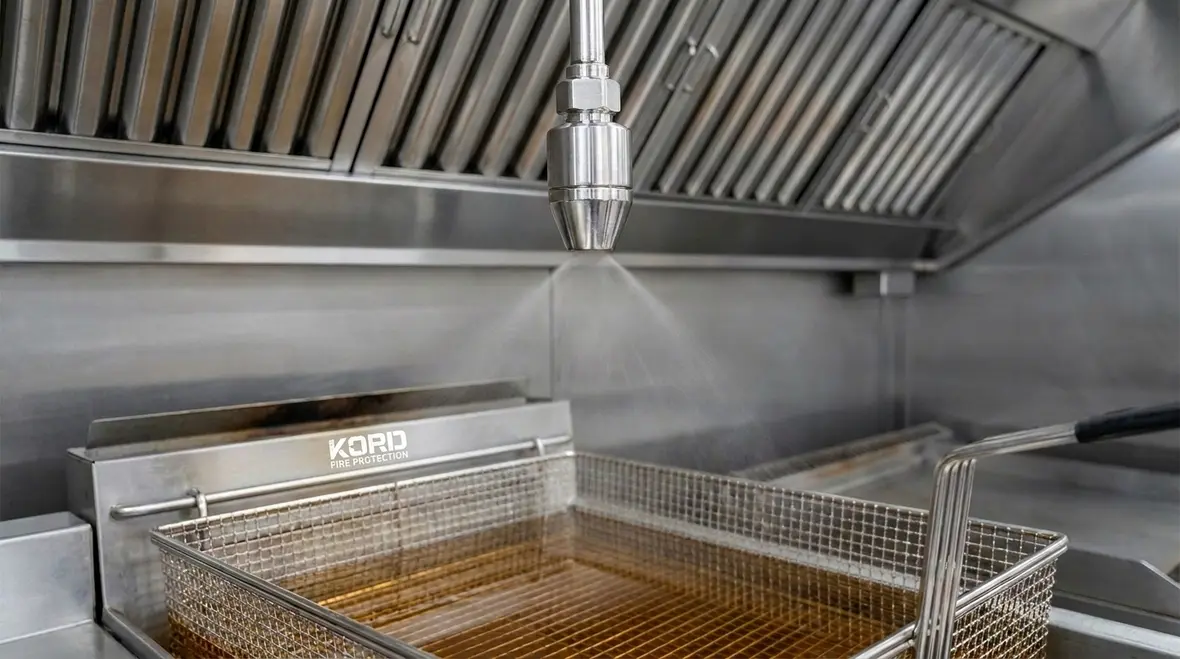
NFPA 17A 5.5 Discharge Nozzle Placement Over Cooking Equipment: Compliance Guide
Quick Answer
NFPA 17A 5.5 requires wet chemical system discharge nozzles to be positioned to achieve effective coverage over cooking equipment and within the protected hazard area. Proper placement accounts for hood geometry, cooking appliances, and clearance for unobstructed discharge.
Facilities reviewing broader suppression compliance can also explore fire suppression system services for a practical look at how inspection, installation, and long term readiness tie together naturally in commercial environments. ([kordfire.com](https://kordfire.com/fire-suppression/?utm_source=openai))
Why NFPA 17A Discharge Nozzle Placement Matters in a Commercial Kitchen
In a commercial kitchen, the fire dynamics of cooking grease and cooking oil demand rapid, targeted wet chemical application. NFPA 17A discharge nozzle placement commercial kitchen systems use directional flow and droplet formation to deliver suppression agents where heat and vapor pockets develop. When nozzle placement deviates from the required coverage strategy, the system may still discharge, but it may not suppress the fire where it starts or where it grows, particularly under and around the hood canopy.
Compliance challenges typically appear during design, retrofit, and maintenance. The design team must translate hood and appliance layouts into nozzle standoff distances, angles, and coverage zones. Facilities teams then must protect that design from change over time, including hood modifications, appliance swaps, damaged ceilings, and airflow adjustments from make up air systems.
What NFPA 17A 5.5 Typically Requires for Over Cooking Equipment
NFPA 17A section 5.5 centers on placing discharge nozzles to ensure they discharge over the cooking equipment and within the protected cooking hood area, so the agent can reach the grease laden surfaces that fuel the fire.
In practical terms, compliant design usually means all of the following:
- Nozzle locations that align with the hood opening geometry and the cooking surface area they are meant to protect.
- Discharge patterns that remain unobstructed by hood baffles, filters, duct transitions, and other components that can block spray distribution.
- A placement strategy that accounts for appliance variety and cooking ranges, including fryers, griddles, and ranges with differing heat spread patterns.
Because hood systems vary widely between restaurants, QSR, and industrial food production spaces, NFPA 17A discharge nozzle placement commercial kitchen practice depends on the specific hood design and the final installed condition, not only the original drawings.
How Designers Determine Nozzle Position Over the Hood
Correct placement starts with translating real-world hood and appliance layouts into a suppression coverage map. Industry teams typically evaluate three variables during engineering and installation:
1) Hood geometry and protected area
The hood canopy width, depth, and height define the boundaries where wet chemical must be effective. Nozzles positioned too far back can under-serve the near-edge grease surface where flare ups commonly occur. Nozzles positioned too far forward can waste discharge on non cooking surfaces or miss grease surfaces behind baffle systems.
2) Cooking appliance spacing and operational heat patterns
Multi appliance lines create coverage overlaps and coverage gaps. Placement must consider whether appliances sit flush under the hood or whether there are service aisles, partitions, or movable components that can interrupt discharge distribution. In facilities that rotate menu offerings, appliances can change with different footprint sizes, and the system must still maintain effective coverage.
3) Obstructions that change spray distribution
Filters, baffle plates, grease extractors, and duct transitions can redirect airflow and block direct wet chemical spray if the nozzle angles do not compensate. These issues are frequently discovered after remodeling when ceiling plenum components are replaced or when hood internal components are upgraded for airflow efficiency.
For a deeper overview of wet chemical system design considerations, review this related resource: Enhancing Fire Safety with NFPA 17A Wet Chemical Extinguishing Systems. ([kordfire.com](https://kordfire.com/enhancing-fire-safety-with-nfpa-17a-wet-chemical-extinguishing-systems/?utm_source=openai))
Common Placement Failure Points During Retrofit and Remodeling
Most nozzle placement nonconformities do not originate from gross errors at the initial install. They develop when the protected area changes after commissioning. Facilities that manage multiple sites often run into the same patterns.
Hood modifications that alter internal baffle layout
Even when the hood shell dimensions remain similar, internal baffles and filter assemblies can change the path of discharge. Placement that was compliant for a prior baffle arrangement can become non compliant for the updated configuration.
Appliance replacement without hazard re evaluation
Swapping appliances can change the effective burning surface area and the distance from nozzle discharge streams. A fryer replacement or range swap that changes the footprint can create a coverage gap.
Plenum obstructions and ceiling changes
Ceiling mounted penetrations, wiring trays, ductwork adjustments, and mechanical equipment can interfere with discharge. In many commercial kitchen layouts, limited plenum depth makes it easier for later trades to unintentionally compromise nozzle orientation.
Inadequate maintenance that impacts distribution
Wet chemical discharge performance depends on correct nozzles, integrity of piping, and valve operation. If nozzles are painted over, partially obstructed, or misaligned after inspection access, the system can discharge but not deliver suppression effectively.
To support broader fire suppression system compliance in commercial spaces, see: Fire Suppression Systems. ([kordfire.com.au](https://kordfire.com.au/?utm_source=openai))
Inspection, Testing, and Ongoing Verification for Correct Coverage
NFPA 17A wet chemical systems rely on both mechanical readiness and correct distribution over the hazard. To protect the intent of 5.5, technicians typically verify the installed configuration during inspections and operational checks.
What maintenance teams should confirm on site
- Nozzle physical condition, including cleanliness and presence of obstructions at the nozzle orifice.
- Nozzle alignment relative to the hood and cooking equipment layout, especially after hood servicing.
- Valve linkage condition, correct detection interface, and verification that discharge initiation routes flow as designed.
- Integrity of piping runs, supports, and hangers that prevent drift or misalignment.
- System agent condition where applicable, including evidence of contamination or degradation that could affect discharge characteristics.
Operational verification after changes
Commercial facilities should treat any hood rebuild, appliance replacement, or internal baffle change as a trigger for a nozzle placement verification review. This includes photographing the hood interior, checking the final installed nozzle geometry against design intent, and documenting findings for compliance traceability.
For additional context on pump and system equipment considerations that frequently interface with suppression system performance, reference: Fire Pumps. ([firepumps.org](https://firepumps.org/?utm_source=openai))
How Kord Fire Protection Supports Compliance for NFPA 17A Coverage
Commercial kitchens operate under frequent schedule pressure, and changes happen between inspections. Kord Fire Protection supports facilities by aligning engineering intent with the actual installed condition, then maintaining that condition through ongoing service.
In practice, that means:
- Reviewing installation details and nozzle layout assumptions during acceptance and post construction commissioning.
- Performing periodic inspections focused on distribution readiness, nozzle integrity, and obstructions that can alter discharge effectiveness.
- Providing documentation that helps facilities demonstrate that nozzle placement commercial kitchen coverage meets the system’s intended protected area.
- Assisting with planned change management, including hood updates and equipment swaps, so the system continues to comply with the protected hazard definition.
Frequently Asked Questions
Conclusion and Call to Action
NFPA 17A 5.5 discharge nozzle placement commercial kitchen compliance depends on correct nozzle location over cooking equipment and within the protected hood area, plus sustained distribution readiness after every remodel or service event. Kord Fire Protection can help facilities verify installation intent, address common retrofit failure points, and maintain compliant system performance through documented inspections and change management. Contact Kord Fire Protection to schedule a nozzle placement and coverage readiness review for your kitchen system.

Join Our Newsletter!
Get the latest fire safety tips delivered straight to your inbox From our Newsletter.



