
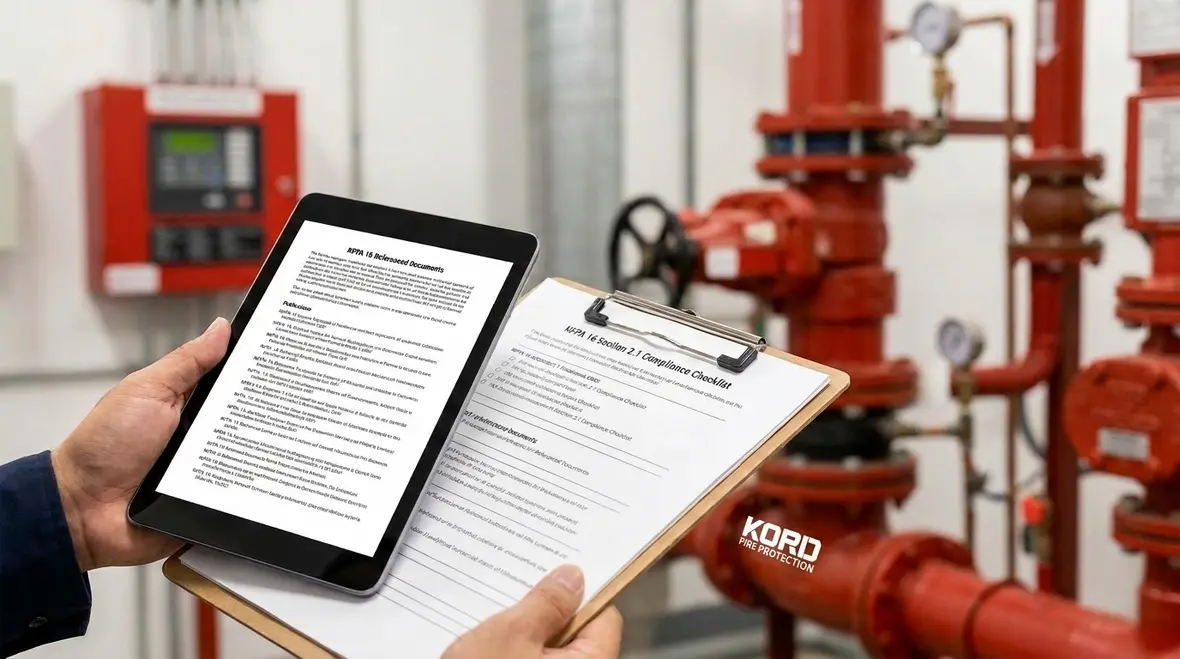
NFPA 16 Section 2.1: How the Standard’s Referenced Publications Work
Quick Answer: NFPA 16 Section 2.1 explains how the standard relies on external documents. Referenced publications become part of the compliance framework when the edition is specified. Fire pump, maintenance, testing, and training duties typically flow from those documents.
For facilities managing broader inspection, testing, and maintenance workflows, fire protection services in Southern California can help connect pump work, documentation, and compliance support into one coordinated plan.
Why NFPA 16 referenced publications matter for real compliance
In commercial, industrial, and retail facilities, compliance failures usually do not start with NFPA 16 itself. They start when teams do not recognize that NFPA 16 Section 2.1 incorporates other standards and documents into the governing requirements. A strong NFPA 16 referenced publications overview helps stakeholders understand what becomes enforceable, what must be maintained, and how inspection and testing documentation should be built.
For facilities with fire pumps, foam systems, clean agent exposure, or other fire protection interfaces, the referenced documents often define the technical “how.” That includes inspection intervals, test methods, acceptance criteria, labeling expectations, and performance verification practices that allow AHJs, corporate EHS, and insurers to trust the record.
What Section 2.1 actually requires: referenced publications as compliance drivers
NFPA 16 Section 2.1 establishes the operational rule for how external publications function inside the standard. In practice, the standard treats referenced materials as authoritative sources for specific topics where NFPA 16 points to them. That means the facility cannot meet the intent by using “similar” practices if the referenced document sets a defined method, frequency, or acceptance test.
Common compliance expectations that flow from referenced publications include:
Edition control: Only the edition referenced by NFPA 16 is considered acceptable for the applicable provisions. Mixing document editions can create audit risk and conflicting test criteria.
Process alignment: Testing, inspection, and maintenance procedures in the referenced publications often specify the sequence of checks and required measurements.
Documentation quality: Referenced publications frequently define what must be recorded to demonstrate proper performance and corrective actions.
Training and competency cues: Some referenced materials drive who performs inspections and what competency evidence should exist for technicians and supervisors.
How referenced publications change inspection and testing workflows
Operationally, referenced publications affect workflows in three high impact areas: preparation, execution, and verification. In many facilities, maintenance teams already perform baseline inspections and tests. The compliance gap occurs when referenced documents require additional steps or more stringent acceptance criteria than the facility’s current work practice.
1) Preparation and pre checks
Before any test, referenced publications commonly require baseline verification. That may include confirming equipment identification, control valve position, system configuration, identification of responsible personnel, and readiness of test equipment. When a facility omits these steps, results become difficult to defend because the record lacks proof that the test started from a verified condition.
2) Execution and method control
Referenced documents often define how measurements must be taken. Typical method controls include pressure, flow, timing, sequencing, instrument accuracy, calibration status, and environmental considerations. For commercial facilities, this is where “field shortcuts” tend to appear, especially when tests are repeated quickly to satisfy internal schedules or tenant requirements.
3) Verification, acceptance, and corrective action
Once testing occurs, referenced publications usually define what constitutes acceptable performance and what corrective actions are required when thresholds are not met. A failure point is not just the equipment failure, but the absence of a defensible response process. That includes documenting the failure, identifying root causes, verifying repairs with appropriate follow up tests, and updating maintenance records in a way that tracks the deficiency to resolution.
Common failure points in the field: where audits and AHJs find gaps
Even when contractors “follow NFPA 16,” facilities can still fail audits if referenced publications are treated as optional guidance. The following are the most common problem patterns seen in commercial, industrial, and retail environments.
Uncontrolled document editions: Facilities use newer or older versions of referenced standards, or they keep PDFs that do not match the edition named in NFPA 16. The fix requires edition verification and a controlled index of current requirements.
Testing done, but not proven: Work orders may show that tests were performed, yet the record lacks required measurements, instrument data, or acceptance statements. Referenced publications drive what must appear in the documentation set.
Maintenance intervals drift: Teams align to internal schedules, not the referenced publication frequencies or triggers. When inspections occur at the wrong interval, reliability performance suffers and compliance risk increases.
Incorrect scope: Technicians test the obvious components but miss subsidiary requirements defined in referenced materials, such as specific inspections of related controls, signal pathways, or accessory equipment.
Weak deficiency management: Repairs occur, but follow up verification tests and documentation updates do not close the loop required by referenced standards.
These issues typically show up during insurance surveys, corporate EHS reviews, or AHJ follow ups. They also frequently surface when new staff take over maintenance responsibilities and do not inherit the previous compliance logic.
Building an internal compliance system around NFPA 16 referenced publications overview
Commercial facilities improve results when they treat referenced publications as an integrated compliance system rather than a one time reading assignment. A practical approach includes three components: an accessible requirement map, a controlled document library, and a maintenance record standard.
Create a referenced requirements map
Map each applicable NFPA 16 activity to the referenced publication provisions that define it. This map should identify what equipment is covered, what tests are required, how often they occur, and what documentation must be produced. When facilities do this, technicians understand why each step exists and supervisors can verify completeness faster.
Control editions and version history
Maintain a controlled library that ties the facility’s compliance documentation to the specific NFPA 16 edition and the exact edition of each referenced publication. If a corporate policy triggers a library update, the facility should assess whether any referenced publication changes alter acceptance criteria or test methods.
Standardize maintenance records for defensibility
Maintenance records should show the test performed, the measured results, the acceptance outcome, and the corrective action when needed. Where referenced publications require specific forms, instrument information, or sign off steps, the record should mirror that structure. This reduces time spent reconstructing missing information during audits.
For a deeper facility readiness conversation, teams often start with a review of the overall NFPA 16 framework.
How Kord Fire Protection supports Section 2.1 compliance outcomes
NFPA 16 referenced publications work best when they guide daily maintenance execution, not when they remain in a static binder. Kord Fire Protection supports commercial facilities by translating referenced publication requirements into clear job scope, field test procedures, and audit ready documentation packages.
Operational support typically includes:
Requirement mapping to ensure the referenced publication provisions tied to NFPA 16 activities are included in the maintenance plan.
Test readiness and method verification to reduce repeat visits and “record gaps” that fail audit review.
Inspection and maintenance execution with a defensible documentation approach aligned to referenced publication expectations.
Deficiency closure workflows that confirm repairs with appropriate follow up tests and clear corrective action records.
This approach helps commercial owners and facility managers maintain system reliability while reducing compliance friction across inspections, insurance reviews, and AHJ interactions.
Frequently Asked Questions
Conclusion and next step
NFPA 16 Section 2.1 turns referenced publications into a practical compliance tool, but only when teams control editions, align test methods, and produce audit ready records. If referenced documents are not mapped to your maintenance plan, inspections can drift and documentation can become incomplete. Kord Fire Protection helps commercial facilities operationalize NFPA 16 referenced publications so testing, maintenance, and deficiency closure stay defensible. Contact Kord Fire Protection to align your program with Section 2.1 expectations.

Join Our Newsletter!
Get the latest fire safety tips delivered straight to your inbox From our Newsletter.



