
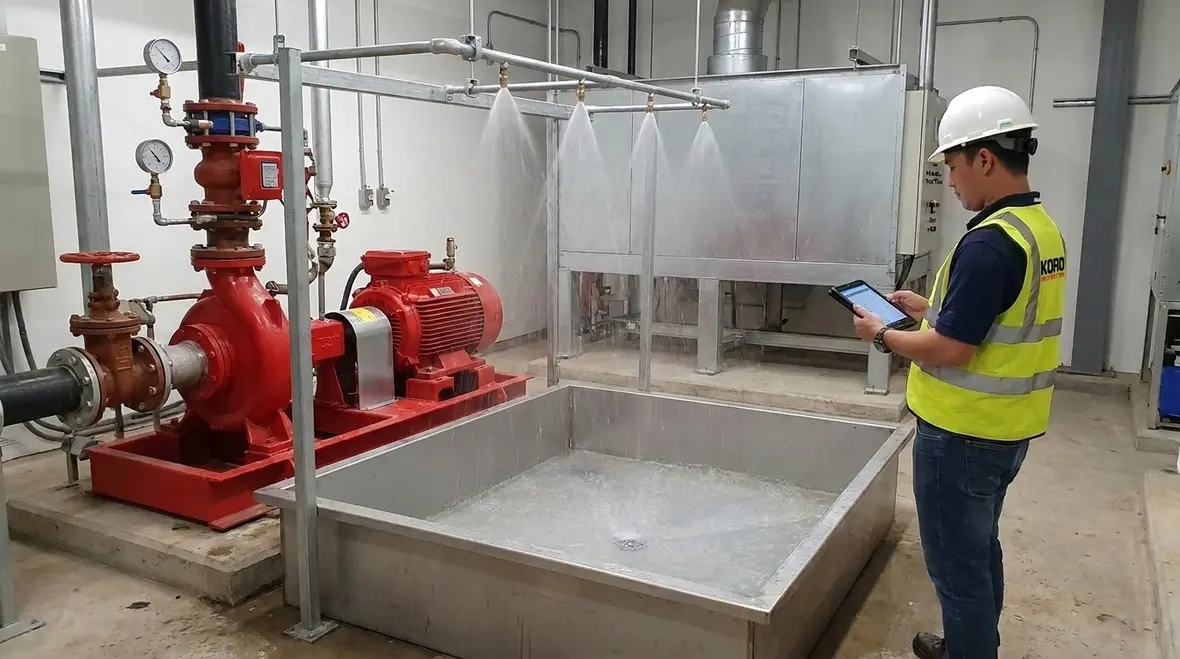
NFPA 15 Section 7.3 Control of Burning: 0.50 gpm/ft² for Pumps and 0.30 gpm/ft² for Pool Fires
Quick Answer: NFPA 15 Section 7.3 specifies the water application needed to control burning, using net rate values of 0.50 gpm/ft² for pump hazards and 0.30 gpm/ft² for pool fires. Correct calculations, layout, and verification are essential to avoid under-delivery and compliance failures.
What NFPA 15 7.3 “Control of Burning” requires
For facilities that rely on fixed water-based fire protection systems, NFPA 15 Section 7.3 establishes the minimum performance target for controlling a fire during the “control of burning” phase. The section ties the required discharge rate to the protected area and hazard category, then requires that the system deliver the specified net flow rate through the total design demand.
In practical terms, the key benchmarks are the NFPA 15 7.3 control of burning net rate 0.50 0.30 gpm/ft2 pumps pool fires. These values are used during design and later during acceptance and inspection verification. When facilities miscalculate net area, neglect hydraulics, or allow obstructed spray patterns, the system may not meet the required delivery. That shortfall can trigger rejection of impairment status and failure to comply during audits.
For a practical look at how ongoing inspection, maintenance, and service planning support real-world fire protection performance, teams often review the full lifecycle of fire protection servicing before tightening up hazard-specific compliance work.
Where 0.50 gpm/ft² applies: pumps
Pump-related hazards are treated as a specific hazard application scenario in NFPA 15. The control of burning net rate at 0.50 gpm/ft² supports enough water delivery to limit heat feedback, slow flame spread, and help prevent escalation.
Common compliance challenges for pump areas
- Net area miscalculation: Design teams often use gross room floor area instead of the required net calculation method. Overstating net area leads to unrealistic demand, while understating net area leads to under-delivery at commissioning. Both conditions become visible during flow verification.
- Hydraulic mismatch: Pump rooms frequently have challenging piping runs, elevation changes, and supply takeoffs. Orifice, nozzle, and hose stream equivalencies do not “average out” errors. The system must still meet the net rate at the design density.
- Blocked or misoriented nozzles: Overspray barriers, stored materials, construction debris, or incorrect installation angles reduce effective coverage. A nozzle may still flow at pressure, but fail the required discharge pattern for control of burning.
- System aging and performance drift: Water residue, nozzle scaling, partially clogged strainers, and corrosion change effective discharge and pattern. Pump room systems are especially sensitive because they operate near industrial contaminants.
Operational implications for commercial facilities
Commercial and industrial sites often require minimal downtime. That constraint pushes facilities to use “best effort” maintenance intervals. NFPA 15 performance targets do not tolerate best effort. The control of burning rate supports fire growth control, so impairment management, nozzle verification, and flow testing must be scheduled and documented as part of the fire protection program.
Where 0.30 gpm/ft² applies: pool fires
NFPA 15 uses pool fire water application targets to address burning liquid scenarios where the flame size and heat output are controlled by water application to the hazard area. The control of burning net rate for pool fires is 0.30 gpm/ft².
What drives coverage effectiveness for pool fires
- Pool geometry assumptions: The design hazard area used for rate calculations must match the credible pool fire scenario. If the protected area boundary is wrong, the net flow rate requirement will be wrong.
- Obstructions and discharge angle: Pool fire suppression performance depends on water reaching the intended region. Cantilevered piping, structural beams, and nearby equipment can shadow coverage if nozzle location and angle do not match the design intent.
- Water distribution uniformity: Two systems can deliver the same total flow, but only one delivers uniform delivery over the net hazard area. NFPA 15 design intent depends on effective distribution, not only volume.
How “net rate” is verified in the field
Net rate language matters because NFPA 15 does not treat the hazard as an open ended spray pattern. Field verification generally evaluates whether the system can deliver the required flow through the design demand under specified operating conditions.
Key verification steps facility teams should expect
- Hydraulic documentation review: Review design calculations, nozzle schedules, and pipe network details. Confirm that the system is capable of meeting the net rate at operating pressure at the time of discharge.
- Inspection for physical performance threats: Verify nozzle orientation, check for obstruction, confirm proper spray pattern, and ensure strainers and filters are not restricting flow.
- Flow testing and residual pressure assessment: Measure the system discharge under controlled conditions to confirm it meets the design demand. Record pressures and compare to acceptance criteria.
- Maintenance and correction closure: If performance is low, the fix must address the root cause, such as nozzle blockage, wrong nozzle type, damaged piping components, or improper valve position and setpoints.
For additional perspective on pump reliability and water supply performance, facility teams can also review Kord’s guidance on proactive maintenance for fire pump system reliability when building maintenance plans around dependable discharge performance.
Design, inspection, and maintenance: where failures usually start
NFPA 15 7.3 performance outcomes depend on how the system is built and then sustained. The most common failures do not come from exotic physics. They come from routine commercial operations that unintentionally degrade system performance.
Failure points that repeatedly show up during inspections
- Nozzle drift from renovations: Retail and light industrial spaces frequently change layout. Even small changes in ceiling height, signage, racks, or suspended equipment can disrupt discharge geometry.
- Valve impairments and control circuit drift: Valves that are “set and forget” often get inadvertently adjusted. Control valves, supervisory switches, and actuator positions must remain verified.
- Inadequate strainers and filters cleaning: Water quality issues and industrial particulate load can restrict effective flow over time. Flow tests may still look “near normal” until they suddenly do not.
- Wrong hazard mapping: Facility teams sometimes treat multiple hazard zones as one. NFPA 15 applications depend on hazard definition and net hazard boundaries.
Water supply reliability and system readiness
Even when sprinkler or spray equipment remains intact, water supply performance governs success. Pump performance, jockey pump operation, tank status, and controller setpoints all affect whether the system delivers the needed net rate during an actual demand. A robust maintenance program ties these elements together so NFPA 15 targets remain achievable.
For teams enhancing overall fixed system performance and water delivery strategies, Kord Fire Protection provides practical commercial guidance here: NFPA 15 enhancing fire safety with water spray fixed systems. This resource supports planning that connects design assumptions to real-world operation.
Why ongoing compliance support matters (and what to ask for)
Meeting NFPA 15 Section 7.3 control of burning net rate targets requires consistent performance across design, installation, acceptance, and ongoing maintenance. Commercial facilities that operate year-round need verification workflows that minimize risk of impairment while maintaining documentation quality for inspections and insurers.
Kord Fire Protection supports commercial compliance with practical service coverage for testing, inspections, maintenance planning, and performance verification. That includes identifying how equipment aging, nozzle condition, and water supply reliability can affect delivery of the required net rates for pump hazards and pool fire scenarios.
Frequently Asked Questions
Call to Action: Facilities should schedule a dedicated NFPA 15 7.3 review that confirms net rate calculations, nozzle distribution integrity, and water supply reliability for both pump and pool fire hazards. Contact Kord Fire Protection for commercial testing, inspection, and maintenance planning so the system can reliably deliver the required 0.50 gpm/ft² and 0.30 gpm/ft² performance targets when they matter most.

Join Our Newsletter!
Get the latest fire safety tips delivered straight to your inbox From our Newsletter.



