
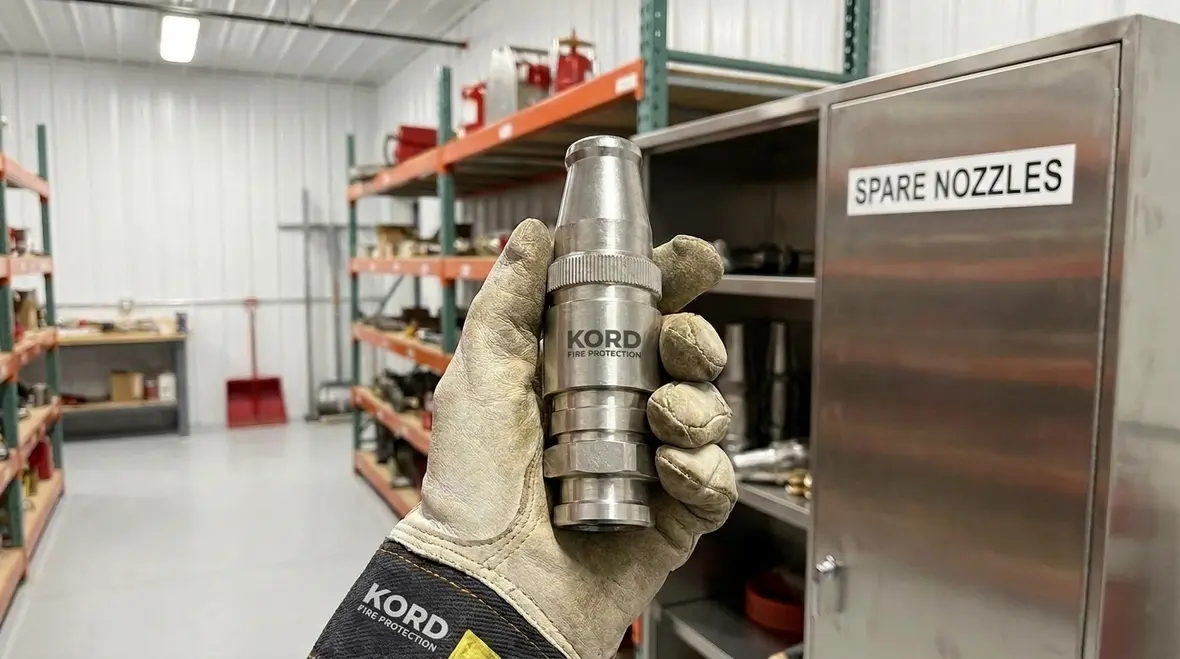
NFPA 15 Section 5.2 Water Spray Nozzles: K Factor, Marking, and Spare Stock Requirements
Quick Answer
NFPA 15 Section 5.2 requires water spray nozzles to meet specified performance criteria and to carry clear identification for critical data such as the nozzle K factor and listing information. It also addresses spare stock expectations so facilities can replace failed or damaged nozzles without delaying compliance repairs.
Facilities that need broader inspection support can also review Kord Fire Protection’s fire suppression inspection checklist for a practical look at what gets checked in the field and how nozzle issues show up during service.
Why NFPA 15 5.2 nozzle details matter in real facilities
Commercial occupancies often assume water spray systems will “just work” until inspection day, when missing or incorrect nozzle data creates downtime and compliance risk. NFPA 15 5.2 water spray nozzles K factor marking spare stock 100F cabinet requirements are not paperwork exercises. They directly affect hydraulic performance, spray pattern accuracy, water distribution, and the ability to restore the system after damage, corrosion, or accidental impact during maintenance activities.
In practice, inspectors and AHJs look for nozzle identification consistency across the hazard area. If the system uses mixed nozzle types, incorrect K factors, or missing markings, the facility can face rework costs and schedule impacts. This is why many service providers align their maintenance program with NFPA expectations and verify nozzle data during routine inspections rather than after failures.
What Section 5.2 requires: K factor, listing, and marking
NFPA 15 Section 5.2 focuses on ensuring water spray nozzles installed in fixed fire protection systems perform as designed. The K factor is the nozzle’s discharge coefficient and directly influences flow rate at a given pressure. When K factor values differ from design assumptions, the system can deliver too little water to meet required application rates or discharge too much water, shifting hydraulics and potentially creating distribution issues.
1) K factor compliance is not optional
Field substitutions sometimes occur when parts appear “equivalent” to maintenance staff. In reality, two nozzles can look similar while having different K factors, different orifice geometry, or different flow characteristics. NFPA 15 5.2 water spray nozzles K factor marking spare stock 100F cabinet expectations help reduce this risk by requiring that correct nozzle identification stays available for verification.
2) Marking supports accurate verification
Markings on the nozzle are the primary mechanism used to confirm nozzle identity during inspection and after repairs. Markings typically include manufacturer identification, temperature rating, and the K factor value or other identifying data aligned to the listing. If markings are degraded, painted over, obscured by overspray, or replaced with nonconforming parts, compliance verification becomes difficult and can force partial replacement.
3) Temperature rating affects system reliability
The system’s temperature classification ties directly to sprinkler compatibility and heat response assumptions for the hazard. The “100F cabinet” reference commonly appears in commercial facilities where heat responsive detection or storage environments require a specified temperature rating for nozzle assemblies. If a facility cannot demonstrate that the correct temperature-rated nozzle is installed, it becomes a failure point during acceptance or recurring inspection.
Spare stock: how facilities should plan replacements without creating new noncompliance
Spare stock is not simply “extra nozzles in a box.” For NFPA 15 5.2 water spray nozzles K factor marking spare stock 100F cabinet compliance, the spare inventory must support fast, accurate replacement using the correct nozzle type and temperature rating. The goal is to restore system design performance without introducing substitution errors that could alter hydraulics or coverage effectiveness.
What usually goes wrong during spare stock programs
- Nozzle mismatch. Spares are purchased based on appearance or location rather than K factor and marking verification.
- Missing or damaged markings. Nozzle labeling is not readable after storage, or parts are placed without documentation.
- Wrong temperature rating. Spares contain an incorrect temperature classification for the application, creating future inspection failures.
- Poor storage control. Spares stored in unsecured cabinets lead to contamination, corrosion, loss of traceability, or accidental substitution.
- No replacement workflow. Facilities stock nozzles but do not define the process to use them during repairs, causing contractors to search for parts ad hoc.
Operational best practices for “spare stock you can actually use”
Commercial facilities typically benefit from a structured spare stock workflow that includes:
- Documented nozzle identity. A record that ties the K factor, temperature rating, listing, and manufacturer to each spare lot.
- Traceable storage. A controlled cabinet and labeling scheme that preserves the ability to verify markings without scraping, repainting, or destroying identification.
- Scheduled verification. Periodic checks of inventory, expiration of any relevant shelf life items per manufacturer guidance, and readability of nozzle markings.
- Replacement procedure. A documented method for confirming the installed nozzle matches spare stock data before any changeover occurs.
When spare stock is managed correctly, maintenance teams can restore the system quickly after a maintenance incident or accidental damage, while keeping system performance aligned with the original design assumptions.
Hydraulic and inspection considerations: where nozzle issues surface
Nozzle nonconformity often shows up at the worst time: preinspection walkdowns, impairments, or post repair reviews. K factor and marking issues may not be visible without close inspection, flow calculation review, or confirmation against design documentation.
Common failure points during inspection
- Unreadable markings. Dust, paint, or corrosion hides the identification required to confirm nozzle identity.
- Non matching nozzle families. Renovations and upgrades introduce mixed nozzle types across a hazard zone.
- Incorrect replacement practices. Contractors replace failed parts with “available” equivalents instead of verified design matching nozzles.
- Obstruction risks. Debris or misalignment affects discharge performance even when the nozzle K factor is correct.
How technicians verify nozzle data efficiently
Effective field verification typically includes:
- On site photo documentation of nozzle markings, including K factor and temperature rating.
- Comparison against system drawings, hydraulic calculations, and the nozzle schedule.
- Validation that replacement parts align to the same listing and functional characteristics.
- Assessment for corrosion, clogging, impact damage, and evidence of overspray or obstruction.
This level of disciplined verification reduces rework and shortens return to service timelines. It also supports a defensible compliance posture for commercial, industrial, and retail facilities that must keep operations running.
Service partnerships that support ongoing compliance
NFPA 15 water spray systems require more than periodic visual checks. The most reliable compliance programs combine nozzle marking verification, spare stock controls, and disciplined replacement workflows. Kord Fire Protection positions these activities as ongoing service rather than reactive troubleshooting, helping facilities maintain system performance and inspection readiness.
For further guidance on water spray fixed systems and compliance support, facilities can review:
NFPA 15 Enhancing Fire Safety With Water Spray Fixed Systems
Additionally, facilities can reference broader fire sprinkler and water based system resources at:
Fire Pumps and Water Based Fire Protection Resources
Frequently Asked Questions
Call to action
Facilities should audit nozzle markings and spare stock now, before the next inspection or any maintenance event introduces substitutions. Kord Fire Protection can help verify K factor and temperature compliance, validate spare inventory readiness, and support documentation for confidence during AHJ review. Schedule a nozzle and spare stock compliance check to protect system performance and reduce costly rework.

Join Our Newsletter!
Get the latest fire safety tips delivered straight to your inbox From our Newsletter.



