
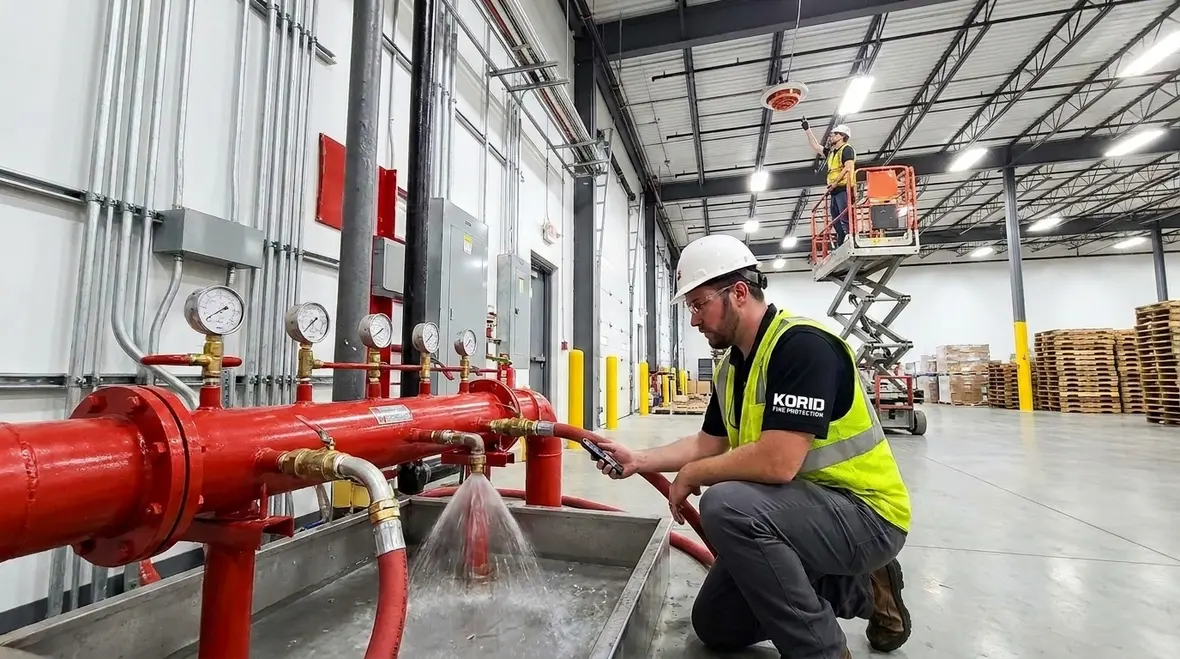
NFPA 15 Section 12.5: Annual Flow Tests and Monthly Detector Checks for Ultra-High-Speed Systems
Quick Answer
NFPA 15 Section 12.5 requires annual flow tests and monthly detector checks for certain fire suppression systems, including ultra high speed configurations. Facilities must verify water delivery performance, detector readiness, and system interface integrity. A documented maintenance cycle reduces the risk of delayed or insufficient actuation.
If you’re reviewing detection reliability alongside broader water supply and system readiness, it also helps to look at NFPA 15 Section 8.4 water supply information for spray systems, which fits naturally with annual flow testing and performance verification. For broader background, see NFPA 15 enhancing fire safety with water spray fixed systems.
Why NFPA 15 12.5 testing maintenance matters in ultra high speed installations
Ultra high-speed water spray systems depend on rapid detection and immediate water distribution. That performance hinges on two linked requirements: (1) detectors that remain sensitive and properly calibrated, and (2) hydraulically reliable flow paths that match the design intent. When NFPA 15 12.5 testing maintenance annual flow test monthly detector radiant requirements get treated as a paperwork exercise, facilities often discover failures during commissioning or after a performance event. Those failures usually show up in clogged strainers, drifting detector alignment, obstructed spray patterns, or inaccurate flow and pressure readings.
For commercial facilities, the compliance challenge is practical, not theoretical. Scheduling impacts operations, access limitations affect inspection coverage, and documentation must support audits by insurers and authorities having jurisdiction. A repeatable maintenance process, aligned to NFPA 15 expectations and supported by experienced field technicians, protects both life safety and business continuity.
What Section 12.5 requires and what “good” looks like
Section 12.5 focuses on confirming that detection and water delivery remain capable over time. In ultra high-speed systems, the system’s value comes from speed plus effective application. Therefore, maintenance targets both the sensing layer and the hydraulic delivery layer.
Annual flow tests: confirm actual water delivery
Annual flow testing evaluates the system’s ability to deliver water as designed. In practice, the test verifies that the pressure and flow available at the remote test points match expected performance and that system components do not degrade flow capacity.
Commercial facilities often see recurring annual failure causes:
- Partial obstruction in strainers, filters, or check valve internals leading to reduced flow or unstable pressure.
- Closed or mispositioned valves after maintenance or construction activity.
- Sensor or test assembly placement errors that yield misleading readings.
- Hose connections, test drains, and gauges that are not calibrated or not installed per the approved test procedure.
- Accumulation of debris in water distribution piping that changes local flow and spray behavior.
Monthly detector checks: verify readiness and radiant performance integrity
Monthly detector checks focus on functional readiness and verification that the detector continues to respond within expected parameters. For radiant-type detectors, the check typically addresses cleanliness, field of view, wiring integrity, physical mounting, and obstructions that can block or alter the received radiation pattern.
Common monthly issues include:
- Dust film or surface contamination on detector windows that reduces sensitivity.
- Paint overspray or construction dust that partially blocks the detector field of view.
- Incorrect orientation after ceiling or lighting adjustments.
- Loose terminations or degraded cable insulation causing intermittent reporting.
- Changes in airflow, steam, or process vapors that can affect perceived signal stability.
When the monthly detector checks and the NFPA 15 12.5 testing maintenance annual flow test monthly detector radiant program operate together, facilities gain a continuous assurance loop: detection stays trustworthy, and hydraulics stays capable.
How technicians execute NFPA 15 12.5 testing maintenance in real facilities
1) Pre test planning: protect uptime and establish test baselines
Ultra high-speed systems can be sensitive to test conditions. Technicians typically coordinate testing windows to minimize operational disruption and ensure safe access for gauges, drains, and electrical panels. They also confirm that the as-built system matches the latest drawings, including changes to piping routes, added floor obstructions, and any modifications to detector placement.
2) Annual flow test: measure, record, and confirm stability
Annual flow tests generally include verifying correct system activation path, confirming water supply pressures, and recording flow and pressure trends. Technicians evaluate test data for stability, not only peak values. Unstable readings can signal air entrainment, valve movement issues, or irregularities in supply conditions.
Best practice documentation includes:
- Instrument calibration status and identification numbers.
- Gauge location and method of connection to avoid misleading pressure gradients.
- Measured pressures at required points and corresponding flow values.
- System status before and after the test, including any temporary isolation used for safety.
- Corrective actions and retest results when thresholds are not met.
3) Monthly detector checks: document cleanliness, alignment, and response path readiness
Monthly checks should include an inspection of the detector physical condition and surrounding area, plus verification that the field of view is not obstructed. For radiant detectors, technicians commonly verify that contaminants are removed using manufacturer-approved cleaning methods. They also confirm that wiring terminations remain secure and that the detector’s reporting behavior aligns with control panel expectations.
Field teams often use a structured checklist to avoid drift, especially in multi-tenant retail centers and industrial warehouses where ongoing maintenance and construction activity constantly changes the environment.
Where compliance breaks down: the failure points that audits uncover
NFPA 15 12.5 testing maintenance annual flow test monthly detector radiant compliance typically fails for predictable reasons. Facilities do not always lack effort. They often lack a unified process that ties monthly detector observations to annual hydraulic validation.
Detector issues that do not show up until they matter
- Obstructions created by seasonal merchandising displays, racks, or signage in retail environments.
- Accumulated dust or coatings after HVAC filter changes or industrial process upsides.
- Loose wiring that looks “mostly fine” but produces intermittent signaling during disturbances.
Hydraulic issues that reduce performance without obvious warning
- Strainers and filters that do not get cleaned on schedule or get reinstalled incorrectly.
- Minor valve position errors that pass visual checks but fail flow tests under real demand.
- Pressure gauge misplacement that skews results and hides deteriorating system capacity.
For water spray fixed systems, consistent performance requires both mechanical integrity and disciplined documentation. Kord Fire Protection supports this with service planning and compliance-focused maintenance for commercial sites, aligning ongoing field work with inspection expectations. For additional context on system maintenance fundamentals, see NFPA 15 enhancing fire safety with water spray fixed systems.
Building a maintenance schedule that actually holds up
Many facilities schedule detector checks as a monthly task but treat the annual flow test as a stand-alone event. That approach misses the value of pairing detection reliability with water delivery capability. A stronger model uses a year-round plan that tracks environment changes, construction impacts, and equipment condition trends.
Recommended commercial maintenance workflow
- Maintain current system drawings and mark test points and detector locations for field teams.
- Use a monthly checklist for radiant detector radiant performance integrity, including cleanliness and field of view verification.
- Plan annual flow testing early enough to schedule flow instruments and gain access to isolation valves and drains.
- Set triggers for additional work if monthly checks reveal persistent contamination, repeated obstructions, or abnormal control panel behavior.
- Archive results in a format that supports audits and insurer questions without rework.
When facilities need reliable execution across multiple locations, experienced service providers help ensure consistency. For reference on pump and water supply considerations often tied to flow testing, see firepumps.org. For regional service information, facilities can also reference kordelectric.com and kordfire.com.au.
As a commercial service partner, Kord Fire Protection supports compliance by performing testing maintenance with disciplined checklists, calibrated instrumentation practices, and documentation designed for inspection readiness.
Frequently Asked Questions
Get compliant, keep performance predictable
Ultra high-speed water spray systems perform only when both detection and hydraulics stay reliable. Facilities should implement a monthly radiant detector check routine and schedule annual flow testing with calibrated instrumentation, documented results, and corrective action triggers. Kord Fire Protection can help plan and execute NFPA 15 12.5 testing maintenance across commercial sites so operations stay protected and audit readiness stays current. Contact Kord Fire Protection to assess your system and lock in the right maintenance cadence.

Join Our Newsletter!
Get the latest fire safety tips delivered straight to your inbox From our Newsletter.



