
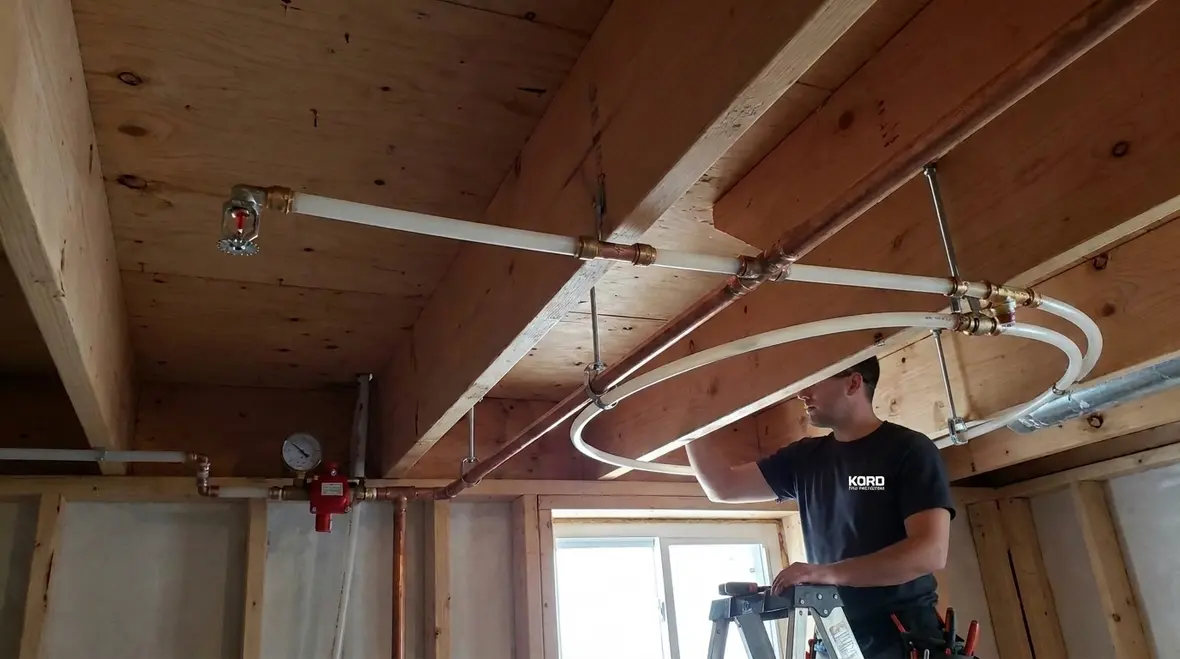
NFPA 13D Section 10.3: Branch Line and Ring Main Piping Configurations for Home Sprinklers
Quick Answer
NFPA 13D Section 10.3 sets out how branch line and ring main piping can be arranged to deliver water to home sprinkler sprinklers using a system that remains hydraulically reliable. Correct routing, sizing, and control of friction losses are essential for compliance, inspection readiness, and maintenance longevity.
If you’re reviewing this in the context of active system upkeep, Kord Fire Protection’s fire sprinkler service and maintenance support fits naturally into the inspection and repair side of these layouts, especially where routing changes, leaks, or aging components start nudging a clean design toward real-world chaos.
Why NFPA 13D Section 10.3 matters for real installations
NFPA 13D Section 10.3 branch line ring main piping configurations home sprinklers NFPA 13D addresses the way water is distributed so that the expected operating pressure and flow reach each sprinkler at the design demand. In the field, the practical challenge often comes down to how installers handle routing, pipe support, fittings, and how the system ages. Even when a design is approved, operational reliability can degrade from small changes such as unapproved alterations, blocked flow paths, sediment accumulation, or corrosion at joints and hangers.
Commercial, industrial, and retail facilities increasingly maintain residential-style sprinkler systems in caretaker apartments, dorm units, staff housing, and mixed-use occupancies. Those environments elevate inspection and maintenance expectations because system downtimes and water delivery issues carry business continuity risk.
What Section 10.3 is regulating: branch lines versus ring mains
Section 10.3 covers two primary distribution concepts used in home sprinkler systems:
- Branch line piping: Water reaches sprinklers through linear or branched runs that feed toward the ends of the distribution network.
- Ring main piping: A continuous loop or near-continuous loop distributes water around a perimeter, feeding sprinkler drops from the main.
Both approaches must preserve the system’s hydraulic intent. The difference is how hydraulic losses accumulate across the network. Branch lines can have longer one direction travel from the supply, while ring mains can reduce the maximum distance to a given sprinkler depending on where the most remote area lies relative to the feed points.
Branch line configurations: compliance critical points
When a layout uses branch line piping, NFPA 13D Section 10.3 branch line ring main piping configurations home sprinklers NFPA 13D focus falls on ensuring the piping arrangement supports the design flow and discharge characteristics at the most remote sprinklers. Practical compliance success depends on controlling three categories of risk: hydraulic loss, physical layout, and system integrity over time.
Hydraulic loss and layout control
Branch line systems can fail operationally when friction loss calculations do not match the installed configuration. Common field deltas include:
- Excess fittings and elbows added during coordination with framing or mechanical services.
- Pipe diameter changes driven by material availability without updated hydraulics.
- Incorrect placement of hangers and supports that cause sagging and localized flow restriction.
- Uncontrolled “as built” changes that shift the most remote sprinkler location.
Commercial facilities often adopt standardized design and installation details to reduce these variations. A similar discipline during handover helps reduce recurring inspection deficiencies.
Physical integrity: supports, protection, and condensation
Branch lines still require secure support and proper protection from mechanical damage. Inspectors typically look for secure anchorage, correct pipe routing, and absence of unauthorized substitutions. Over time, branch lines can develop corrosion at joints, particularly where water quality issues exist or where insulation traps moisture.
Maintenance planning should include a joint and hanger condition review as part of ongoing impairment checks. Where systems serve mixed occupancy spaces, Kord Fire Protection can align inspection schedules with facility operations to minimize interference with tenants and business areas.
Common failure points during inspection
In practice, the following issues frequently cause delays or corrective actions:
- Obstructions or storage placed too close to sprinkler discharge patterns.
- Pipe changes completed by other trades without sprinkler contractor signoff.
- Missing or incorrect escutcheons that allow hidden damage around penetrations.
- Evidence of leakage at threaded connections or improperly assembled fittings.
Ring main configurations: performance benefits and added responsibilities
Ring mains typically provide improved distribution symmetry by allowing water to reach remote sprinklers through multiple paths. This can be advantageous in larger or more perimeter distributed home configurations, and it can help the hydraulics remain within intent if the most remote location sits away from the primary feed direction.
However, ring mains introduce added installation and maintenance responsibilities because the looped arrangement can trap air, sediment, or debris in ways that differ from straight branch runs.
Hydraulic balancing and remoteness
Ring main performance depends on where the supply tie-in points occur and how the loop is executed. A poorly executed loop with unintended dead ends, disconnected sections, or excessive offsets can increase the maximum friction loss for the most remote sprinklers. Designers and contractors typically manage this by:
- Maintaining pipe sizing continuity through the loop where required by the design basis.
- Limiting unnecessary fittings that increase turbulence and friction.
- Ensuring that each sprinkler branch and drop line meets its design demand and pattern.
Air and water quality issues: maintenance focus
Ring mains can be more sensitive to air entrapment and sediment movement depending on how the loop slopes and how drain or inspection provisions are arranged. A section of pipe that holds air can delay flow when a sprinkler operates, affecting available discharge patterns and potentially triggering nonconformance in performance verification.
For facilities with long dormant periods or variable occupancy, Kord Fire Protection recommends an impairment and verification program aligned to local inspection standards and the facility’s risk profile. That program commonly includes routine checks for valve access, unobstructed sprinkler locations, and confirmation that system water conditions support reliable operation.
Inspection readiness: what inspectors expect to see
When inspectors evaluate ring mains, they generally confirm:
- The loop piping is installed as designed with correct routing and no unauthorized field modifications.
- Supports and hangers provide stable alignment and prevent deformation of the loop.
- Valves and drain points are accessible and maintained in correct positions.
- Sprinkler drops connect properly without adverse cross connections, leaks, or misalignment.
How commercial facility standards affect “home” sprinkler piping
Even though NFPA 13D targets residential sprinkler systems, commercial building operations influence how those systems stay compliant. Typical integration points include mechanical coordination, ceiling and partition changes, and ongoing tenant modifications.
Change control and documentation discipline
Branch line and ring main piping can become noncompliant if maintenance staff or other contractors modify the piping without design updates. A documented change control process should include:
- Clear labeling of system components and valve locations.
- As built drawings or record updates for any alterations.
- Updated hydraulic review when pipe sizes, routing, or feed locations change.
This type of discipline supports smoother inspections, less rework, and faster restoration after repairs.
Ongoing maintenance and operational readiness
For sprinkler systems serving apartments, residential wings, or staff housing inside commercial facilities, operational readiness depends on routine testing and impairment management. Kord Fire Protection provides service that supports inspection cycles, ensures valve and waterflow related readiness, and reduces the likelihood that small issues become large failures.
For additional context on system installation principles and best practice coordination, refer to: NFPA 13 overview and automatic fire sprinkler system installation guidance.
Inspection and testing: the practical checklist tied to Section 10.3
Section 10.3 configurations rely on the system performing as intended at the moment of operation. That outcome typically depends on three execution steps: correct install, correct acceptance, and controlled long term condition.
Acceptance checks that protect branch and ring performance
- Verification of piping routing and fitting inventory: Confirm the installed network matches the design assumptions for friction loss.
- Leak testing and joint validation: Confirm integrity at threaded or joined components.
- Support verification: Ensure the piping is supported to prevent sagging that can alter flow characteristics.
Maintenance checks that prevent degradation
- Obstruction and clearance review: Ensure storage and fixtures do not interfere with sprinkler discharge.
- Corrosion and joint condition review: Look for seepage, coating failure, and deteriorated hangers.
- Valve access and water delivery path: Confirm that valves and drains remain operable and accessible.
For broader fire protection system context, trade guidance from industry associations can support training and cross system understanding at Fire Pumps Association.
Frequently Asked Questions
Conclusion and next steps
NFPA 13D Section 10.3 branch line ring main piping configurations home sprinklers NFPA 13D demand careful control of hydraulic losses, installed routing fidelity, and long term system integrity. Kord Fire Protection helps commercial facilities reduce inspection surprises through disciplined acceptance verification, change control support, and ongoing maintenance readiness. If your home sprinkler system configuration needs review, impairment assessment, or documentation cleanup, contact Kord Fire Protection to schedule a compliance focused inspection and maintenance plan.

Join Our Newsletter!
Get the latest fire safety tips delivered straight to your inbox From our Newsletter.



