In-Rack Sprinkler Systems for Rack Storage Protection
By a slow-speaking narrator… somewhere between your favorite bedtime storyteller and a facilities management insider
Hidden within the whirring hum of your warehouse operation lies a quiet, unsung hero. It’s not the forklift. It’s not even the night shift coffee pot that’s been fighting for its life since 1997. No, it’s something infinitely more important, and surprisingly majestic — the in-rack sprinkler system.
Now when engineering and permitting teams in areas like Los Angeles start a fire protection design plan, one key phrase dominates the blueprints: in-rack sprinkler design standards for Los Angeles. With its strict fire codes and seismic concerns, LA doesn’t let you phone anything in, especially not fire protection. These rules bring a combination of NFPA regulations, local fire marshal tweaks, and seismic implementing quirks that can’t be ignored. Yes, the Golden State plays by its own rules — but those rules might just save your inventory and your insurance rating.
So pull up a comfy chair. We’re going to walk you through how in-rack sprinkler systems protect rack storage like a bodyguard protects Beyoncé.

What Exactly Makes In-Rack Sprinkler Systems Special?
So what’s the big deal with these in-rack contraptions anyway?
Most buildings rely on overhead sprinklers. They hang up top, like a polite library monitor, watching quietly and stepping in only when needed. But when you’ve got rack storage that stretches higher than your college hopes and dreams, overhead just won’t cut it.
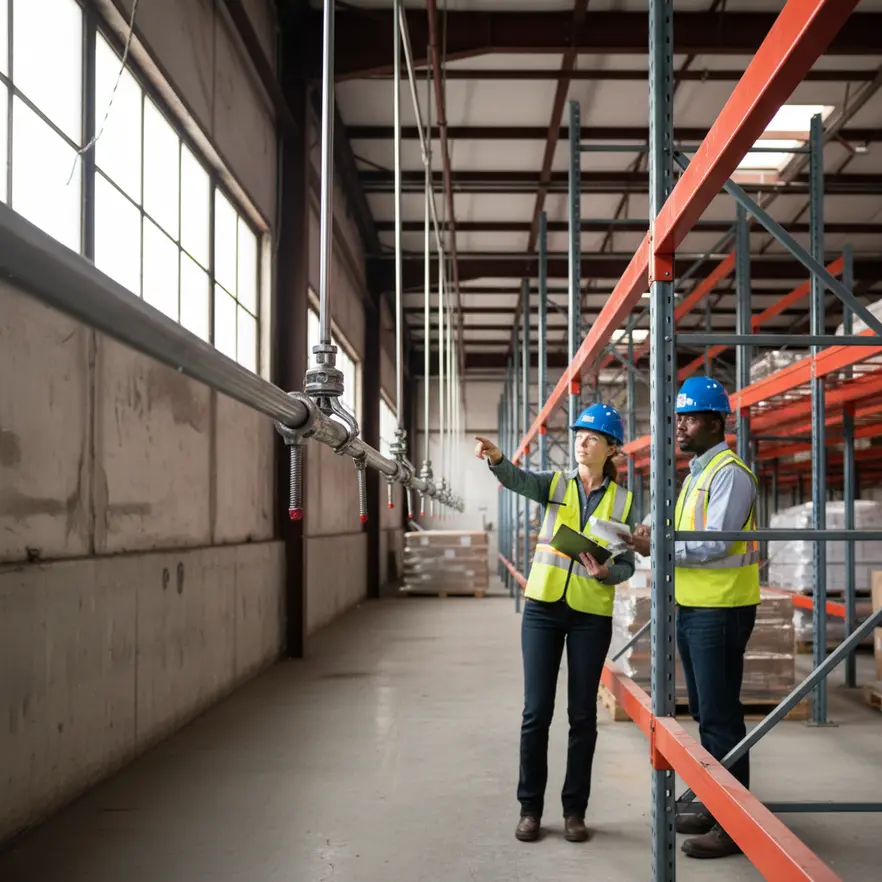
In-rack sprinkler systems dive deep. They’re strategically placed between the storage levels inside the actual racks. When flames kick off at the bottom or middle of these racks, they get suppressed immediately — instead of relying on water hoping to travel past boxes, shrink wrap, and the occasional rogue plastic gnome (don’t pretend your warehouse doesn’t have one).
This precise location increases response time, minimizes damage, and keeps suppression targeted where it’s needed most — like that friend who shows up with pizza when everything’s on fire, metaphorically or literally.
How In-Rack Sprinklers Change The Fire Fight
By attacking the fire at its origin point, in-rack sprinklers keep a small problem from becoming a warehouse-torching spectacle. They cut off vertical flame spread inside pallet loads, reduce radiant heat to surrounding commodities, and limit how many sprinkler heads need to open. That means less water, less mess, and far less drama for your operations and your insurance adjuster.

The Building Blocks: In-Rack Sprinkler Design Standards for Los Angeles
Designing in-rack sprinkler systems in Los Angeles isn’t like tossing darts at a fire protection catalog. Oh no.
Local standards require you to factor in all the goodies:
- Seismic sway bracing for both pipes and racks
- Commodity classification adapted for high-hazard items and plastics
- Clearance spacing with precise engineering for ceiling vs. in-rack coordination
- Vertical and horizontal barriers that manipulate fire spread direction
Given LA’s tendency to tango with earthquakes, designers must also ensure calculations consider not only structural weight but movement. A sprinkler head that’s slightly misaligned during a seismic jolt won’t just be annoying – it’ll be catastrophic.
Layering Local Rules On Top Of NFPA 13
NFPA 13 sets the baseline rules for in-rack sprinklers, but Los Angeles adds its own flavor. Think additional seismic design criteria, more conservative water supply assumptions, and closer scrutiny on how in-rack and ceiling systems interact. The phrase “in-rack sprinkler design standards for Los Angeles” isn’t just jargon — it’s a reminder that every detail, from pipe schedule to head guard selection, is going to be inspected, peer-reviewed, and probably discussed in at least three meetings.
Documentation That Keeps AHJs Happy
Submittal packages usually need hydraulic calculations, rack elevation drawings, head placement maps, and clear demonstration that commodity class, storage height, aisle width, and water demand all line up with the adopted standard. It’s less “napkin sketch” and more “term paper with footnotes,” but the reward is a system that performs under pressure — literally and figuratively.

Why In-Rack Systems Beat Overhead (For Rack Storage)
Listen, no disrespect to the overhead sprinkler crowd. They’ve served many office buildings and big-box retailers well. But when it comes to high-density rack storage, in-rack systems throw punches with more precision than Rocky in round 12.
Here’s why:
Overhead Sprinkler Cons
- Water can’t reach deep rack fires quickly
- Coverage is often delayed by packaging or pallets
- Response time depends on fire’s vertical movement
- Risk of water not penetrating flue spaces
In-Rack Sprinkler Wins
- Fast activation near point of combustion
- Minimized collateral damage — target suppression
- Scalable to various rack heights and product classes
- Engineered to fit within seismic and fire code compliance
Where Overhead Still Matters
In most serious rack storage designs, it’s not “overhead versus in-rack” — it’s “overhead plus in-rack.” The ceiling system controls heat and smoke in the upper volume of the building, while the in-rack sprinklers put out the fire in the storage array. Together, they act like a tag-team wrestling duo: one handles the big picture, the other works the close combat.
Strategic Placement and Coverage: A Literal Hot Spot
If in-rack sprinklers were playing chess, they’d be ten moves ahead. Correct placement isn’t about guessing, it’s about precision. You can’t just hang one every five feet like discount Christmas ornaments.
System designers must understand:
- Rack geometry: How deep and wide the racks are
- Storage materials: Are we talking plastic bins, aerosols or paperbacks?
- Flue space widths: These invisible pockets help guide airflow and fire movement
Every cubic inch of your rack needs reliable detection and suppression patterns. In a fire emergency, seconds matter more than the time you hesitated to watch just one more episode on Netflix. Even a smidge of delay can cause cascading ignition through rows of inventory — a domino effect that’s more horror flick than warehouse opera.
Horizontal And Vertical Spacing Done Right
Head spacing along the rack length, the number of levels, and whether you use single-row, double-row, or back-to-back racks will all change how many sprinklers you need and where they sit. Designers also plan for heat collection — ensuring that when a fire starts, the hot gases rise right where the sprinkler is waiting, not two bays over near the exit door.
Dos and Don’ts of Integrating In-Rack with Warehouse Systems
In-rack systems might be a miracle of fire engineering, but let’s not pretend miracles don’t come with instructions. Installing them improperly is like getting GPS directions and still ending up in a lake.
Here’s what seasoned fire pros know better than to ignore:
- DO ensure system pressure settings match both the riser and rack length
- DO NOT install heads too close to baskets, boxes or pallet wrap
- DO coordinate maintenance with seasonal warehouse changes
- DO NOT ignore code compliance changes post-earthquake or remodel
Remember, installing sprinklers and just walking away is like buying a goldfish and hoping it feeds itself. Routine inspection and code review are essential to keep that system ready at all times.
Operational Changes That Can Break Your Design
Change from cardboard to plastic totes? Start storing aerosols where you once kept books? Decide to double-stack pallets because sales is “on a roll”? Each of these can blow up your carefully crafted fire protection strategy. Smart operators run layout and commodity changes past their fire protection team before the forklifts start rearranging reality.
Design Considerations Unique to Los Angeles Warehouses
Ah, Los Angeles. Land of movie stars, palm trees, and painstaking building codes.
The in-rack sprinkler design standards for Los Angeles must take into account more than national NFPA 13 guidelines. That includes:
- Working around tight real estate — ceilings barely kiss the minimum clearance limits
- Tight vertical flue spacing due to dense storage logistics
- Integration with seismic restraint systems
- Coordination with local water supply concerns, especially in parched zones
Simply put, your warehouse has to be both fireproof and earthquake-resistant — which, frankly, is about as easy as getting toddlers to share snacks. But not impossible with the right planning, reviews, and a solid collaboration with AHJs (Authorities Having Jurisdiction).
Seismic Reality Meets Rack Reality
Los Angeles doesn’t assume your racks will sit perfectly still during a quake. In-rack piping gets braced, rack frames are evaluated for added loads, and clearances must anticipate a little shaking. It’s like designing a sprinkler system that can ride a roller coaster and still perform flawlessly.
How Technology Is Leveling Up Fire Protection
In-rack sprinkler systems aren’t stuck in a time warp. Today’s iterations offer more than just water and a prayer. Modern sensors communicate with warehouse alarms and monitoring systems, allowing for automated alerts, head activation tracking, and zone-specific shutoffs.
In some Los Angeles facilities, sprinklers are now paired with smart analytics that study airflow changes, thermal patterns, and even packaging behaviors. Industry giants are integrating AI with legacy systems — so yes, your fire protection might soon be smarter than your teenager’s phone.
And the cherry on top? Many of these advanced systems reduce insurance premiums. Who knew safety could also stack savings?
From Data To Decisions
With the right monitoring, you can spot valve closures, impaired zones, or damaged heads before they quietly sit dormant for months. Trend data can reveal recurring issues with specific aisles or rack levels, letting you adjust layouts or procedures before a real fire ever puts them to the test.
Cost Factors: Because Nobody Loves a Budget Surprise
Before you commit to an in-rack system, it’s good to ask: how deep are your pockets?
But as with most safety systems, value doesn’t always mean lowest cost — it means return on investment. A targeted in-rack design will cost more upfront than basic overheads, but here’s what it can reduce:
- Total water damage claims by thousands
- Loss of inventory from delayed fire response
- Property risk ratings that drive up insurance
- Downtime from warehouse repairs or fire cleanout
In other words, it’s cheaper than replacing 40 pallets of mystery cheese and explaining it to headquarters. Nobody wants that email chain.
Planning For Life-Cycle Costs
Smart budgeting doesn’t stop at installation. Your financial forecast should include periodic testing, occasional head replacements, system upgrades when codes evolve, and training for in-house teams. When you spread those costs over the life of the warehouse — and compare them to a single severe fire event — in-rack sprinklers start to look less like a luxury and more like common sense.
Maintenance and Long-Term Performance Tips
If you’ve installed an in-rack sprinkler system and think you’re finished, let’s remind you gently: your job has just started.
Maintenance isn’t optional. It’s compliance required. And smart warehouses treat it like monthly rent — you don’t miss it without consequences. Common tasks include:
- Flow testing annually
- Visual head inspection monthly
- System flushes for sediment buildup
- Verification testing after seismic activity
Add sensors and smart valves to make these check-ins smoother. Some crews even schedule theirs with coffee breaks — suppression checks paired with espresso? Genius.
Housekeeping: The Lowest-Tech, Highest-Impact Strategy
Keeping flue spaces clear, preventing pallets from creeping into sprinkler zones, and training forklift drivers not to use sprinkler piping as a “gentle guide rail” will do more for long-term system health than any fancy gadget. A clean, orderly rack layout is basically love language for your in-rack sprinklers.
FAQ: Protection Methods Using In-Rack Sprinkler Systems
What is an in-rack sprinkler system?
An in-rack sprinkler system is a network of sprinkler heads placed inside warehouse rack storage areas to directly target and suppress fires at the point of origin.
When should I use in-rack sprinklers vs overhead?
Use in-rack systems when storing high-density or highly combustible materials or when racks are too tall for overhead sprinklers to reach effectively.
Are in-rack sprinklers required in Los Angeles?
Yes, many industrial facilities in Los Angeles are required to follow specific in-rack sprinkler design standards based on occupancy type, seismic activity, and local ordinances.
How often must in-rack sprinkler systems be inspected?
They typically require monthly visual inspection and annual flow testing, with added checks after structural shifts or seismic events.
Do in-rack sprinklers affect warehouse layout?
Yes. Storage configurations, pallet spacing, and flue space must allow for proper sprinkler placement and coverage.
Can in-rack sprinklers lower insurance costs?
Often, yes. Improved fire suppression can reduce risk metrics, leading to potential policy savings over time.
Your Warehouse Deserves Smart Fire Protection
When it comes to rack storage, fire protection is no minor detail — it’s the quiet protector of your entire operation. Choosing in-rack sprinkler systems isn’t just about code compliance. It’s about safeguarding your product, your people, and your bottom line.
Partner with experts who understand Los Angeles in-rack sprinkler design standards. Get customized solutions built for today’s risks and tomorrow’s growth. Your inventory’s future hero might already be hidden between the pallets. Build smart. Prepare wisely. And sleep easier tonight.

Join Our Newsletter!
Get the latest fire safety tips delivered straight to your inbox From our Newsletter.