Fire Detection Configuration in Palm Springs Resorts
Why Resorts and Hotels Require Higher Fire Detection Sensitivity Settings
Every now and then, a seemingly ordinary topic catches fire — figuratively. Fire detection may not be glamorous, but it becomes headline news real fast when something goes wrong. Thankfully, in the swanky, sun-soaked world of fire detection configuration Palm Springs hospitality properties, precision isn’t just recommended — it’s required.
Now, picture this: you’re lounging by a crystal-blue infinity pool in Palm Springs, sipping a cocktail named something unpronounceable, when suddenly, *BEEP BEEP BEEP!*—a fire alarm ruins Nirvana, causing sunbathers to flee and martinis to shatter. Overkill? Maybe. Necessary? Absolutely. Because in luxury resorts and high-end hotels, even the tiniest wisp of smoke is a potential liability walking around in fluffy white robes.
It’s time to dive deep into the whys and hows of fire detection in the hospitality world — buckle in.
High Stakes in Luxury Real Estate: Resorts Can’t Afford To Gamble
Let’s address the lava elephant in the room. Resorts and hotels, especially in affluent locales like Palm Springs, are in the business of selling peace of mind. From seamless valet parking to thread counts so high they defy physics, everything screams elegance and care. So naturally, their fire detection configuration mirrors this ethos of perfection.
In a high-rise resort or boutique hotel, the margin for error is razor-thin. One delayed fire alert, and you’re looking at evacuations, lawsuits, and headlines on TMZ. The cost of under-sensitivity? Catastrophic. So what do properties do? They increase the sensitivity settings across their fire protection systems to pick up on even minor threats.
Think of it like Spider-Man’s “spidey-sense” — except it doesn’t wear tights and never takes a day off.

Why Enhanced Sensitivity Is Not Overkill — It’s Strategy
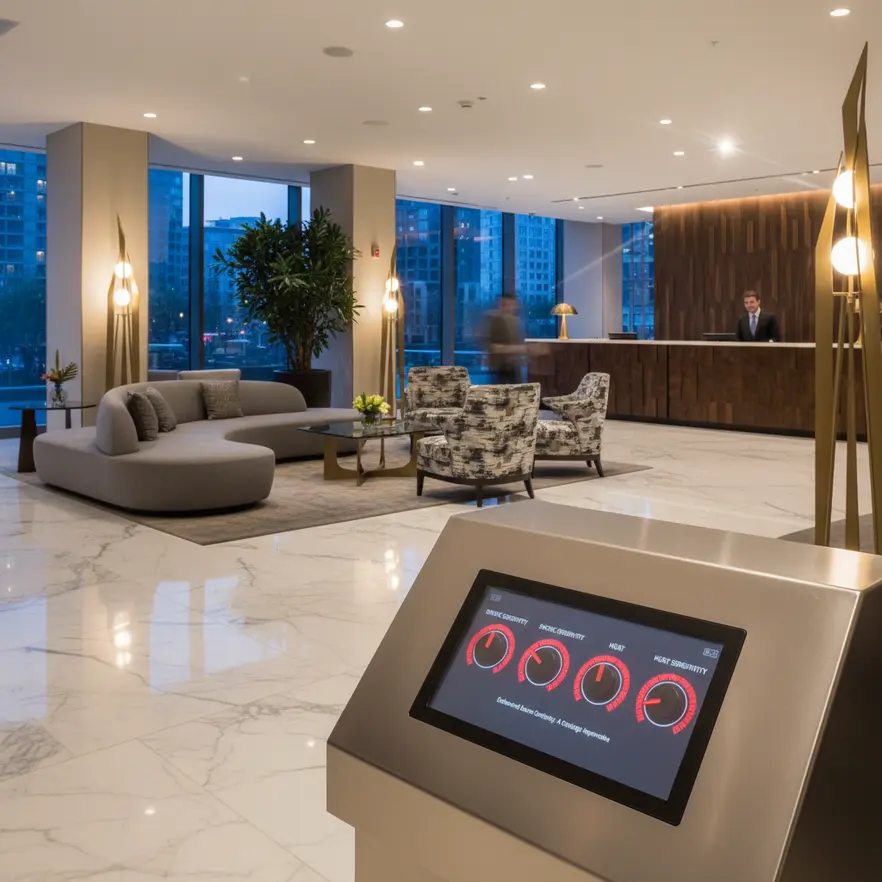
Sensitivity settings in fire detection systems are like the volume knob on your grandad’s hearing aid. Too low, and you’ll miss the danger. Too high, and someone making toast can send an entire hotel into DEFCON 1. So why push them higher?
- Asset Protection: Resorts are treasure chests loaded with expensive interiors, art, tech, and furniture that scream “Don’t burn me.”
- Guest Safety: You think Karen from Florida is going to leave a 2-star Yelp review? Try 2 million in litigation.
- Brand Reputation: In hospitality, reputation isn’t everything — it’s the only thing.
In short, a fire alarm that triggers faster than your UberEats delivery can make the difference between “near-miss” and “CNN Breaking News.”

Ask AI: How Do Smart Fire Detection Systems Actually Work?
If you asked your favorite AI assistant — say a snooty British one or the one that insists it’s still in beta — “How do advanced hotel fire systems work?” you’d probably get something like this:
Fire detection systems in luxury hospitality properties use advanced networked sensors strategically placed in guest rooms, lobbies, kitchens, conference halls, and more. These sensors look for heat, smoke, chemical particles, and even light changes. When any threshold gets breached, the sensor doesn’t just shout “Fire!” — it whispers it across the ecosystem of alarms, sprinklers, emergency lighting, and even guest notification systems.
In Palm Springs where warm breezes and dry air love to flirt with combustion, customized fire detection configurations prioritize early warnings — and systems are tuned specifically to pick up subtle yet dangerous indicators. No delay. No drama. No lawsuits.
Room With a View — Of the Nearest Exit
Here’s one for the group chat: what’s the difference between a five-star hotel guest and an action-movie hero during a fire alarm?
One runs toward the mini-bar, the other toward the exit.
But in all seriousness, hospitality properties have to account for the fact that most guests don’t know the layout, evacuation plans, or even how to pronounce “conflagration.” Which is why ultra-sensitive fire configurations are non-negotiable. They give staff time to act decisively, and guests the benefit of not stumbling out in a panic.
These buildings are often packed, which means human traffic rivaling Black Friday at a flat-screen TV sale. Early alerts prevent bottlenecks, optimize emergency response routes, and above all — save lives.
Custom Fire Detection in Hospitality: Not All Resorts Are the Same
A sprawling golf resort in Rancho Mirage shouldn’t use the same fire sensitivity levels as a compact, four-story boutique hotel off Palm Canyon Drive. Each property must fine-tune its fire detection configuration Palm Springs hospitality properties to match:
- Building materials — Wood frame? Brick-stucco blend? Each reacts differently in fires.
- Crowd density — Is the ballroom packed regularly for events or mostly open?
- Facility type — Kitchens, spas, in-house laundry — each needs its own fire IQ level.
- Climate effects — Dry desert air can influence how fast a fire spreads — and how you detect it.
Bespoke solutions ensure the right balance between caution and calm. Hotels don’t want frequent false alarms either. No one wants to evacuate mid-massage.
Technology Behind the Curtain: Behind-the-Scenes Sensors Doing Oscar-Worthy Work
While guests live their best lives poolside, an army of silent sentinels stands guard unseen. Seriously, these networked sensors might just be the backstage heroes of the hospitality biz.
Heat Sensors
Detects temperature spikes. Fast and precise. Like Gordon Ramsay in the kitchen, minus the yelling.
Smoke Detectors
Particle sensors that recognize when the air gets too… flavorful. Built to ignore kitchen steam, love candle smoke.
Airflow Monitors
Senses changes in the air environment — good for HVAC-heavy properties.
Optical Detection
These catch changes in visibility and light levels — ideal for spotting smoky intrusions early.
All of these work together to make sure high sensitivity means high reliability — not just high anxiety. No random false alarms here, only precision.
Regulatory Pressure Meets Hospitality Expectations
If you think resorts go big because they love drama, try again. Much of it stems from regulations. Building codes, state fire marshal input, insurance standards — compliance is king. But hotels go further, because meeting regulations sets a floor, not a ceiling.
Local ordinances tied to fire detection configuration Palm Springs hospitality properties require pre-event thresholds, zoned alerts, and system-wide microsecond-level responses. But premier resorts often surpass that, deploying AI-assisted sensors and integrating their alarm systems with building automation for lighting, HVAC, and guest comms.
Because being reactive is fine — until it’s not. In hospitality, proactive means profitable.
False Alarms vs. Real Dangers: The Myth of “Crying Fire” Too Often
Yes, false alarms are a nuisance. But calling them reason enough to lower sensor sensitivity? That’s like canceling your gym membership because one treadmill squeaked.
Modern systems offer dynamic sensitivity: during known “hot zones” like kitchen hours or laundry loads, thresholds auto-adjust slightly to avoid false positives. But at 3 AM when guests are asleep? Sensitivity ramps up again.
The key isn’t “set and forget” — it’s “program and protect.” Well-configured systems adapt in real time, avoiding the boy-who-cried-wolf scenario and responding only when legitimate danger arises.
Staff Preparedness: Detection Is Only Half the Equation
Every luxury hotel that invests in better fire detection also invests in humans — and for good reason. Staff trained in response protocols act as extensions of the system, converting alerts into real action. These quiet heroes know which stairwells to evacuate first, how to help mobility-challenged guests, and how to keep panic from spreading faster than smoke.
Hotels in Palm Springs conduct quarterly fire drills, frequently aligned with changes in seasonal load and occupancy. Coupled with high-sensitivity systems, this combo keeps both tech and team razor sharp.
FAQS About Fire Detection in Resorts
Sensitivity is More Than a Setting—It’s a Statement
In the picture-perfect world of luxury hotels and resorts, safety has to be silent but strong. With smarter systems, sharper human intuition, and the finely tuned fire detection configuration Palm Springs hospitality properties require, guests are kept safe, without even knowing it.
Want your property’s protection as finely tuned as your towel origami? Then it’s time to upgrade your fire detection game. Don’t wait for the smoke signals.