Extinguisher Placement for Compliance in Industrial Australia, by Kord
Quick Answer: Strategic extinguisher placement keeps industrial spaces safer, reduces fire spread, and supports Australian compliance. By matching extinguisher locations to your layout, risk level, and travel routes, facilities staff can respond faster. For many sites, Kord fire extinguisher service and certification becomes a practical partner to plan, install, and maintain protection that actually fits real operations.
In industrial workspaces across Australia, extinguisher placement for compliance starts before anyone strikes a match. It begins with how far people must travel, where hazards sit, and how workers move through corridors, bays, and storage areas. When organizations position firefighting equipment correctly, response times shrink and confusion drops, which is good for safety and good for everyone’s insurance phone calls.
However, placing extinguishers “somewhere near the door” rarely works in the real world. Machinery, racking, flammable liquids, dust, and tight access routes create challenges that generic placement plans can’t solve. That is where a deliberate approach matters, and where Kord Fire Protection can step in as a vital partner, bringing field knowledge and practical guidance to the process. Sites that also need broader system coordination can naturally pair extinguisher planning with fire alarm service so detection, response, and documentation stay aligned instead of living in separate silos.
Why extinguisher placement for compliance is about more than distance
People often focus on how far a worker must walk to reach an extinguisher. Distance matters, yes, but it is only one piece of the puzzle. Fire growth depends on fuel load, ventilation, and the way heat and smoke travel through a facility. Therefore, strategic placement also considers visibility, access, and the likelihood that a first-arriving person can reach the unit before the area becomes smoke-heavy.
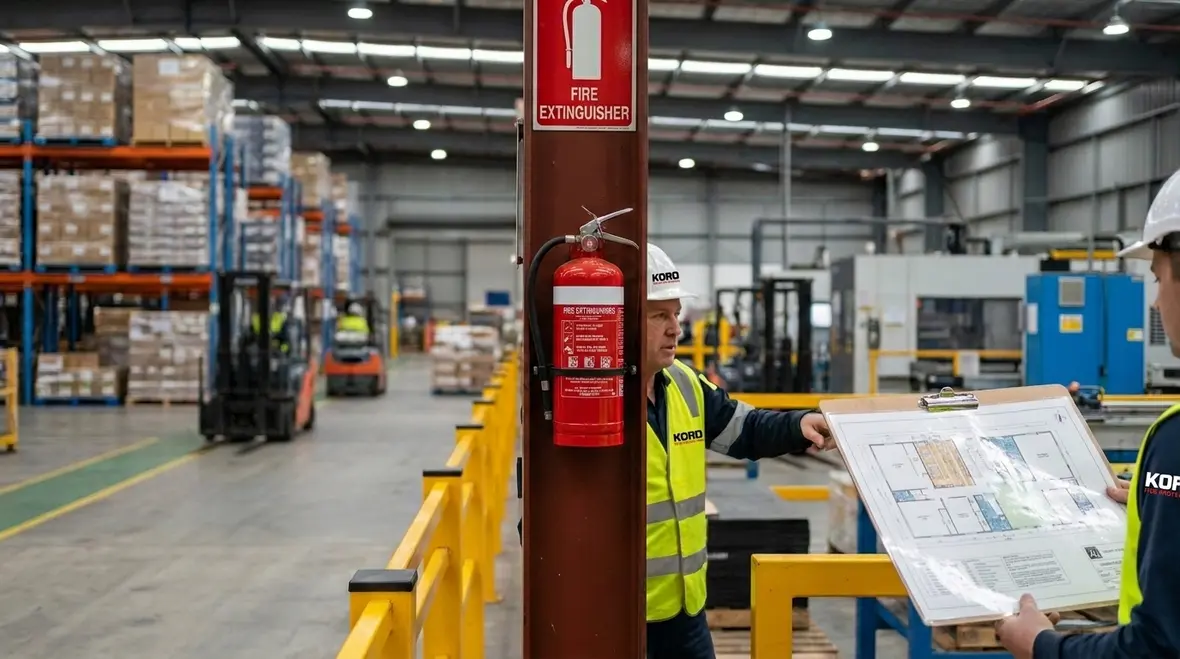
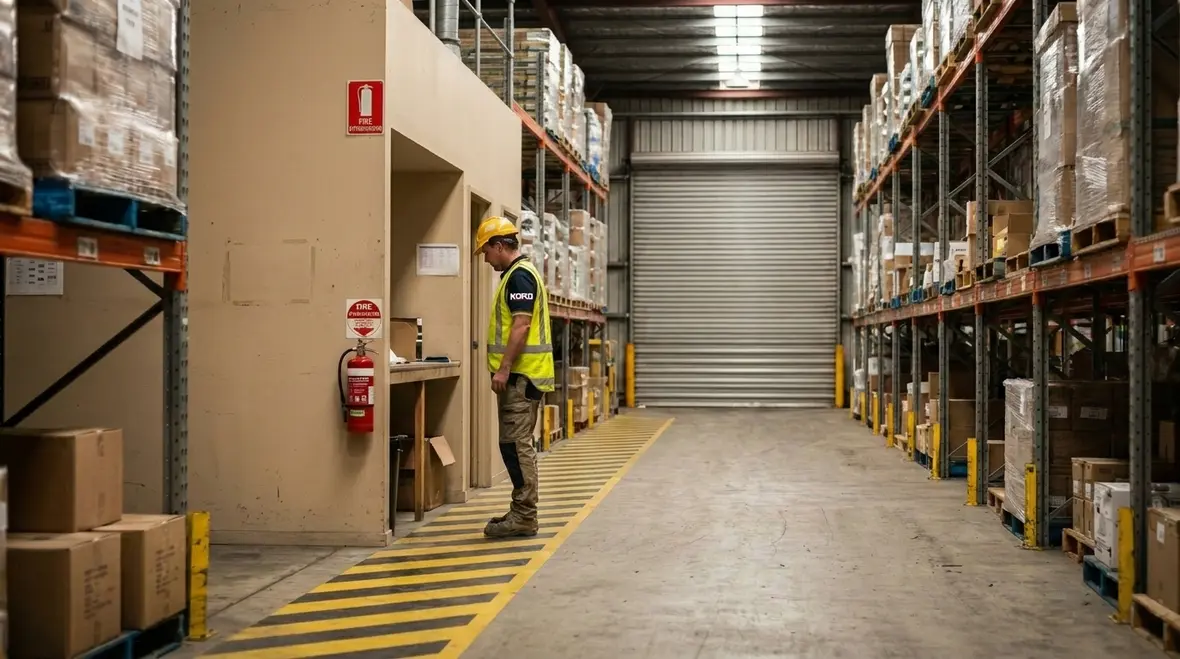
In warehouses and workshops, this means extinguishers must line up with how tasks actually run. For example, a busy picking lane should not be the place where a worker must squeeze past pallet stacks just to reach a unit. Also, mounting height and clearances matter. If a device sits behind a sign, under a shelf, or beside a cluttered workstation, the best extinguisher in the world becomes a very expensive paperweight. And unlike a universe-ending monster movie, fire does not wait politely for equipment to be moved.
That is why practical compliance is part measurement and part common sense. A site may look compliant on a sketch, yet fail the moment a shift supervisor stacks materials in front of a cabinet or a new machine narrows an aisle. Real placement asks a simple question: can someone spot the extinguisher, reach it fast, and still keep a safe path to retreat? If the answer is no, the plan needs work.
Map the hazards first, then place the units
Successful plans start with hazard mapping. Instead of treating the facility like a generic grid, teams should identify ignition sources and fuel types across areas such as:
- Plant rooms with electrical panels and motors
- Machine areas where hot surfaces and sparks occur
- Workshops using oils, solvents, adhesives, or paints
- Charging bays and battery storage zones
- Loading docks, waste storage, and packing areas
Once hazards are clear, the next step is to match extinguisher type to likely fire classes and sizes. For instance, an area with flammable liquids needs a different response approach than one dominated by electrical faults or ordinary combustibles. Then, teams should plan placement around likely travel paths for staff, including the route that someone can reach under stress and smoke conditions.
Additionally, the placement plan must respect operational realities. If forklifts block certain aisles during shifts, then extinguishers in those lanes may be “technically present” but practically unreachable. So, teams should review real movement patterns for each shift and consider where a person could realistically access an extinguisher while keeping escape routes open.
Hazard mapping also helps reduce the classic overconfidence problem. People know where the obvious risks are, but smaller risks often hide in utility corners, temporary storage spots, charging areas, and mixed-use spaces where one activity quietly borrows danger from another. That back room with cardboard, solvents, and a battery charger is not exactly a zen garden. A careful survey catches these combinations before they become tomorrow’s incident report.
How to choose mounting locations that workers can reach fast
Industrial spaces move fast. Therefore, accessibility becomes a safety feature, not a nice-to-have. Extinguishers should sit where they can be seen quickly, reached without detours, and used with stable footing and safe standing distance.
Key practical checks include
- Mounting height that suits the expected users, including shift changes and training levels
- Clear walkways with no obstructing cages, hoses, or stored materials
- Locations near exits or near key access points when that aligns with risk, not just tradition
- Placement that avoids high-traffic pinch points where people cannot stand and operate safely
- Visible signage that does not blend into a wall of other signs
Also, teams should consider what happens during a real incident. If an extinguisher is located on the far side of a hazard zone that fire is likely to cut off, then the placement will fail under pressure. In that scenario, response times grow, and the first action becomes “run and hope.” And yes, running helps escape, but it does not replace early firefighting.
Visibility matters just as much as reach. In a noisy, busy industrial setting, workers are scanning for tasks, vehicles, stock, and co-workers, not admiring wall-mounted safety equipment. Extinguishers need a clean visual lane, sensible signage, and enough surrounding space that they do not disappear into the background. If someone has to squint and play detective during an emergency, the layout has already become part of the problem.
Industrial layout challenges across Australia, and how teams handle them
Australian industrial sites vary widely: coastal facilities with salt exposure, inland warehouses with high dust loads, retail back-of-house areas with mixed stock, and commercial fit-outs that share walls with other businesses. Because of this, layout challenges show up in different ways.
For example, in large distribution centres, long travel distances can make equipment appear far away on paper. In turn, teams may need to place extinguishers more frequently along travel routes, while also ensuring each unit sits where a person can actually access it.
In workshops, there is another twist. Benches, shelving, and temporary staging can change day by day. So, a smart approach includes a review cycle that accounts for seasonal changes and new equipment. Otherwise, a placement plan can slowly drift out of date. It is like an office coffee machine: it works great until the day it does not, and by then everyone is already annoyed.
In multi-tenant commercial facilities, coordination also matters. If adjacent businesses change their operations, their hazard profile changes too. Therefore, facilities managers should verify that the fire protection plan still fits the building’s current reality, not last year’s assumptions.
Temporary conditions deserve attention too. Shutdowns, fit-outs, contractor work, and seasonal inventory surges can all create short-term choke points that turn good placement into bad placement. One week of overflow storage in front of a fire point is still one week too many. The sites that manage this well usually build extinguisher checks into broader housekeeping and pre-start routines, so changes are caught before they become normal.
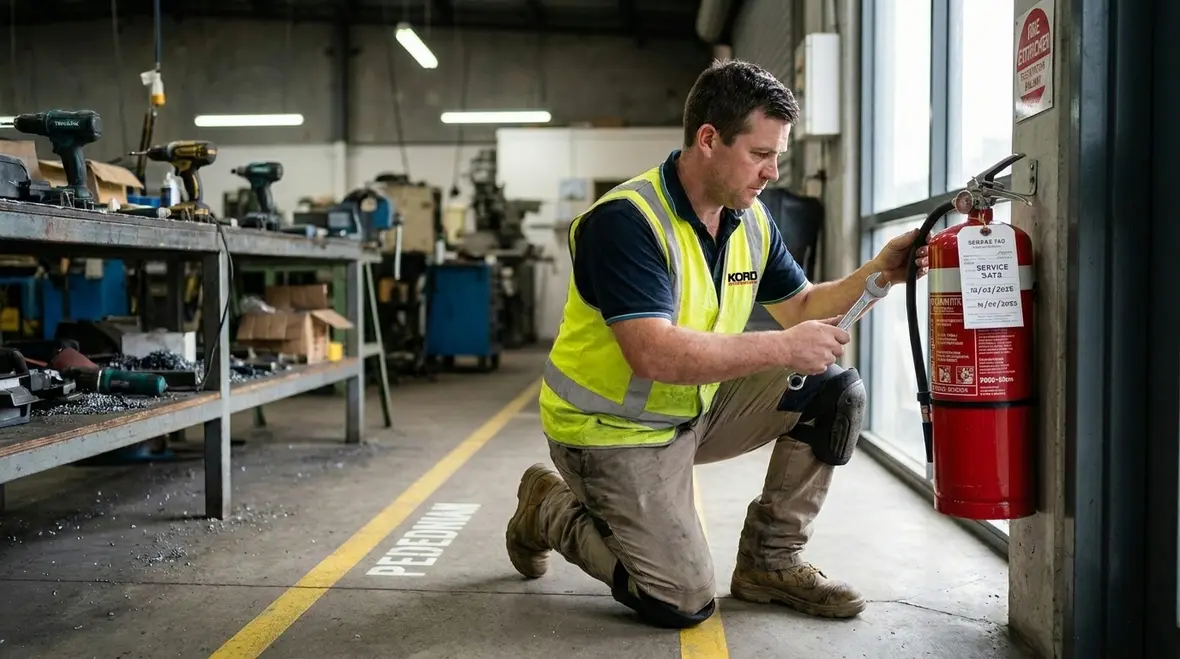
Maintenance and inspection: keep protection ready, not “mostly ready”
Placement can be perfect and still fall short if maintenance is ignored. Extinguishers must remain accessible, operational, and correctly serviced. That includes routine checks, annual servicing where required, and records that prove compliance.
Furthermore, industrial environments add wear and tear. Vibration, dust, humidity, and knocks from daily operations can affect indicators and hoses. So, inspection schedules should reflect the realities of the workplace.
This is also where Kord Fire Protection can become a valuable partner. Instead of handling inspections like a box-ticking exercise, a capable provider helps facilities build a system: clear service intervals, reliable documentation, and practical recommendations based on what technicians see during visits. In other words, they bring the field feedback that a generic spreadsheet cannot.
Good maintenance is not dramatic, and that is exactly the point. Tags are current, units are charged, paths stay clear, and the records are easy to produce when an auditor, landlord, insurer, or safety lead asks for them. No scavenger hunt. No mystery binder. No one saying, “I think Steve had that file.” That kind of boring reliability is beautiful.
Why Kord Fire Protection fits the real workflow of facilities teams
Facilities managers juggle multiple priorities: compliance, asset uptime, contractors, and shift staffing. Therefore, fire safety needs partners who understand operational constraints and communicate clearly. Kord Fire Protection can support industrial, retail, and commercial workplaces by aligning extinguisher placement and ongoing readiness with how the site operates.
They help organizations evaluate where units should go, confirm the right coverage strategy, and maintain the equipment so it stays useful during an emergency. Also, they can assist with training coordination and documentation support, which helps reduce gaps between “we have a plan” and “our team can execute the plan.”
And if someone ever says, “We’ll update it later,” Kord Fire Protection can help turn that later into an organized schedule. Because fire safety does not improve with age. It improves with action.
That support becomes even more useful when sites are balancing multiple systems at once. Extinguishers do not live in isolation. They share space, planning, and compliance attention with alarms, suppression, inspections, signage, and training. The more coordinated those pieces are, the easier it becomes for facilities teams to run a safer operation without needing a daily supply of aspirin.
FAQ
Conclusion
Strategic extinguisher placement keeps industrial and commercial spaces safer by improving access, reducing response time, and aligning protection with real hazards. When teams map risks, plan clear travel routes, and maintain equipment properly, first response becomes practical, not theoretical.
To get this right across Australian facilities, work with Kord Fire Protection. Reach out to review your layout, confirm coverage, and build an inspection routine that stands up when it matters most.

Join Our Newsletter!
Get the latest fire safety tips delivered straight to your inbox From our Newsletter.