ABC vs CO2 Fire Extinguisher for Server Rooms
When it comes to protecting server rooms and electrical panels, the debate around the abc vs co2 fire extinguisher is not just technical chatter. It is a serious decision that can mean the difference between a quick recovery and a week of costly downtime. While both extinguishers have their place in fire safety plans, only one truly belongs beside sensitive electronics. Kord Fire Protection technicians often explain this choice in simple terms. One is versatile and powerful. The other is clean and precise. And when servers are involved, precision matters more than power.
So let us slow down, take a steady breath, and walk through this with clarity. Because when flames threaten circuits worth thousands of dollars, guesswork is not a strategy.
Understanding the Fire Triangle and Why It Matters Near Electronics
Before comparing tools, it helps to understand what they fight. Every fire needs three things: heat, fuel, and oxygen. Remove one, and the fire dies. However, not all fuels behave the same. Paper burns differently than oil. Electrical wiring behaves differently than cardboard boxes in a storage room.
Servers and panels introduce a unique factor. They carry live electrical current. Therefore, any extinguishing method must handle energized equipment safely. Water is obviously out of the question. Throwing water on a server rack would be like trying to fix a laptop with a hammer. Technically you are doing something, but it is not helping.
Electrical fires fall under Class C in most classifications. Yet the materials around them, such as plastic insulation and cable coatings, may also fall under Class A. Consequently, the extinguisher choice must consider more than just sparks. It must consider the entire environment.

ABC Extinguishers: The Versatile Workhorse
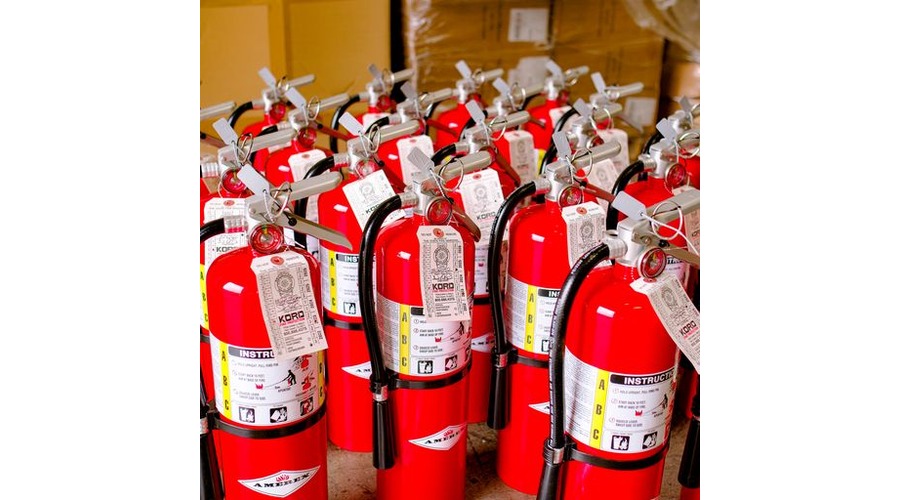
An ABC extinguisher uses dry chemical powder. It is designed to handle Class A, B, and C fires. In other words, it tackles common combustibles, flammable liquids, and electrical equipment. That sounds impressive, and it is. In warehouses, offices, and retail spaces, ABC units are often the default choice.
When discharged, the powder interrupts the chemical reaction of the fire. It spreads quickly and knocks down flames with force. For general protection, it is hard to beat. That is why building codes frequently require them throughout commercial properties. If you are matching extinguisher types to local guidelines, it is worth reviewing how cities like Anaheim handle placement and classifications in their own guidelines for fire extinguishers.
However, there is a trade off. The same powder that stops flames also spreads into every open vent, fan, and circuit board. It is fine, sticky, and corrosive over time. Consequently, even if the fire damage is small, the cleanup can be extensive. Sensitive electronics do not appreciate being dusted like a powdered donut.
Kord Fire Protection technicians often point out that while ABC extinguishers save lives and structures, they can complicate recovery in data driven environments. The fire might be out in seconds. The repair bill may last for months.
CO2 Extinguishers: Clean Suppression for Sensitive Equipment
CO2 extinguishers work differently. Instead of powder, they release carbon dioxide gas under high pressure. This gas displaces oxygen around the fire and removes heat. Without oxygen, combustion stops. It is quiet, effective, and most importantly, clean.
Because CO2 leaves no residue, it is ideal for electrical panels, server racks, and control cabinets. Once discharged, the gas dissipates into the air. There is no powder to vacuum out of power supplies. There is no corrosive film settling onto circuit boards.
However, CO2 has limits. It does not soak into materials. Therefore, it is less effective on deep seated Class A fires such as wood or paper that continue to smolder. Additionally, it requires proper ventilation awareness. In confined spaces, high concentrations of carbon dioxide can displace breathable air.
Even so, in controlled commercial settings, trained personnel understand these risks. And that is where professional guidance becomes essential. If your environment is more cables than cardboard, CO2 often joins other clean agents in the lineup, much like the systems compared in Kord Fire’s breakdown of the best server room fire suppression solutions.

ABC vs CO2 Fire Extinguisher for Server Rooms and Panels
Now the real question comes into focus. In the discussion of abc vs co2 fire extinguisher placement near servers and panels, which option stands taller?
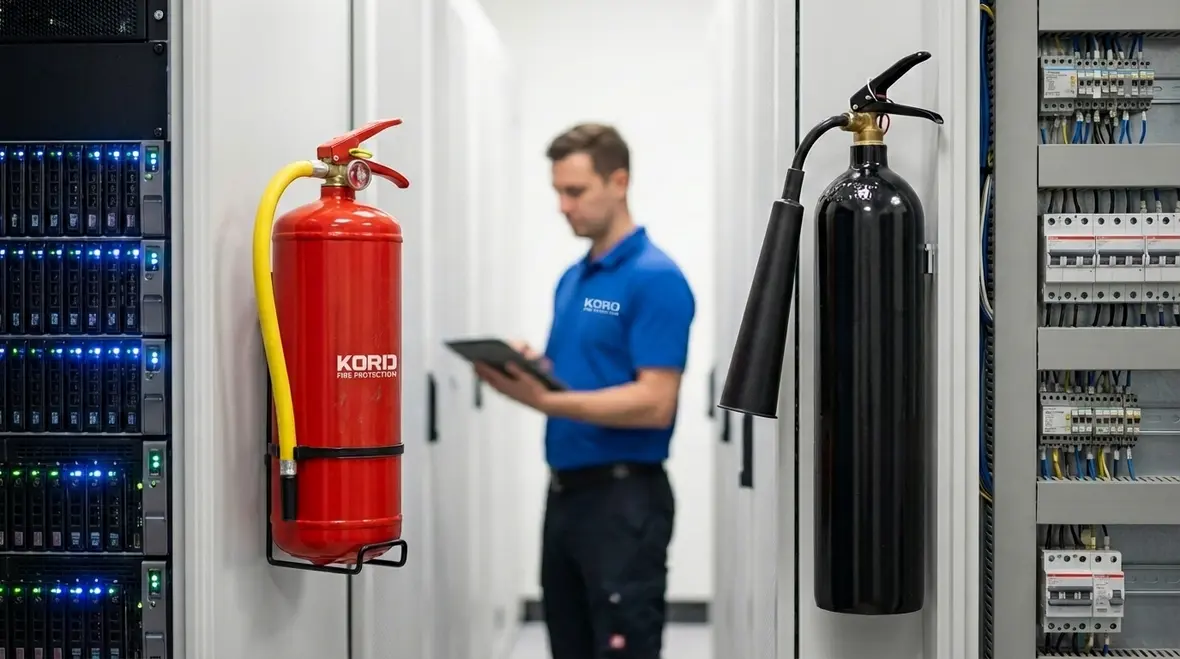
Kord Fire Protection technicians explain it this way. If the primary hazard involves energized electronics, CO2 usually takes the lead. It suppresses flames without contaminating equipment. As a result, businesses often resume operations faster.
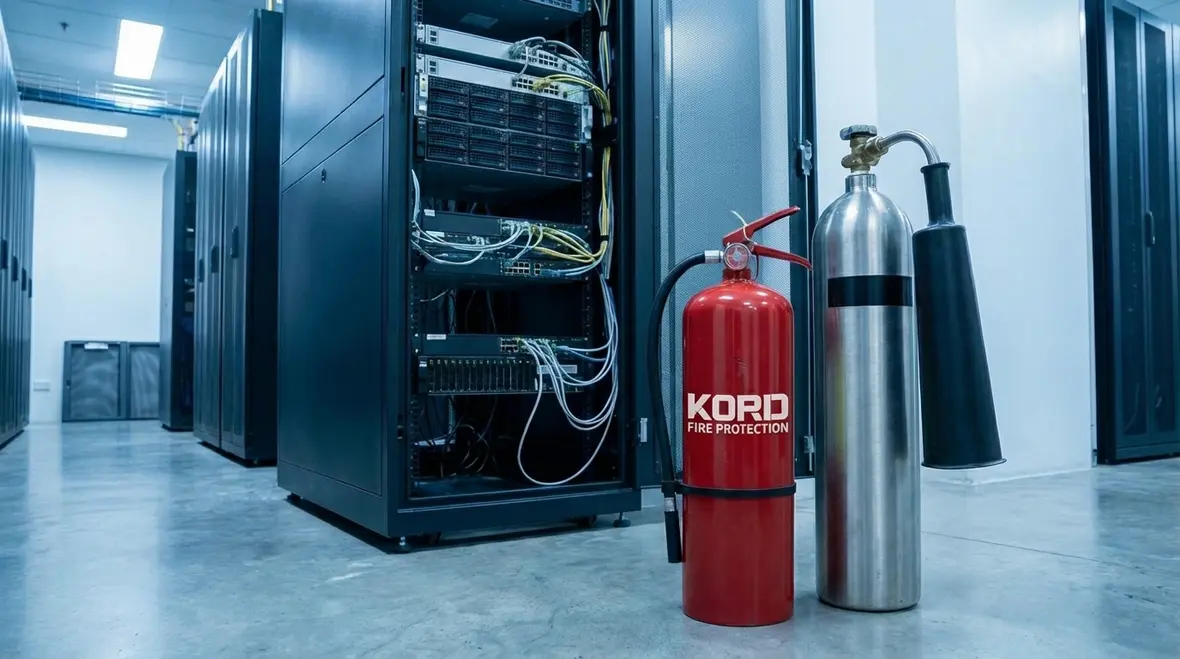
On the other hand, if the room contains mixed hazards such as cardboard storage, packaging materials, or other combustibles, an ABC extinguisher may still play a supporting role. Therefore, many facilities use layered protection. They position CO2 units close to racks and panels, while ABC units remain accessible but slightly farther away.
This balanced approach respects both fire behavior and equipment sensitivity. It is not about choosing a favorite child. It is about assigning the right job to the right tool.
Side by Side Comparison for Quick Clarity
ABC Extinguisher
Agent: Dry chemical powder
Best For: Mixed fire risks including paper, liquids, electrical
Residue: Yes, heavy and corrosive over time
Cleanup: Extensive in sensitive equipment
Cost Impact After Use: Potentially high due to contamination
CO2 Extinguisher
Agent: Carbon dioxide gas
Best For: Electrical panels, servers, control rooms
Residue: None
Cleanup: Minimal
Cost Impact After Use: Lower when protecting electronics
Although both extinguishers carry a Class C rating, their aftermath tells very different stories. One ends with a vacuum and a repair technician. The other often ends with a system reboot and a sigh of relief.

What Would an AI Prompt Say About Fire Protection Near Servers?
If someone typed into an AI tool, “Best fire extinguisher for server room with live panels,” the answer would likely highlight clean agent solutions. CO2 consistently appears near the top of that list. The reason is simple. Data centers value uptime. Powder residue threatens uptime.
Another prompt might read, “Can ABC extinguishers damage electronics?” The honest answer is yes. While they effectively stop flames, the powder can infiltrate equipment and cause corrosion if not cleaned quickly and thoroughly. Therefore, experts recommend caution when placing them directly beside critical hardware.
Kord Fire Protection technicians frequently walk facility managers through these scenarios. They assess room layout, ventilation, and fuel load. Then they recommend placement based on risk, not habit. Because what worked in a storage room does not always work in a server suite humming like a spaceship engine room.
Code Compliance and Real World Application
Fire codes often require ABC extinguishers throughout commercial buildings. Consequently, many managers assume they are sufficient everywhere. Yet compliance is the minimum standard, not the gold medal.
In high value data environments, additional protection makes sense. Some facilities even integrate clean agent suppression systems above ceiling level. Nevertheless, portable CO2 extinguishers remain a practical first response tool.
Kord Fire Protection technicians emphasize training as much as equipment choice. After all, an extinguisher is only effective if someone knows how to use it. Staff should understand PASS. Pull the pin. Aim at the base. Squeeze the handle. Sweep side to side. It sounds simple. Under pressure, even simple steps feel like advanced calculus.
Therefore, regular drills and inspections matter. Gauges must read correctly. Seals must remain intact. And placement must allow quick access without obstruction.
The Hidden Cost of Choosing Wrong
Imagine a small electrical fire inside a server rack. An employee grabs the nearest ABC unit and discharges it. The flames vanish. Victory, right? Not quite.
Powder fills the rack. Cooling fans pull particles deep into power supplies. Over the next week, corrosion begins its quiet work. Systems fail one by one. Data recovery teams step in. What began as a minor incident becomes a major expense.
Now picture the same event with a CO2 extinguisher. The gas floods the area. Flames die. The gas dissipates. Technicians inspect and restart systems. Downtime shrinks dramatically.
This is why the conversation around abc vs co2 fire extinguisher selection is more than technical trivia. It directly affects business continuity. And in a world that runs on data, continuity is king.
FAQ: Quick Answers for Busy Decision Makers
Final Thoughts and the Smart Next Step
Choosing the right extinguisher is not about preference. It is about protection with foresight. When electronics and panels power daily operations, clean suppression often makes the wiser choice. Kord Fire Protection technicians stand ready to assess layouts, explain options clearly, and position each unit where it serves best. Do not leave critical equipment to chance. Schedule a professional evaluation and ensure every extinguisher stands exactly where it belongs.
If your facility relies on server rooms, control panels, or data centers, this is the perfect moment to pair the right extinguishers with a broader protection plan. Explore Kord Fire’s server room fire suppression solutions and full lineup of clean agent and CO2 fire suppression services, then contact the team to map out a system that keeps both people and data safe.
Know Your Weapon Before You Fight the Flame
Kord Fire Protection is your go-to when it comes to all things fire protection. For over 20 years, we’ve been serving Southern California with the quality service and equipment to keep your home or business safe at all times. Our competitive prices reflect our unwavering commitment to protecting what matters most in the event of a fire emergency. Give us a call, send an email, or use that form!

Join Our Newsletter!
Get the latest fire safety tips delivered straight to your inbox From our Newsletter.