
NFPA 52 Section 19.6: LNG Supplemental Siting and Construction Requirements
Quick Answer: NFPA 52 Section 19.6 sets detailed supplemental siting and construction rules for LNG systems. It focuses on hazard separation, structural and protective measures, installation practices, and operational readiness so facilities can reduce escalation risk, maintain safe boundaries, and support inspection and maintenance.
What does NFPA 52 Section 19.6 require for supplemental LNG siting?
NFPA 52 includes baseline requirements for LNG plants and systems, but Section 19.6 addresses additional siting and construction conditions that apply when installations include supplemental elements. In practice, this section becomes critical for commercial and industrial operators because it governs how LNG-related components are placed, protected, and built so that failures do not propagate to occupied structures, critical utilities, or public exposure areas. When teams plan expansions, relocations, or retrofits, the NFPA 52 LNG supplemental siting construction requirements drive layout decisions that impact permitting, engineering signoff, and the long term ability to inspect and maintain equipment safely.
Commercial stakeholders often underestimate how quickly supplemental siting requirements influence mechanical routing, electrical classification, access for emergency response, and ongoing maintenance clearances. Kord Fire Protection regularly supports these projects by translating code intent into field verified expectations that align with inspection and maintenance realities. For teams building the bigger compliance picture, the full lifecycle of fire protection is a useful companion read that connects design choices to long term inspection and maintenance planning.
How supplemental siting affects fire and gas risk during normal operations
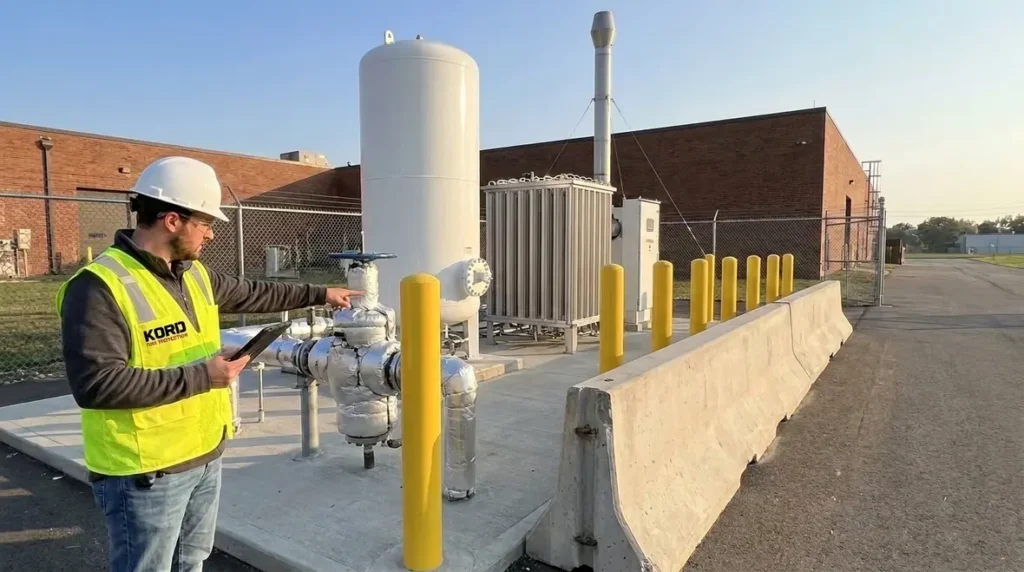
Supplemental siting requirements are not limited to “where equipment goes.” They also define how the installed arrangement controls consequence if an abnormal event occurs, including loss of containment, impingement on structures, or exposure of ignition sources. Facilities with LNG vaporization, transfer, storage, or ancillary equipment must treat siting as a risk control system that supports:
- Hazard separation and exposure control: Maintaining safe distances and orientation to reduce escalation toward buildings and occupied areas.
- Consequence limitation: Ensuring that released LNG and vapor dispersion patterns do not undermine protective barriers or create unacceptable exposure.
- Correct placement of ignition risk sources: Aligning equipment location and operational practices with electrical classification and ignition control expectations.
- Maintainable access: Providing enough clearance and access paths so technicians can inspect valves, relief devices, heat tracing components, and shutoff controls without bypassing safety procedures.
At the commercial facility level, the biggest operational challenge usually appears after installation: maintenance teams still need to reach components under permit required conditions, but early siting decisions can later force unsafe access workarounds. This is where compliance planning and asset management workflows must start before construction.
Construction requirements that commonly drive redesign and rework
Section 19.6 construction expectations generally focus on physical integrity, protective measures, and installation methods that support reliable performance over the asset life. Typical areas that require close coordination among engineering, contractors, and inspection teams include the following.
1) Structural protection and barrier effectiveness
Supplemental LNG components often require protective structures or barriers to prevent damage from impacts, environmental exposure, or inadvertent contact. Construction details matter because barriers must remain effective under normal and credible abnormal events, and they must also support visibility and access for testing.
- Failure points: Underbuilt curbs or inadequate reinforcement, barriers that block sensor visibility, and protective structures that cannot be inspected.
- Field verification: Alignment checks, material verification, and confirmation that barriers do not reduce required clearances for relief and vent systems.
2) Piping, supports, and cryogenic performance
LNG systems experience thermal cycling, low temperature contraction effects, and specific requirements for supports, insulation, and component compatibility. Supplemental construction requirements influence how piping is routed, supported, and protected.
- Failure points: Incorrect support spacing, insulation gaps that allow moisture ingress, and routing changes that create stress concentration.
- Commercial impact: Retail and industrial tenants often have limited downtime for corrective work, so early construction verification reduces operational disruption.
3) Venting, relief, and discharge control
Relief and vent discharge locations are a common source of missed expectations because they intersect siting and construction. Even when relief sizing is correct, discharge pathways can create unintended hazards if they are placed near structures, within shadow zones, or in locations that complicate inspection and maintenance.
- Failure points: Discharge stacks installed without the required orientation or clearance, vent routes that conflict with roadway access, and termination details that block periodic inspection.
- What inspectors look for: Correct installation of termination hardware, clearance verification, and evidence of durable installation quality.
4) Electrical and instrumentation alignment
Supplemental siting and construction requirements often intersect with electrical installation practices. Sensors, shutoff components, and alarm interfaces must be placed and installed so they remain reliable, accessible, and maintained. For projects where controls and protection systems need to play nicely together instead of behaving like grumpy neighbors, fire safety system electrical integration for advanced suppression offers helpful context.
- Failure points: Instrument location choices that reduce maintainability, conduit routing that increases mechanical stress, and protective housings that impede leak detection performance.
- Practical compliance step: Ensure that commissioning documentation includes traceability for calibration, set points, and installation verification.
Inspection and testing readiness: what breaks during occupancy
Section 19.6 indirectly tests the facility’s maturity during inspection and ongoing readiness. Many compliance failures do not appear during initial commissioning. They appear later, when maintenance is performed under schedule pressure, during staffing turnover, or when contractors are changed.
Common compliance gaps seen during field reviews
- Access conflicts: Equipment placed too close to structures or obstructions so inspections require nonstandard disassembly.
- Documentation shortfalls: Missing as built drawings, incomplete commissioning data, or no evidence of calibration and functional tests.
- Maintenance interval drift: Heat tracing, insulation integrity checks, valve actuators, and detection devices that lack defined PM routes and responsibility.
- Protection deterioration: Barrier corrosion, insulation degradation, or weathering that reduces effectiveness.
Kord Fire Protection helps commercial owners and facility managers close these gaps by aligning inspection scopes with practical asset access, establishing maintenance verification logic, and supporting ongoing testing programs that stand up to regulatory and third party reviews.
Commercial siting realities: industrial, retail, and mixed use facilities
NFPA 52 LNG supplemental siting construction requirements can be difficult to apply because many commercial properties involve tight site constraints, shared utilities, and ongoing tenant operations. The section’s intent supports hazard control, but execution must match the site’s day to day conditions.
Key planning considerations for commercial and retail environments typically include:
- Site access planning: Ensuring safe inspection walkways, clear paths for emergency response, and safe routes for maintenance personnel.
- Coordination with operational zones: Aligning siting with loading areas, pedestrian pathways, and vehicle movement patterns.
- Change management: Controlling modifications to adjacent structures, landscaping, or temporary storage that can alter clearances or barrier function.
- Contractor continuity: Maintaining consistent inspection and testing practices even when subcontractors change.
For facility teams looking to strengthen their compliance program beyond installation, Kord Fire Protection provides support for recurring verification and maintenance workflows.
Implementation checklist: how to apply Section 19.6 to your project
Use the following checklist to reduce late-stage redesign and minimize inspection findings tied to supplemental LNG siting and construction.
- Confirm which components are covered as supplemental: Validate the scope early with engineering and code consultants.
- Document siting and separation basis: Record layout decisions, clearances, and exposure considerations.
- Verify construction details for long term integrity: Confirm materials, insulation quality, supports, barrier build quality, and durable installation practices.
- Validate discharge pathways and access: Ensure relief and vent terminations remain inspectable and do not compromise safety boundaries.
- Commission with test traceability: Maintain calibration records, functional test results, and commissioning signoffs.
- Build maintenance into the layout: Ensure PM activities can occur without unsafe workarounds.
- Plan ongoing verification: Schedule routine inspection and testing with clear responsibility assignments.
For related guidance on fire protection program structure and ongoing compliance planning, refer to Kord Fire Protection resources: Kord Fire Protection.
Frequently Asked Questions
Call to action
Plan and validate your NFPA 52 LNG supplemental siting construction requirements before installation decisions become irreversible. Engage Kord Fire Protection to review layout and testability, strengthen inspection readiness, and support ongoing maintenance verification so your facility can meet compliance expectations with less downtime and fewer surprises. Contact Kord Fire Protection to start a project readiness assessment.

Join Our Newsletter!
Get the latest fire safety tips delivered straight to your inbox From our Newsletter.