
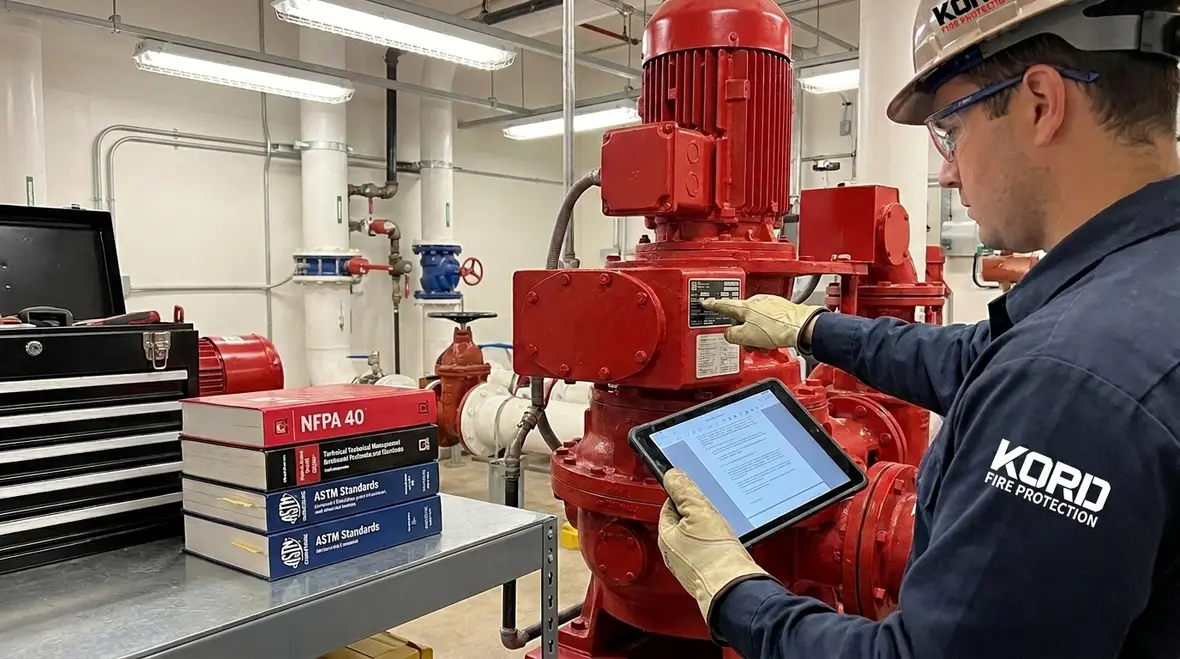
NFPA 40 Section 2.1 General: How Referenced Publication Editions Apply
Quick Answer: NFPA 40 Section 2.1 explains how to treat referenced standards within the code. It establishes which edition applies and how to handle later revisions. This prevents compliance gaps during design, installation, and ongoing maintenance of flammable liquid facilities.
Facilities that want a broader maintenance and documentation framework can also review full lifecycle fire protection servicing as a practical companion to edition control planning.
Why NFPA 40 edition references matter in real facilities
Commercial, industrial, and retail facilities that handle flammable liquids often comply through a layered system: NFPA 40 plus multiple referenced standards that define equipment performance, testing methods, inspection intervals, and installation requirements. The most common compliance failures occur when contractors, installers, or maintenance teams use an outdated (or mismatched) edition of a referenced publication.
This article focuses on NFPA 40 referenced publications edition rules under Section 2.1 General, and it translates those rules into practical actions for facility managers, fire protection engineers, and service teams.
What NFPA 40 Section 2.1 General actually governs
NFPA 40 Section 2.1 General sets the governing approach for referenced publications used throughout the standard. In practice, the section clarifies how the code controls the edition year of referenced documents when multiple versions exist in the market.
For compliance programs, the key takeaway is straightforward: facility teams must not treat referenced standards as “whatever version is available.” Instead, they must identify the specific edition referenced by NFPA 40 and apply it consistently across design, installation, commissioning documentation, inspection procedures, and maintenance work orders.
Where facilities struggle is not typically the interpretation. The struggle is operational: teams pull procedures from vendor manuals, internal SOPs, and past contracts without confirming which edition the applicable code text points to. That drift creates audit findings, rework, and sometimes equipment replacement when testing criteria or acceptance thresholds differ by edition.
How to apply referenced publication edition rules during engineering and maintenance
To operationalize NFPA 40 referenced publications edition rules, facilities should implement an edition-controlled workflow that ties code references to maintenance execution. A practical approach follows:
1) Build a single “edition map” for NFPA 40 references
- Collect every referenced publication cited by the applicable NFPA 40 edition in force.
- Create an internal register that lists publication name, edition year, scope, and where it appears in your installation package (drawings, specs, procedures, testing plans).
- Assign ownership for updates whenever NFPA 40 adoption changes or when a referenced standard is superseded.
2) Lock the edition at procurement and commissioning
- Ensure contractor bid documents and commissioning checklists explicitly reference the same edition controlled by NFPA 40.
- Require submittals that show compliance to the editioned requirements, not just compliance claims.
- Retain evidence that testing procedures matched the required edition, including test forms, calibration records, and acceptance criteria.
3) Maintain edition alignment in inspection and service
- Update inspection checklists and maintenance SOPs when the controlling code edition changes.
- Train technicians so they do not substitute “current version” guidance from manuals if it conflicts with the edition referenced by NFPA 40.
- Document any divergence and obtain approvals before performing noncompliant testing.
For facilities that manage multiple buildings or sites, the edition map becomes a powerful risk control. It reduces the likelihood that a local maintenance vendor uses a different standard interpretation than the central compliance plan.
Where compliance fails most often (and how to prevent it)
Even strong fire protection programs fail when edition control breaks down between documentation and field execution. Common failure points include:
Contractor substitution during upgrades
During pump replacements, tank accessory work, venting modifications, or piping upgrades, contractors sometimes rely on “current best practice” from vendor documentation. If the referenced publication edition shifts the test method or acceptance criteria, the facility may pass a procedure that later fails an inspection review.
Maintenance drift over time
Maintenance teams update SOPs periodically, but not always based on NFPA 40. The result is an SOP that follows a newer edition of a referenced standard than the one NFPA 40 edition requires. That drift can invalidate prior test evidence.
Inadequate documentation for audit traceability
Auditors and code enforcement stakeholders often look for traceability. Facilities should be able to demonstrate not only that testing occurred, but that testing met the referenced publication edition edition requirements.
Kord Fire Protection supports these operational needs by aligning inspection, testing, and maintenance activities with the edition-controlled requirements expected for commercial flammable liquid systems. This includes procedure review, service planning, and documentation practices that help facilities maintain defensible compliance records over time.
Practical checklist for facility teams
Use the following checklist to tighten control over referenced publication edition requirements under NFPA 40 Section 2.1:
| Process step | What to verify | Evidence to retain |
|---|---|---|
| Confirm governing NFPA 40 edition | Know the NFPA 40 edition applied at your facility | Adoption date, compliance basis record |
| Identify referenced publications | List each referenced standard cited by NFPA 40 | Edition register or “edition map” |
| Match field procedures | Ensure SOPs reflect the referenced publication edition | Controlled SOP versions and revision history |
| Procure and install to edition requirements | Submittals and specs match editioned acceptance criteria | Submittals, commissioning checklists |
| Perform inspections and testing | Test methods and acceptance thresholds align with edition | Test reports, calibration records, forms |
| Manage changes | Recheck edition impacts after modifications | Change orders, engineering review notes |
For additional guidance on ongoing service readiness, facilities can also review Kord Fire Protection support resources for inspection and maintenance planning. See Kord Fire Protection for commercial fire protection services and compliance support.
Frequently Asked Questions
Take control of edition risk now
NFPA 40 Section 2.1 protects facilities from edition mismatches, but only if teams manage references deliberately. Establish an edition map, lock editions during procurement and commissioning, and keep inspection procedures aligned over time. Kord Fire Protection helps commercial facilities validate testing and documentation practices so compliance stays defensible during audits and operational changes. Contact Kord Fire Protection to review your referenced publication alignment and maintenance documentation approach.

Join Our Newsletter!
Get the latest fire safety tips delivered straight to your inbox From our Newsletter.



