
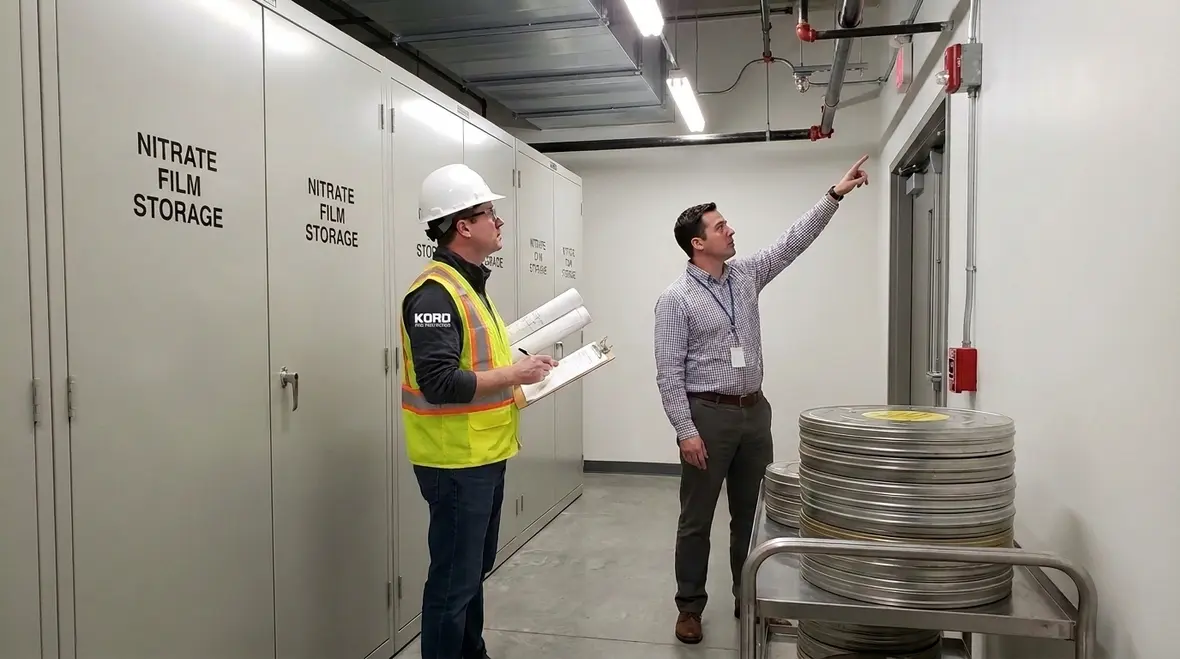
NFPA 40 Section 1.6: Plan Approval Requirements for Nitrate Film Storage
Quick Answer
NFPA 40 Section 1.6 requires the facility to submit nitrate film storage plans for review and approval before construction, alteration, or certain storage changes. Authorities evaluate construction features, storage arrangements, protective systems, and operational controls to reduce ignition and fire growth risks.
For additional support on system readiness and compliance focused documentation, facilities can also review fire pump testing requirements as part of a broader fire protection planning strategy.
What NFPA 40 Section 1.6 requires before nitrate film storage is built or changed
For organizations storing nitrate film, the planning stage is where most compliance failures occur. NFPA 40 plan approval requirements nitrate film storage focus on ensuring the design matches the hazard profile and includes the right protective measures, before the site is constructed or modified. Section 1.6 is not a paperwork formality. It sets the basis for how the authority having jurisdiction (AHJ) evaluates life safety, fire development, and safeguarding of stored film.
Who reviews the plans and what the AHJ looks for
NFPA 40 Section 1.6 places review responsibilities on the AHJ or the designated reviewing authority. In commercial and industrial settings, approvals typically involve coordination between the AHJ, the fire prevention bureau, the building department, and in some jurisdictions a fire protection professional. The AHJ evaluates both the concept of protection and the practicality of implementation.
Design intent and compliance documentation
- Project scope clarity: The submission must clearly identify whether the work is new construction, alteration, change in storage location, or modification to storage capacity.
- Hazard classification support: The plans should align with nitrate film hazards and storage limits used by the facility and recognized by the AHJ.
- Construction and enclosure details: The AHJ expects information that shows how openings, walls, doors, and compartments prevent fire spread to adjacent spaces.
- Operational controls: The submission should show how film handling practices, storage integrity, and access control will be managed after approval.
Practical inspection readiness
Even when the drawings appear compliant, AHJs often look for whether the design is inspectable. That means the plan should indicate access to key components, location of safety-critical equipment, and how the installation will support ongoing testing. For commercial facilities, the same plan set often needs to support future renewals, maintenance records, and incident investigations.
Key plan elements typically required for nitrate film storage approval
While specific plan submittal items can vary by jurisdiction, NFPA 40 plan approval requirements nitrate film storage generally require the submission to address storage configuration, fire protection, and operational safeguards. The goal is to verify the facility is protected against ignition, fire growth, and rapid involvement.
Storage arrangement and compartmentalization
- Storage configuration: The plans should define where nitrate film storage occurs, how film containers are arranged, and how storage limits are managed.
- Separation from occupancies: The AHJ expects separation distances and barriers that reduce the probability of a single event spreading beyond the storage space.
- Access paths: Plans should show controlled pathways for emergency response and safe handling workflows without exposing additional combustibles.
Protective measures and fire control interfaces
Approvals commonly depend on clear descriptions of fire protection approaches. AHJs look for consistency between the planned hazard and the installed protection strategy. Plan submittals should address interfaces between storage design and any fire detection or suppression features, including how equipment will be protected, inspected, and maintained.
Utilities, power, and supporting systems coordination
In commercial and retail environments, building systems often share infrastructure with other occupancies. Plan reviews typically verify that critical supporting functions remain reliable for fire and safety operations, including any controls affecting access, ventilation, or emergency response support.
Common compliance challenges during plan review and how facilities prevent delays
Plan approval delays usually trace back to predictable issues. Facilities that treat Section 1.6 as an afterthought often face rework that can impact construction schedules, licensing timelines, and operational readiness.
Challenge 1: Incomplete scope definition
Some submissions fail because they do not clearly separate new installation from ongoing changes. For example, relocating storage, increasing storage quantity, or updating handling practices can trigger plan review. To avoid this, organizations should define the exact change event and its boundary conditions.
Challenge 2: Drawings that do not support field verification
AHJs and inspectors expect that what is shown on plans will be what is built. If drawings lack detail on enclosure construction, penetrations, access points, or equipment location, inspectors will flag issues during rough or final inspections.
Challenge 3: Missing maintenance and operational clarity
Commercial compliance is not “set and forget.” The AHJ often expects the facility to demonstrate that protective measures can be maintained and tested. If a facility cannot clearly explain how components will be inspected, serviced, and documented, the design may face approval friction.
Challenge 4: Poor integration with the facility’s safety management system
Large retail and multi use industrial sites often operate under layered safety programs. If nitrate storage procedures do not match the safety management system, the AHJ may require additional review. Aligning procedures, training records, and inspection schedules reduces uncertainty.
How Kord Fire Protection supports ongoing compliance after approval
Plan approval is only the beginning. Commercial facilities need an implementation and maintenance pathway that protects the investment made during design. Kord Fire Protection helps organizations sustain compliance after NFPA 40 approvals by supporting inspections, testing documentation, and operational readiness.
To strengthen your overall fire safety program, Kord Fire Protection can support site assessments and maintenance planning for facilities that store hazardous materials or require documented protection performance. For additional guidance on building system readiness and inspection support, facilities can review resources available at Kord Fire Protection.
Facilities looking for a practical service pathway can also explore Kord Fire Protection’s inspection and testing services to see how field verification, documentation, and ongoing maintenance support come together in real-world compliance work.
What to expect after the plans are submitted
After the submittal, the review process typically involves corrections, clarification requests, and sometimes site specific conditions. Facilities should be prepared to respond quickly with revised drawings, updated narratives, and technical justifications that address the AHJ concerns. A strong response includes a clear cross reference between the corrective action and the hazard it addresses.
Field readiness planning
Organizations should also plan how the installed protection will be verified. That typically includes confirming equipment accessibility, ensuring installation tolerances align with the approved design, and scheduling any required testing so that final approvals align with occupancy timelines.
Frequently Asked Questions
Call to Action: If your organization is planning a new nitrate film storage space or changing storage capacity, act early. Prepare a complete, inspectable submittal package aligned with NFPA 40 Section 1.6, then build a maintenance and testing plan that supports ongoing AHJ expectations. Engage Kord Fire Protection early to streamline review support, reduce rework, and keep your program audit ready.

Join Our Newsletter!
Get the latest fire safety tips delivered straight to your inbox From our Newsletter.



