
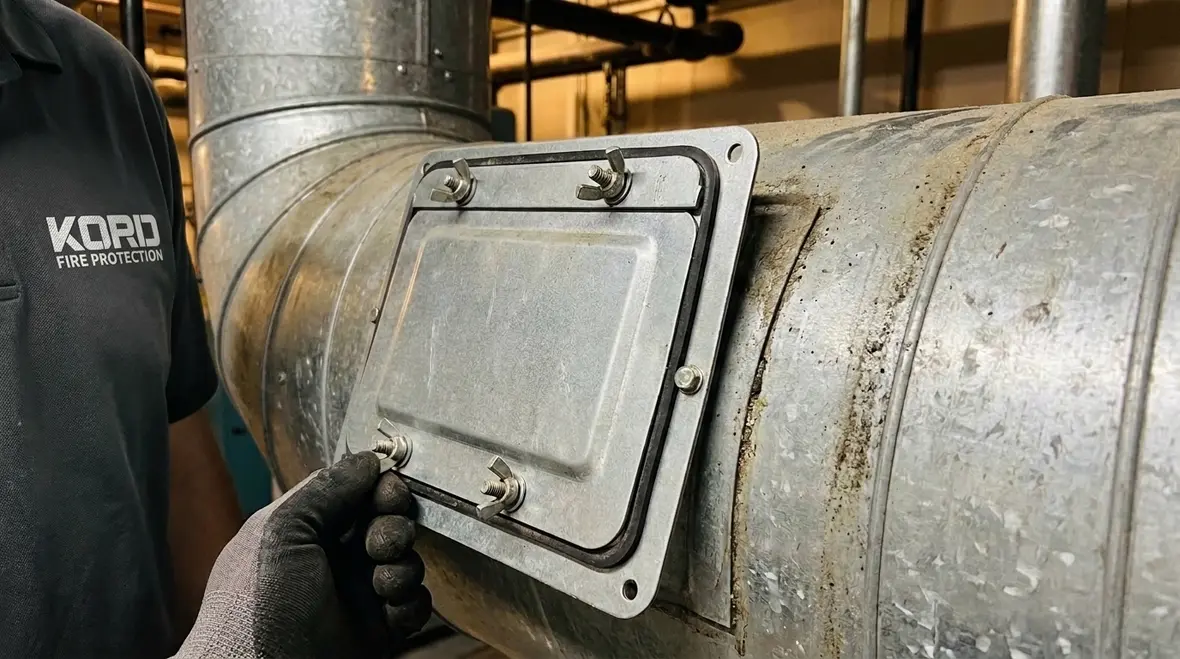
NFPA 34 Section 7.10: Access Openings in Exhaust Ducts
Quick Answer: NFPA 34 Section 7.10 establishes how and where access openings must be provided in exhaust ducts so technicians can inspect, clean, and verify duct integrity. These openings also support effective maintenance in high-use commercial and industrial exhaust systems.
For facilities that need a broader compliance view tied to inspection planning and documentation, take a look at NFPA 20 Chapter 14 Fire Pump Acceptance Testing Requirements. It is a different system, obviously, but the same operational truth shows up fast: if service access and verification are sloppy, compliance gets weird in a hurry.
What NFPA 34 exhaust duct access opening requirements mean in practice
NFPA 34 exhaust duct access opening requirements focus on creating access points in ductwork that allow personnel to safely reach internal surfaces for inspection and maintenance. In real facilities, this requirement often becomes the difference between a duct that can be serviced effectively and one that turns into a concealed hazard due to buildup, corrosion, or component failure.
In commercial, industrial, and retail operations, duct systems supporting exhaust often handle grease, vapors, dust laden air, or other process contaminants. When access is limited, maintenance teams rely on indirect cleaning methods that may miss hard to reach areas, especially at elbows, vertical transitions, and upstream sections that accumulate residues.
Where access openings are required: duct segments that fail first
Access openings typically must be located to provide practical reach and visibility into duct sections that accumulate deposits or experience recurring stress. Facilities commonly find that failures originate in predictable duct areas, including:
- Elbows and turns where turbulence slows flow and promotes deposition.
- Vertical drops and risers where condensation and residue can collect.
- Upstream of controls and filters where capture devices can create pressure or carryover issues.
- Sections with changes in direction or diameter where flow distribution shifts.
From a compliance standpoint, the practical goal is not just “a door in the duct.” NFPA 34 exhaust duct access opening requirements aim to support verification activities that maintenance personnel can complete without unsafe disassembly or improvised access methods.
Access opening construction and closure: containment, stiffness, and serviceability
Access openings must remain capable of maintaining the duct system’s integrity during normal operation and during inspection. The closure mechanism must support safe opening and reliable re-sealing so that the duct does not become a leakage path or a route for uncontained products of combustion if fire conditions occur.
Common real-world concerns that lead to noncompliance or unsafe conditions include:
- Access panels that do not seal, allowing leakage at joints and undermining duct performance.
- Loose or corroded hardware that prevents proper closure or makes panels difficult to open safely.
- Insufficient panel stiffness causing warping, misalignment, or contact failures with gaskets.
- Missing gaskets or deteriorated gaskets that degrade sealing over time.
- Panels installed in locations that block safe maintenance access, forcing technicians to reach through confined spaces.
Commercial facilities often underestimate the maintenance lifecycle of access hardware. Even when an opening meets the original layout intent, ongoing service can degrade gaskets, fasteners, and panel alignment. Kord Fire Protection typically treats access openings as a maintainable feature, not a one time installation item.
How inspectors and technicians verify compliance during maintenance
NFPA 34 requires that duct systems be maintained to control hazards. Access openings provide the verification path for teams that need to inspect internal conditions and document remedial actions. During compliance checks, inspectors and fire safety professionals usually look for:
- Correct location relative to duct geometry and known deposition zones.
- Usable access that enables direct observation and safe internal cleaning activities.
- Reliable closure using hardware that returns the panel to an intact condition.
- Evidence of operational maintenance, such as cleaning history and residue control practices tied to accessible sections.
Practically, verification happens during planned maintenance intervals. Technicians should be able to open the panel, inspect internal surfaces, confirm the condition of duct components and seams, and then reclose the opening without compromising duct integrity. When access is inadequate, residue buildup can continue unnoticed and become a recurring driver of alarms, performance issues, and higher fire risk.
Common failure points in commercial installations and retrofit scenarios
Most “access opening” deficiencies in the field do not arise from lack of intent. They arise from construction changes, equipment upgrades, and maintenance work that fails to preserve the original access concept.
1) Retrofit openings that do not match maintenance workflow
Facilities frequently add access panels during duct modifications but place them where tools cannot reach effectively, or where panels cannot be opened without interfering with adjacent structural members. This creates a functional gap between installed compliance and usable compliance.
2) Obstructed access created after commissioning
Even when access openings exist, later activities like adding insulation layers, installing conduit runs, adding ceilings, or rerouting pipes can block access. Over time, teams may stop using the openings because reopening becomes slow and inconvenient.
3) Improper panel hardware selection
Access panels require appropriate fasteners and closure hardware. In harsh environments, corrosion and vibration can loosen fasteners or deform panels, reducing sealing performance and creating leakage.
4) Inconsistent documentation and maintenance intervals
Access openings support maintenance documentation. Facilities that cannot demonstrate cleaning, inspection, and corrective action tied to duct interior condition often struggle during audits.
Kord Fire Protection supports commercial owners and facility teams by aligning duct access design and maintenance practices with ongoing compliance expectations. For organizations seeking a structured approach to inspection readiness, Kord Fire Protection can help evaluate duct systems, confirm access usability, and plan maintenance support to reduce recurring noncompliance risk.
For related guidance on service planning and inspection support, review Kord Fire Protection and discuss how your duct access strategy supports safe internal inspection and cleaning.
Best-practice checklist: aligning duct access openings with ongoing compliance
Use this checklist to manage the day to day compliance reality that NFPA 34 exhaust duct access opening requirements are designed to support:
- Confirm location relative to duct geometry so internal surfaces in high deposition areas remain inspectable.
- Verify panel usability with the tools and work practices your technicians actually use.
- Inspect closure condition for sealing, gasket condition, alignment, and hardware integrity.
- Track cleaning and inspection results tied to the accessible duct sections.
- Plan for re-inspection after renovations that can obstruct access or alter the duct configuration.
- Correct deficiencies promptly so access openings remain functional between scheduled services.
When these steps remain consistent, facilities reduce the chance that residue, corrosion, or compromised duct components persist undetected.
Frequently Asked Questions
Call to action
Ensure your exhaust duct access openings support real inspection and cleaning work, not just installed appearance. Kord Fire Protection can help evaluate duct accessibility, panel closure condition, and maintenance readiness so you can reduce audit risk and improve ongoing fire safety. Schedule a review today to align your duct system with NFPA 34 expectations and your facility’s maintenance workflow.

Join Our Newsletter!
Get the latest fire safety tips delivered straight to your inbox From our Newsletter.



